2026 Assembly polls: BJP’s long march meets its first major test
Upcoming state elections to set political tone in the run-up to 2029 as Congress weighs alliance shifts amid nationwide MGNREGA protests

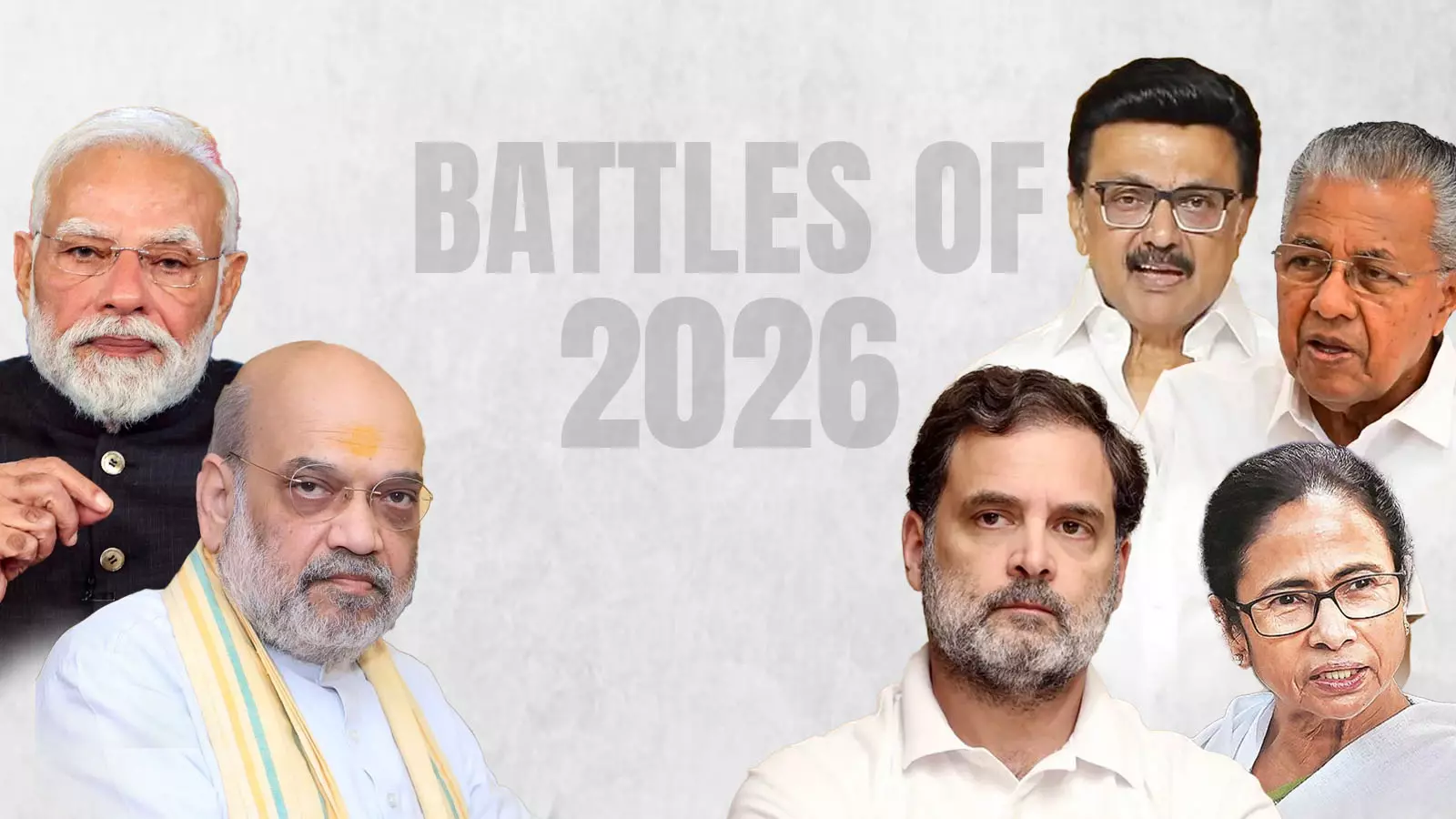
The year gone by clearly belonged to the Bharatiya Janata Party (BJP), but can the Opposition balance the scales of power in the year that has just begun? The challenges that 2026 presents for the two sides are, at least in theory, somewhat evenly split, but how they face off against these could determine whether the ride towards 2029 for Prime Minister Narendra Modi and his party would be smooth or bumpy.
Little over three months into 2026, the BJP will face off against various constituents of the Opposition’s Indian National Developmental Inclusive Alliance (INDIA) bloc in high-stakes poll contests across Tamil Nadu, Kerala, West Bengal, Assam and the Union Territory of Puducherry.
Also read: Politically vocal but electorally outfoxed — what 2025 has been like for India's Opposition parties
Tamil Nadu and Kerala represent a southern frontier that the BJP, despite its infinite electoral resources, has been unable to breach beyond isolated and impermanent victories.
Quiet, backchannel efforts are on in Bengal to explore the possibility of an alliance with the mercurial Mamata’s TMC by junking the Left Front
Bengal, by all indications, is an ongoing project for the party’s electoral expansion where the saffron footprint has waxed and waned over the past decade; matched blow for blow by the feisty Mamata Banerjee’s Trinamool Congress (TMC).
Assam, once a Congress bastion, had fallen to the saffron tsunami a decade ago and in the years since has been converted by the party into yet another laboratory for viciously communal politics, while the Congress and smaller regional outfits in opposition scramble to stay afloat.
2026 poll outcomes will set tone leading up to 2029
The electoral outcome in these states, which are all scheduled for polls between March and May, will not determine merely the fate of incumbent state governments but also set the political tone for the years leading up to the 2029 Lok Sabha polls, each of which will be packed with equally important electoral battles (seven states in 2027 and nine in 2028).
Also read: How voting patterns undid LDF dominance in Mattathur; BJP gained at Congress' expense
For the Opposition, these 2026 contests are less about isolated state victories and more about proving that it can still function as a credible counterweight to the BJP despite the recurring turbulence within its INDIA bloc.
A persistent challenge before the Opposition has been its inability to find coherence, both in its narrative and electoral strategy, that can sufficiently override the ego clashes, competing regional ambitions, overlapping electoral bases and mutual distrust among the INDIA bloc partners. On this score, 2026 gives the INDIA bloc much to ponder over.
Congress in Tamil Nadu
The Congress, the national and notional pivot of the Opposition alliance, has been in a stable and formidable alliance with Tamil Nadu chief minister MK Stalin’s Dravida Munnetra Kazhagam (DMK), which is confident of retaining power in the state for a second consecutive term.
However, a band of Congress whippersnappers who owe their electoral victories to the incremental votes they receive due to the DMK and their organisational heft to the proximity they claim to share with Rahul Gandhi, are learnt to be advising the party high command to explore an alliance with actor Vijay’s Tamilaga Vettri Kazhagam (TVK), on the assumption that such an alliance would allow the Grand-Old Party to expand its footprint in Tamil Nadu by stepping out of the DMK’s shadow.
Also read: Bangladesh unrest casts long shadow over 2026 West Bengal polls
Congress old-timers from the state believe the campaign to steer the party towards a truck with the TVK is “suicidal” and a “misadventure best avoided”. Sources say senior leaders from the state have cautioned party president Mallikarjun Kharge and Rahul against any move to sever ties with Stalin and urged them to “rein in those creating mistrust with the DMK” just three months ahead of the polls; a view that has, at least for now, been accepted by the high command.
The Bengal scenario
If the mood in the Congress high command is for continuity of the current alliance in Tamil Nadu, sources say “quiet, backchannel efforts” are on in Bengal to explore the possibility of an alliance with the mercurial Mamata’s TMC by junking the Left Front. While the possibility of such an alliance seemed non-existent till two years ago, when despite being part of the INDIA bloc, Mamata had made it clear that she would spare no seats in the Lok Sabha polls for any other ally, sources say a “rethink is underway on both sides” due to “evolving political challenges” in the state where the BJP is expected to lead its most high-decibel campaign yet.
Sources said renegade TMC leader and Janata Unnayan Party chief Humayun Kabir’s bid to splinter the ruling party’s base among Bengal’s 27 per cent Muslim vote base, coupled with SIR (Special Intensive Revision)-linked challenges facing the BJP among its own voters from the predominantly Hindu Matua and Rajbongshi communities, has compelled Mamata to “keep an open mind” towards rekindling alliance with the Congress.
If such plans do yield fruit, sources in the Congress say the ramifications could be national and not limited to Bengal as an “alliance with Trinamool will not only help us win seats in Bengal and keep the BJP out of power in the state but will also help stabilise the INDIA bloc because, so far, Mamata has been seen as the anti-Congress face within our alliance… if we are together, her people will stop raising questions about the Congress’s centrality to the INDIA bloc”.
Also read: Congress to launch MGNREGA Bachao Abhiyan from Jan 5; will it resonate nationally?
The inability to present a seamless united front has repeatedly allowed the BJP to frame itself as the only stable and decisive political force. A better Congress-TMC camaraderie coupled with a strengthened DMK-Congress alliance could bring the coherence that is currently lacking in the INDIA bloc’s campaign against the BJP, and if these alliances also manage to retain power in their respective states while shrinking the saffron party’s footprint further, it would give the Opposition the morale booster it desperately needs before the packed electoral calendar of 2027 draws closer.
Congress' challenges
This is not to say that the challenges for the Opposition in 2026 are only electoral. There is still much heavy lifting that Opposition parties would need to do through the year that has just begun before they can claim to be a match for the political juggernaut that the BJP has become since 2014. Without a doubt, the heaviest burden of this task lies on the Congress party, which remains besieged by a multitude of problems — electoral, ideological, structural, et al.
On January 5, the Congress is set to launch its countrywide protests against the repeal of the Mahatma Gandhi National Rural Employment Guarantee Act (MGNREGA) and its replacement with the Viksit Bharat- Guarantee for Rozgar and Ajeevika Mission (Gramin) Act during the last month’s winter session of Parliament.
The dismantling of the rights-based MGNREGA by the Modi regime has given the Congress — and the wider Opposition — an issue on which it can mount an anti-BJP public campaign as robust, if not more, than the one witnessed when the Modi regime bulldozed the three contentious farm laws (finally repealed in December 2021, following 15 months of sustained peasants' protests) through Parliament.
Also read: Xmas outreach, silence on attacks: PM’s maiden service ahead of Kerala polls
Congress sources concede that while the announcement of the nationwide protests from January 5 was a welcome move, the party leadership should have “got all Opposition parties on board” for it as the MGNREGA’s repeal had agitated most INDIA bloc parties, including Mamata’s TMC, equally and “has the potential to unite all like-minded Opposition parties despite internal differences”.
More importantly, though, Congress insiders caution that the protest “must not become a token act of resistance” and that “it would yield political benefits only if the party organisation is strengthened enough to sustain it across the length and breadth of the country for a prolonged period”.
Questions over the Congress’s organisational inertia and the inability of the party high command to crack the proverbial whip on errant actors within the ranks, while simultaneously reviving and reinventing the party into an outfit as hungry for electoral triumphs as the BJP, have lingered.
Also read: Assam draft rolls: Over 10.5L names removed ahead of 2026 polls
That the party leadership has failed to address them despite repeated humiliation at the hustings, a steady attrition of leaders and growing disenchantment within the organisation, which manifested just last week in veteran leader Digvijaya Singh’s candid but discomforting statements ahead of a Congress Working Committee meet, makes the party susceptible to mockery by friends and foes alike.
The inability to present a seamless united front has repeatedly allowed the BJP to frame itself as the only stable and decisive political force.
Whether the Congress leadership has the resolve it needs to face these challenges head on in 2026 is unclear still. Sources say a long-due reshuffle of AICC (All India Congress Committee) office-bearers is on the cards but whether it would give the party the glide path it requires for revival or be reduced to another exercise of rewarding Gandhi-family sycophants with uninterrupted records of failure is a call Kharge will need to take with the expected aid and advice — or diktat — from Sonia Gandhi and Rahul Gandhi.
A section of party leaders is also pushing for a well-defined role for Priyanka Gandhi Vadra, the party general secretary without portfolio, who many believe is a more astute politician than her philosophical and often absentee brother.
Many in the INDIA bloc concede in private that the reinvention of the Congress into an outfit assiduously geared towards electoral recovery and ready for street-fights is a pre-requisite for the Opposition bloc’s revival as a credible alternative to the BJP.
Opposition have three states to challenge BJP
Yet, with elections at least in Tamil Nadu, Bengal and Kerala being no cakewalk for the BJP and no major state elections due in the second half of 2026, Opposition leaders believe the next 12 months will spare ample time for the INDIA bloc to coalesce on multiple planks; elections being just one of them.
Economic anxieties, demands for greater federal autonomy, and social tensions offer potential entry points for a more assertive Opposition politics, provided the INDIA bloc constituents can move beyond ad hoc alliances and episodic coordination.
The year of Census
The year will also see the Census being held after a delay of nearly five years. The conclusion of the exercise, to be done for the first time since 1931 alongside caste enumeration, will pave the way for the Modi regime to clear the decks for two key and controversial political exercises — delimitation of constituencies and rollout of 33 per cent reservation for women in Lok Sabha and state Assemblies.
Also read: TN SIR goof-ups: Dead live on; living marked dead and deleted
The BJP, with the Election Commission's expected complicity, is sure to turn this three-step move — its electoral ramifications amplified further by completion of a pan-India SIR — to its advantage. It would, however, be naive to assume that the tremors this extensive reconfiguration of India's political landscape will cause would leave the BJP entirely unscathed. It would, thus, be for the Opposition to exploit those chinks to its advantage, and its failure to do so cannot be blamed on the BJP.
The challenge, as one senior Rajya Sabha MP from Bengal pointed out, is “not merely electoral arithmetic but political imagination”.