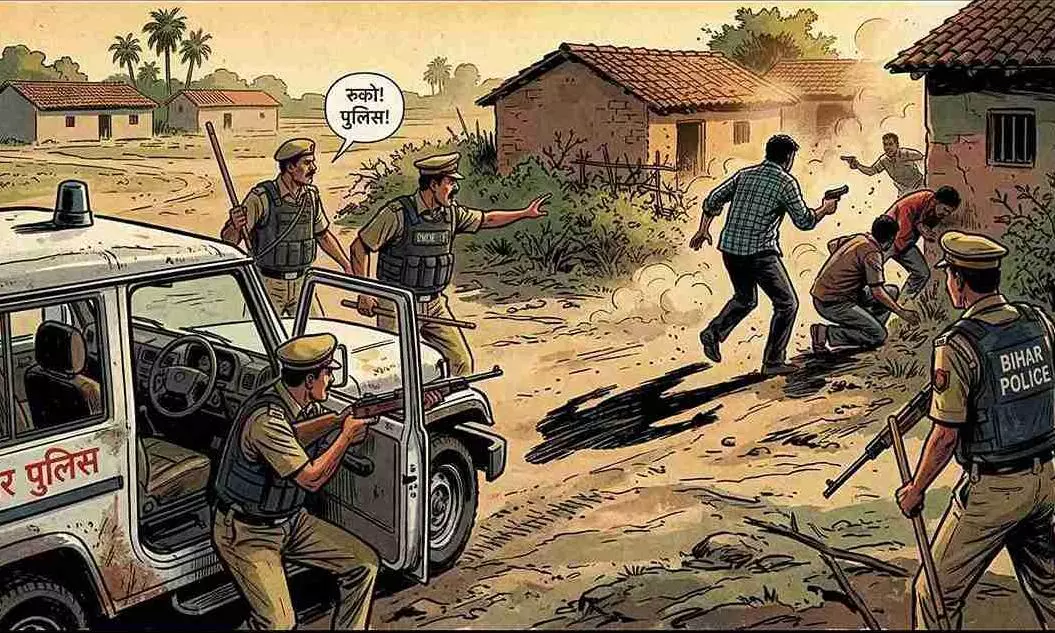
In the past month, while two criminals have been killed in as many encounters, seven have been “half encounters”, meaning that the suspects were shot in the leg and then arrested. AI-generated image for representation only
A month in, Samrat Choudhary govt echoes Yogi’s encounter model in Bihar
The new Bihar CM, an Amit Shah man, adopts tough policing to instil fear among criminals, even as JD(U) leaders, used to decades of 'sushasan', watch in silence

It has been a little over a month since Samrat Chaudhary took over as the Bihar Chief Minister. In these 34 days, the state has recorded nine police “encounters”. While two criminals were killed in as many encounters, seven have been “half encounters”, meaning that the suspects were shot in the leg and then arrested.
In a marked departure from Nitish Kumar's oft-stated bid to offer sushasan (good governance) and kanoon ka raj (rule of law) over two decades, the BJP government under Chaudhary seems to have taken a leaf out of Yogi Adityanath's rule book instead.
Just like the Uttar Pradesh government, it has given the police a free hand to deal with alleged criminals, even as Nitish’s JD(U), a BJP ally, maintains a studied silence.
Encounters, half encounters
The two latest incidents of “half encounters” happened on Tuesday (May 19) morning and late in the night. While a criminal named Nitish Kumar, accused of looting Rs 27 lakh from a cash van, was shot in his leg and arrested in Patna, another was shot in the legs in Samastipur before being arrested.
Leaders of Opposition Tejashwi Yadav on Tuesday alleged that police encounters are being conducted on the basis of caste. “CM Samrat Choudhary jaati dekhkar encounter karwa rahe hai, yeh galat hai (CM Samrat Choudhary is getting the encounters done based on caste; this is wrong,” he alleged.
Two more police “encounters” took place early on Monday (May 18), within a span of a few hours. In the Siwan district, Ankit Kumar Singh, 26, was shot in the legs during a police encounter. He was wanted in a Rs 20-lakh jewellery store robbery that took place on May 6 in Jamapur market, under the Jiradei police station.
Watch/Read: Bihar gets first BJP CM in Samrat Chaudhary, but will his govt be stable? | Capital Beat
According to Siwan SP Puran Kumar Jha, police were tipped off about Ankit, who opened fire when he spotted the police, resulting in an “encounter”.
The second incident, in Patna, was quite similar. Sandip alias Badal, who allegedly shot at a government school teacher, Sambhu Kumar, last week while trying to snatch his expensive mobile phone, was arrested after being shot in the legs as well.
“We got specific information about two accused, and a police team was sent to nab them in Transport Nagar. But they opened fire on the police, and the police fired in retaliation, in which one of the accused sustained bullet injuries in his legs,” said KK Sharma, Senior Superintendent of Police, Patna.
Both Singh and Sandip were arrested and admitted to a government-run hospital for treatment.
Free rein to police
A political analyst said police encounter is a part of the BJP government’s strategy in Bihar. It plays a dual role — to spark fear among criminals and to send a strong message to the police to be strict with miscreants.
Encounters & Half Encounters
An encounter refers to a lethal police shootout where suspects are shot dead in retaliatory fire.
A half-encounter refers to a non-lethal shootout where suspects are intentionally shot in the legs to disable and arrest them
“The police action is simply to show that the government is dealing strictly with criminals to improve law and order. It was a must step for the state government after police officials were reportedly attacked by sand and liquor mafia amid daily reports of murder, rape, loot, robbery, and lynching,” said the analyst who refused to be named.
Also read: How will Bihar remember Nitish Kumar’s two-decade reign as CM?
Choudhary, who became the first BJP Chief Minister in Bihar on April 15, also holds the Home portfolio. Soon after taking charge, he warned criminals to either leave Bihar or face action within 48 hours.
On Monday, he announced at an official event of the fire brigade of Bihar police in Patna, “We have given the police a free rein. The steps against criminals will continue.”
Adopting the “encounter” model of Uttar Pradesh Chief Minister Yogi Adityanath and to improve law and order was an old demand of BJP leaders as well as a section of the people of Bihar. As early as 2018-19, some BJP leaders sought the elimination of criminals through police encounters “to create a sense of fear”.
‘Amit Shah’s man’
JD(U) leaders, who would once strongly condemn such demands and claim that only the Nitish model was suitable for Bihar, have been maintaining a studied silence. Some party leaders have reportedly even supported the police encounter of criminals.
“It is true that BJP leaders in Bihar had been demanding Yogi Adityanath’s ‘encounter model’ to get rid of criminals and control the increasing crime rate in the state. Now, the BJP has its own chief minister. Everything, including police encounters, will be done to rein in criminals,” said BJP state president Sanjay Saravgi. A senior BJP leader told The Federal that Choudhary is widely seen as “Amit Shah’s man” in the state unit of the party and seen as a strong leader.
Also read | Turban off, crown on: Samrat Choudhary’s journey from BJP’s target to Bihar CM
When the BJP emerged as the single largest party in Bihar last year, it got the key Home portfolio for the first time in 20 years. Choudhary, then the Deputy Chief Minister, was given this ministry with the blessings of Shah.
A bulldozer leader
With his aggressive bulldozer and police encounter stance, Choudhary did not disappoint the Union Home Minister. Sources in the police headquarters told The Federal that the credit for 12 encounters from January to April goes to him.
In the first week of February, the Special Task Force (STF) and police, in a joint operation, shot dead a dreaded criminal, Prince alias Abhijeet, in Vaishali district. He was the accused in 30 cases of murder, loot, and robbery and was carrying a Rs 2-lakh bounty.
On March 17, two more criminals, Prince Dubey and Kundan Thakur, were killed in a police encounter in Motihari in East Champaran district.
Sushasan Babu at work
Nitish Kumar’s success in controlling crime in his first term (2005–10) is lauded and praised by many even today, even earning him the tag of Sushasan Babu (good governance man). When he became the chief minister on November 24, 2005, he promised to make the state crime-free within three months. It is a different matter that he soon admitted it was not really possible.
Former Bihar DGP Abhayanand, the brain behind the speedy trial of criminals when he was ADG (headquarters) in 2006, thus playing an important role in controlling crimes during Nitish’s first term, told The Federal he was completely against encounter killings to improve law and order.
Also read: Why Nitish's Rajya Sabha move signals end of JP Movement era in Bihar
“Crime data is not the sole indicator of law and order. If 80 per cent of the common people in any town or rural area say they are safe and do not live in fear, that is an indicator of law and order. If 80 per cent of people say they are not safe, live in fear and are afraid of criminals, it is an example of bad governance and poor law and order. Only common people can say whether there is lawlessness or not,” Abhayanand said.
Loss of mojo
A police officer of ADG rank recalled that as many as 52,343 people were convicted between January 2006 and August 2010, thanks to fast-track courts set up in January 2006.
In the past, the conviction rate in Bihar was very low. “There is no doubt that the high rate of convictions in a short span of time resulted in a decline in crime rate and instilled a sense of fear in the minds of criminals and rowdies. For the first time in the state, over a dozen MPs and MLAs were convicted and punished, in a big blow to the politician-criminal nexus,” said the officer.
But later, trials slowed down and so did the conviction rate, as the government changed it attitude. And Bihar went back to its old lawless ways that Nitish had been able to curb only in his first term.