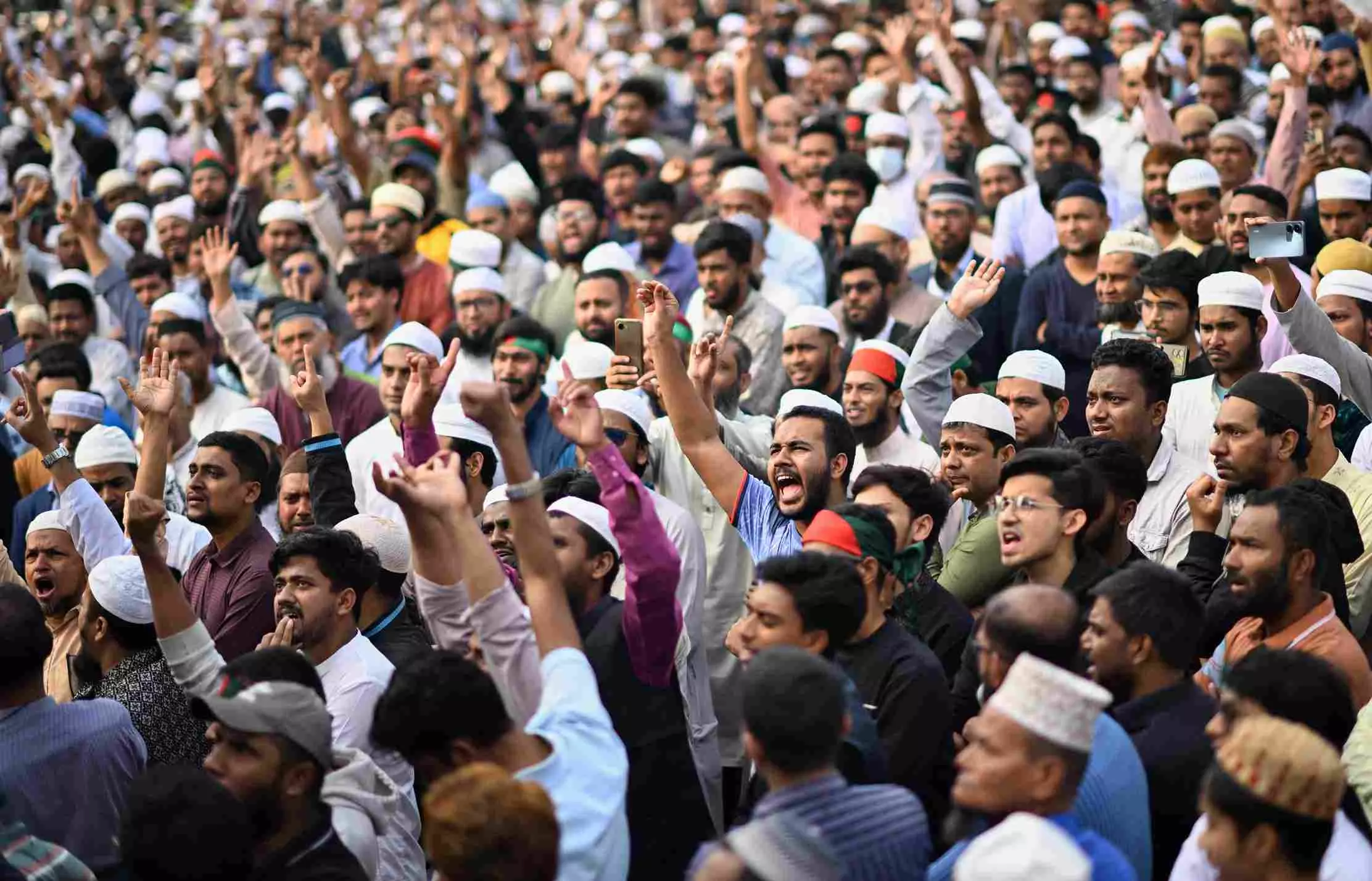
India has become the primary focus of the massive protests that have been rocking Bangladesh over the past few days. It came under attack at the recent rally held in Dhaka’s Shabagh after Sharif Osman Hadi’s funeral as well.
The attacks on them by Islamist-backed protesters could be a warning to refrain from praising freedom fighters and being critical of Pakistan, a country with which Bangladesh is currently deepening bilateral ties in multiple sectors, particularly defense and security.
Death of a youth leader
Attempts are now being made to describe the protests as the people's spontaneous response to the assassination of youth leader Hadi. He was fatally wounded when two motorcycle-borne assassins shot at him in broad daylight, on a busy Dhaka street, on December 12. He was flown to Singapore for treatment but succumbed to his injuries on December 19.
Hadi had taken part in last year’s student protest against Hasina. He led the Inqilab Mancha (Freedom Platform) and was a candidate in the forthcoming election. He had been a strong believer in holding elections as per the schedule and felt it was the only way forward for Bangladesh.
A Dhaka-based editor asked if any protester had the courage to enter the offices of two most prominent newspaper establishments and attack them unless he had strong backing from influential political quarters?
Observers believe the Islamists led by the Jamaat-e-Islami are behind the protests in the country.
If the election is called off and postponed indefinitely, the Jamaat, which has been successful in spreading its influence in Bangladesh since the ouster of former Prime Minister Sheikh Hasina, could further consolidate its position and unite Islamists in the country to form a strong coalition.
The violent protests come at a time when Bangladesh Nationalist Party (BNP) co-chairperson and the party’s de facto leader, Tarique Rahman, is scheduled to return to Bangladesh after his 18-year self-exile in London.
Blame on Sheikh Hasina
Sheikh Hasina, the longest-serving prime minster of Bangladesh was driven out of the country after a student protest on government jobs turned into a people’s insurrection in August last year. She has been in India since.
In November, a Special Tribunal in Bangladesh tried Hasina in absentia and awarded her death penalty for the death of a large number of students during the protests in police firing.
Several legal and political experts felt the trial to be a sham. They saw it as an attempt to punish her with the death penalty, as she had done to Jamaat leaders, when she was in power in 2008 for their crimes during Bangladesh’s Liberation Struggle of 1971.
Despite an official request from Bangladesh to hand over Hasina, India has so far not obliged the neighbour.
Hasina is now being blamed for the attack on Hadi. It is also being said that the attackers fled to India and were being sheltered by her.
There were large demonstrations outside the Indian embassy and the Consulate in Chittagong in the wake of Hadi’s attack, and protesters even threatened to breach the security wall and enter the premises.
The protesters were mostly affiliated to the Jamaat and other Islamist groups. They demanded that India hand over Hasina and Hadi’s assassin to Bangladesh authorities immediately.
Tense relations with India
On December 14, Indian high commissioner in Dhaka, Pranay Varma, was summoned by Bangladesh foreign ministry to protest against the “incendiary statements” of Hasina against the interim government of Mohammed Yunus.
A few days later, India summoned the Bangladesh high commissioner in Delhi and expressed its desire to see a peaceful, free and fair, and inclusive election in Bangladesh. The Indian remark, however, did not go down well with the Dhaka establishment.
The government's foreign affairs advisor, Touhid Hossain, said Bangladesh did not need “advice” from India to conduct the election, as it was capable of conducting a fair election without outside prompting.
He pointed out that India should refrain from making such remarks, as it had remained silent for 15 years when Hasina was regularly manipulating elections, not allowing opponents and large numbers of people to vote.
Hossain said Bangladesh was willing to accept suggestions from the European Union on elections since it regularly engaged with Dhaka to help the country in its growth and development.
His remark, which implied that India is not a friendly country, was taken note of by the Indian establishment. The ongoing protest in Bangladesh with its focus on India, therefore, does not surprise Dhaka watchers.
Tarique’s arrival
The violent protests and political instability are also being seen by sections of experts as a signal to Tarique Rahman and the BNP leadership.
Tarique announced his desire to return to Dhaka on December 25. However, the possibility of him changing his plans if the violence continues and the situation deteriorates further is also not being ruled out.
There is an expectation within the BNP that Tarique Rahman’s arrival will rejuvenate the party’s leaders and cadres, as they still have doubts about the election being held on the announced date.
His arrival will put the party in the election mode. Most political pundits are of the view that the BNP would form the country’s next government.
Jamaat’s gameplan
The Jamaat-e-Islami has collaborated as a junior partner in a BNP government in the past. But it is keen to break away from playing the role of the second-fiddle.
In its recent assessment, associating with the BNP has tarnished Jamaat’s image because of the former's corruption while in power.
The Jamaat has felt the party should go on its own and create a grand alliance of Islamists to turn Bangladesh into an Islamic Caliphate.
Since Hasina’s departure, it has strengthened the organisation and spread its influence. But it needs more time to counter the BNP and other parties electorally. Otherwise, it might either be in the Opposition or end up, yet again, as a coalition partner to the ruling party in the next government.
Neither of the two options would help Jamaat reach its goal of turning Bangladesh into an Islamic State. It needs time to achieve that and therefore, if elections are pushed back for an unspecified period, it helps the Jamaat.
Option for India
The prevailing situation does not leave India with too many options. But by ensuring an inclusive, free and fair election as per the schedule, it can hope that if the BNP wins to form the next government, India could do business with it.
But to ensure that the pro-business and moderate section in the BNP controls the party, and decides on the India relation, Delhi would have to make sure the Awami League gets to contest the election with its traditional electoral symbol.
Even an Awami League in the Opposition, could play a meaningful role to marginalise the Islamists agenda and ensure both Dhaka and Delhi respect each other’s core strategic interests and do not indulge in jeopardising them.