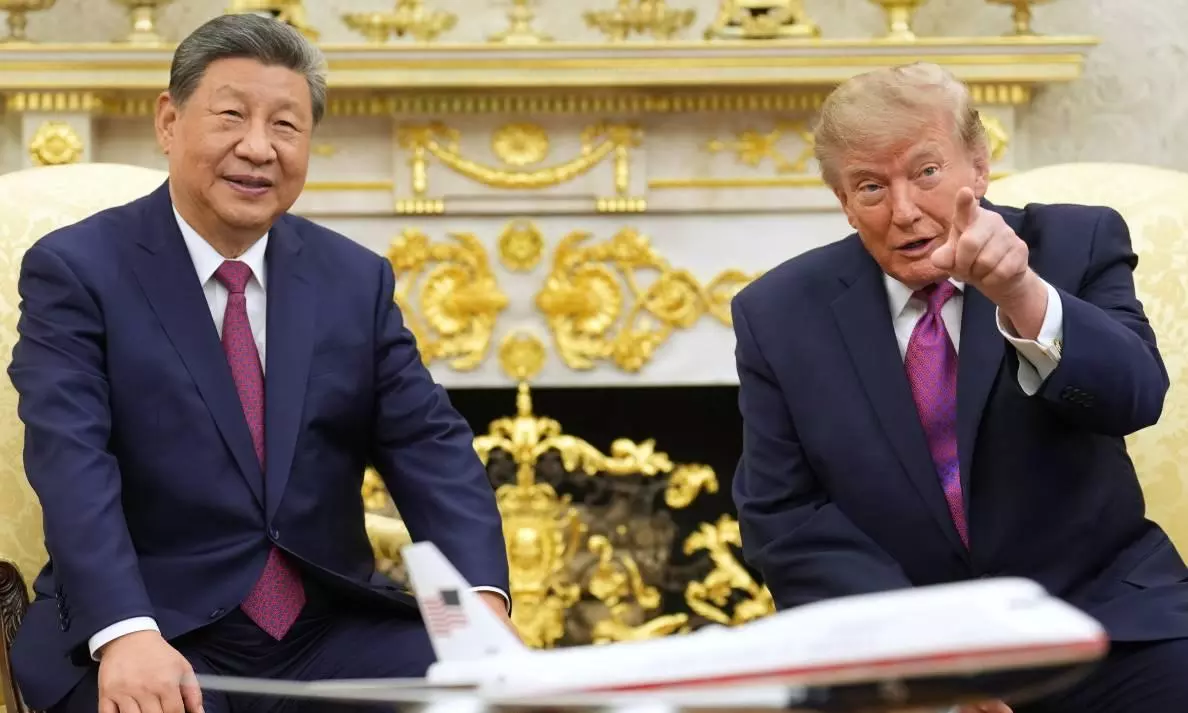
Xi-Trump meet: Plenty of optics, pleasantries, few breakthroughs
Trump’s personal warmth, Xi’s measured words show an attempt to maintain stable ties, make summit a success; talks on AI, Taiwan ticked off list; all eyes on critical minerals, computer chip exports

US President Donald Trump laid out a lavish welcome ceremony for Chinese President Xi Jinping that was in step with the grand welcome he received in China this summer. The setting was perfect, complete with a military band, booming cannons, and a flypast by stealth bombers. But beyond the extravaganza, there was no breakthrough.
Message of stability amid global unrest
Yet the summit between the leaders of the world’s number one and number two powers suggested a measure of stability at a time of global uncertainty. Trump’s personal warmth and desire to make the summit meaningful were on display from the beginning. China reciprocated in Xi’s measured words.
Also read: Trump-Xi meeting: Key takeaways on trade, Taiwan, AI and US-China ties
Xi called for translating a vision of a constructive China-US relationship of strategic stability, worked out during Trump’s visit, into action. Strategic stability is the buzzword China favours. Xi pointed out that the exchange of visits between the heads of state of China and the United States in less than half a year is unprecedented in the history of China-US ties.
Xi’s ‘Thucydides trap’ warning
“The Thucydides trap can be overcome," Xi said in his opening remarks, acknowledging the long-held view in academic circles taken from ancient Greece that the rivalry between a rising and an established power leads to a conflict. Xi said the US and Chinese militaries should maintain regular dialogue to improve crisis prevention.
“It should be a race of catching up with one another, not a wrestle in which one either wins or loses,” Xi said, adding that both countries were deeply interconnected and should engage in “healthy” competition that is “kept within bounds”.
President Trump was his usual effusive self, gushing over his friendship with Xi, forged since he took office in his first term. Never mind that it was Trump who called out China for cheating Americans of thousands of dollars, blaming Beijing for the COVID pandemic, and starting a trade war.
Critical minerals, chips trade on agenda
For now, the tariff war is on hold, with the extension of the trade deal worked out last year extended by two months up to January. Officials will work on that later. The farsighted Chinese were not about to make a deal till such time as the political situation in the US would become clearer after the mid-term elections in November, according to Alka Acharya, a long-time China watcher.
Also read: US-China must avoid ‘Thucydides Trap’, says Xi as Trump calls for better future
Trade talks on access to rare earth minerals, essential for American business, as well as China's need for high-tech computer chips, will come up during official discussions later as the two sides work out an agreement to extend the trade truce beyond January.
Xi draws red line on Taiwan
Xi is said to have pressed Trump not to encourage Taiwan’s bid to break away from China. This is a red line China draws, saying it is interference and an issue of great political sensitivity for China. Trump has so far kept on hold a $14 billion arms deal for Taiwan on hold, which was earlier passed by the US Congress. During his first term, Trump rattled China by loudly proclaiming his pro-Taiwan statements.
Ahead of the summit, there was talk about the two countries reaching an understanding on AI, now a hot-button subject with the US and China competing to get the upper hand. The US is ahead of China in the field of high-end AI technology. According to experts, the focus of the US in the AI sector is on innovation, while China’s AI strength is more market-oriented and commercial to help rejuvenate its industry. AI for China is to upgrade industries, but for the US, companies are hoping to break new frontiers in technology.
Future of AI rivalry
“US-China AI rivalry highlights the continued technological competition between the two countries as China seeks to reduce US restrictions on advanced chips and technology, while the US leads in AI investment and innovation. At the same time, the US is apprehensive of China catching up in the AI race through its dominance in AI in manufacturing and hardware. Until any one country establishes a dominant supply chain in the field of AI, both countries would hedge their bets against the other,’’ says MS Prathibha, an expert on China at the Delhi-based think tank Manohar Parrikar Institute for Defence Studies and Analyses.
Also read: China President in US: Trump hails 'truly great friendship' with Xi
Trump has embraced AI with enthusiasm and does not want any restrictions or oversight in place. He calls it ‘super intelligence’ or SI. He said in a social media message earlier on Thursday (September 24) that he wanted to “leave it exactly where it is,” according to the New York Times. He would rely on the Department of Justice rather than impose new guardrails. He wanted China to do the same.
But Xi was more cautious. “We have both the capability and responsibility to develop and manage AI for good, and ensure that the development of AI is always under human control and serves the well-being of the people,” Xi said.
Tech giants Sam Altman, Jensen Huang and Sundar Pichai met Xi during the state dinner at the White House.
Can US sanction China over Russian oil?
It is not known whether Xi raised the issue of the Lindsey Graham Sanctioning Russia and Iran Act of 2026, which enables the US president to slap up to a 100 per cent tariff on countries buying Russian and Iranian oil.
China and India are two of the largest buyers of Russian oil. Considering that American and Chinese business interests are literally joined at the hip, and the US is dependent on critical minerals to power its own industrial production, Trump is unlikely to use his authority to target China. He knows that China has the leverage with its monopoly over critical minerals.
Also read: Xi-Trump summit: Why thawing of US-China ties puts India on high alert
If he does not target China, can India escape?
For now, the summit appears to have achieved what both sides needed most - keeping the relationship stable without resolving their fundamental differences. For India, the message is equally important: as Washington and Beijing manage their rivalry and protect their own economic interests, New Delhi will have to navigate the space between the two carefully, particularly on Russian oil and trade.