'SIR debate' packs no surprises as govt deflects Oppn fire with platitudes
BJP leaders lean on past narratives and evade key concerns over voter roll revision, as Opposition raises pointed questions and offers specific suggestions

Last week, in a bid to break the logjam in Parliament over the Opposition’s insistence on discussing the Special Intensive Revision (SIR) of electoral rolls, the Treasury side had conceded a broader discussion on electoral reforms.
On Tuesday (December 9), as the Lok Sabha took up the discussion, it was instantly clear that the Centre’s decision to meet the Opposition mid-way on its demand was no largesse but an attempt to obfuscate an already complicated issue while redoubling its attacks on the Congress party over past misadventures.
Oft-repeated arguments
Through the nearly eight hours that the Lower House discussed electoral reforms, talking heads from the Treasury side parroted the same line of defence they have been proffering since the SIR was first rolled out in Bihar.
Tuesday’s discussion was a collective soliloquy of the Opposition’s lament against an electoral system it viewed as deeply compromised, to which the Centre responded with its typical hubris and contempt.
That the exercise was “entirely within powers of the Election Commission”, for which the Centre is not answerable, or that “purification of electoral rolls was necessary to weed out ghuspaithiyas (infiltrators)”, was what the Centre had maintained when the last Parliament session was washed out over its refusal to discuss the SIR.
Also read | INDIA Biggest anti-national act you can do is vote chori: Rahul in Lok Sabha
This remained the Centre’s line of defence on Tuesday, too. Additionally, Union ministers Arjun Ram Meghwal and Rajeev Ranjan Singh ‘Lalan’, alongwith MPs like Nishikant Dubey, PP Chaudhary and Sanjay Jaiswal, among others, fortified the Centre’s arguments with the cue they had received from Prime Minister Narendra Modi at the start of the winter session — flaunting the NDA’s recent Bihar triumph as the “people’s endorsement” of the SIR and the Opposition’s protests as a “sign of frustration”.
Back to Nehru and Indira
The predictable taunts at the Opposition’s “double-standards” in crying foul over alleged electoral malpractice and a compromised electoral apparatus “only when they lose”, flew thick and fast from the Treasury side.
As did the constant leitmotif of the Centre’s counter-offensive directed more specifically at the Congress – that of raking up the excesses of the Emergency, which started with Indira Gandhi’s election to the Lok Sabha being set aside by the Allahabad High Court in an electoral malpractice case, and of going even further back in history to bash Jawaharlal Nehru for “never respecting the electoral process”.
If the Centre had answers to questions the Opposition and other watchdogs of democracy have been agitating over, either with specific regard to the SIR or on the swiftly eroding credibility of the EC and the electoral process, it clearly didn’t wish to share them in the Lok Sabha. Instead, the Centre came armed with instances of past wrongs – some accurate, some imagined and many outright distortions.
Forward-looking solutions
In contrast, the Opposition came not just with specific instances of a backsliding electoral democracy but also with forward-looking solutions.
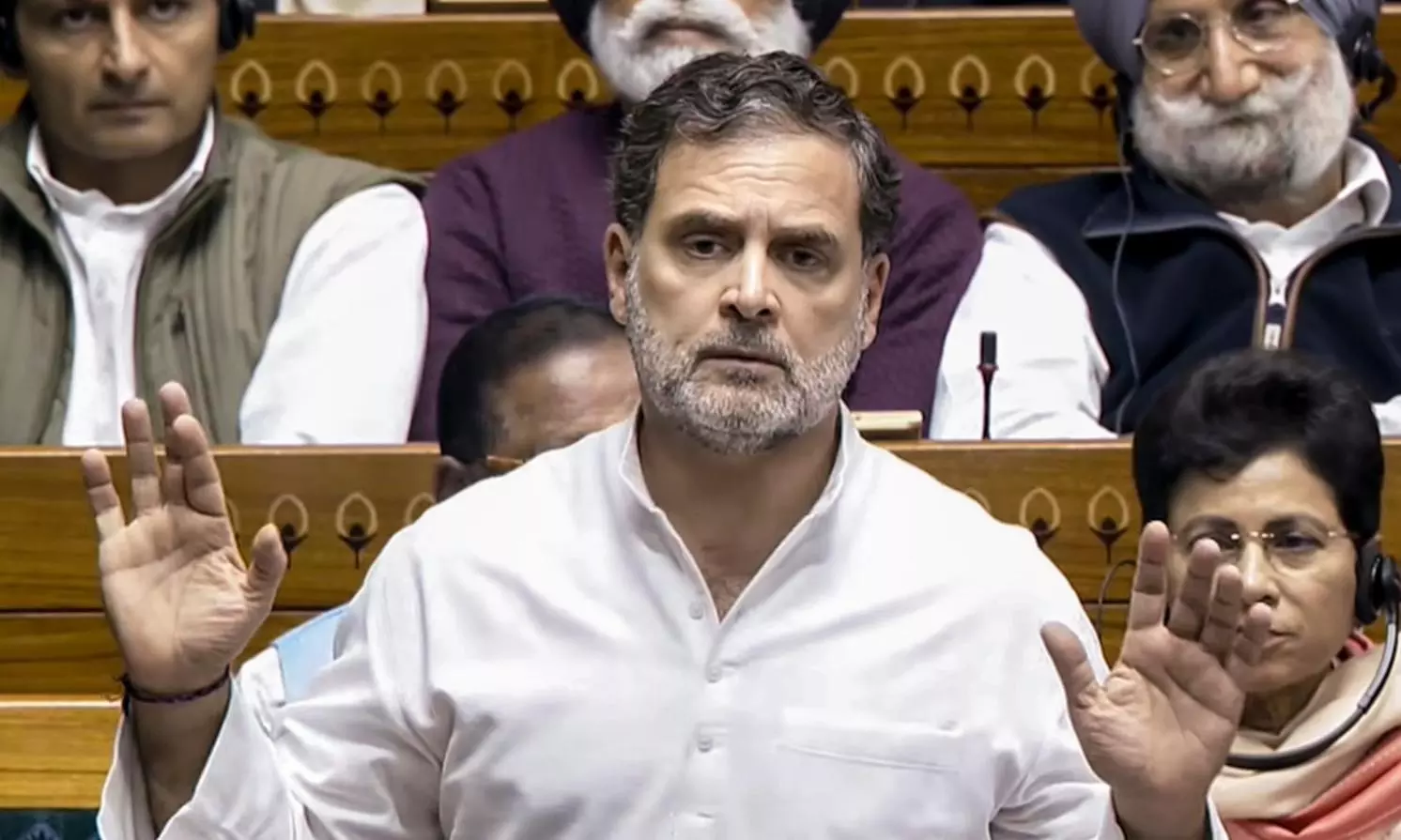
After a meandering start that sought to use khadi and other Indian fabrics as metaphors for electoral democracy, Leader of Opposition Rahul Gandhi systematically laid out his and the broader Opposition’s concerns over the electoral apparatus while reiterating his allegations of “vote chori” and asserting it is “the biggest anti-national act because when you destroy the fabric of India’s democracy”.
Watch/Read | EC tells SC its deduplication software was ineffective; what does it mean for SIR?
While the Treasury Benches mocked him, Rahul raised pertinent questions on why, if the poll panel had nothing to hide, machine-readable voter lists were not being provided to political parties, and why the Centre had, through a surreptitiously passed law, provided Election Commissioners with blanket immunity against any punishment for their actions in office.
The Opposition demanded to know how many 'infiltrators' had been found in Bihar SIR. It was a question that had been repeatedly posed to CEC Gyanesh Kumar. The Centre’s answer today was only cruder than Kumar’s silence.
Rahul also demanded that the poll panel’s amended rules that allowed it to destroy polling-related CCTV footage after 45 days of an election should be withdrawn and that political parties must be allowed to “examine the architecture of the EVMs”.
Pre-poll cash transfers
Equally pointed arguments and demands came from other Opposition MPs too. The Congress’s Manish Tewari demanded that the controversial 2023 law that allowed a panel comprising the Prime Minister, another cabinet minister (currently the Home Minister) and the Lok Sabha LoP to select the Election Commissioners must be amended to include in the panel the Rajya Sabha LoP and the sitting Chief Justice of India, to ensure fairness in the selection process.
The Chandigarh MP also demanded that pre-poll cash transfers to voters by incumbent governments, as most recently seen in Bihar, must be stopped and so should the SIR, which he called “blatantly illegal and unconstitutional”.
Samajwadi Party chief Akhilesh Yadav cited specific cases from the bypolls for the Rampur Lok Sabha seat and the Farrukhabad and Milkipur assembly seats of alleged voter intimidation by the BJP and electoral manipulation through the EC, while claiming that he had “filed multiple affidavits with the EC, along with proof of his allegations, but had not received any reply till date”.
Pointed questions
Supriya Sule of the NCP-SP, Kalyan Banerjee of the Trinamool Congress, the DMK’s Dayanidhi Maran and several other Opposition MPs too came with pointed queries and specific suggestions.
Also read | How Rajnath rewrites Ayodhya, twisting Nehru-Patel’s role in 1949
With speakers from the Treasury side repeatedly justifying the SIR as a legitimate means to weed out “infiltrators, Rohingya and Bangladeshis” from the voter rolls, the Opposition side demanded to know how many such voters had been found in Bihar when the SIR concluded. It was a question that had been repeatedly posed to Gyanesh Kumar, the Chief Election Commissioner, too.
The Centre’s answer today was only cruder than Kumar’s silence. BJP MPs such as Nishikant Dubey offered no facts but, instead, pushed their familiar rhetoric, dripping with vile bigotry, of “Muslims displacing Hindus” in areas of Bihar, Bengal and Jharkhand, among other states.
Tuesday’s discussion was, thus, a collective soliloquy of the Opposition’s lament against an electoral system it viewed as deeply compromised to which the Centre responded with its typical hubris and contempt.