



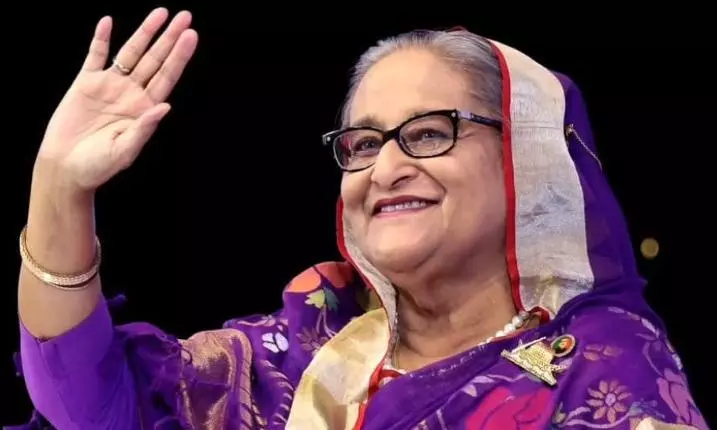
Sheikh Hasina’s return bid stirs Bangladesh turmoil, puts India ties under strain
Hasina's return plans have fuelled political tensions in Bangladesh, with violence and accusations against India threatening to deepen an already strained bilateral relationship

Ousted Bangladesh Prime Minister Sheikh Hasina has set the cat among the pigeons by announcing her intention to return to the country next month. Her decision has added to the woes of the Bangladesh Nationalist Party (BNP) government, which is already grappling with growing violence and political uncertainty.
Prime Minister Tarique Rahman has accused India of stirring trouble in Bangladesh by encouraging the Awami League's violent activities, raising the prospect of an already-strained relationship between the two neighbours deteriorating further.
An uncertain road home
India, however, has not risen to the bait. Asked to comment on the Bangladesh PM’s accusation, foreign office spokesperson Randhir Jaiswal refused to do so, saying it was an internal political issue. Instead, he said that “India wants a positive, constructive, and forward-looking relationship with Bangladesh rooted in shared history, sacrifices, and cultural values”.
Also read | Hasina’s passport gambit has Bangladesh’s BNP government in a bind
Sheikh Hasina has been living in India since August 5, 2024, when she fled the country following a student-led mass movement. She was sentenced to death in absentia by Bangladesh’s International Crimes Tribunal.
Yet, perhaps knowing that Prime Minister Tarique Rahman is unlikely to allow the sentence to be carried through, Sheikh Hasina has decided to take the risk of returning to the country to save her party and her father’s legacy.
Her application for a fresh passport last month was turned down on technical grounds. She has applied afresh, but there are problems with signatures not matching. However, for the moment, that is besides the point. What is clear is that Dhaka is in no mood to issue her travel papers. Bangladesh would rather have her extradited from India. The process is already on, but could stretch on for years.
Hasina's gamble to reclaim legacy
Meanwhile, since Sheikh Hasina expressed her desire to return home, Bangladesh's political landscape has been in a churn. Energised by the news, Awami League workers have thrown caution to the wind, unleashing their pent-up fury in violent attacks on the homes of two ruling BNP lawmakers in Hasina's stronghold of Gopalganj. Party workers went on a rampage, perhaps to signal that they are now ready to take on the ruling party.
The Awami League has been barred from all political activities since Sheikh Hasina was ousted from power. The party's recent violence, coupled with ongoing protests by garment workers demanding higher minimum monthly wages to keep pace with the steep rise in living costs, poses a major challenge to Prime Minister Tarique Rahman's fledgling government. These developments have added to the uncertainty at a time when the country is undergoing a difficult transition.
Also Read: Bangladesh prepares security plan for possible unrest over Sheikh Hasina's return
“Sheikh Hasina’s passport request and announcement of a possible return have further complicated the political atmosphere,’’ says Zillur Rahman, president of the Dhaka-based Centre for Governance Studies. “However, I believe the larger issue is how Bangladesh manages political inclusion, accountability, and institutional stability without allowing confrontation to become the dominant feature of its politics.”
Yet, for Sheikh Hasina, this is a gamble worth taking to ensure that her father Sheikh Mujibur Rahman’s legacy is not forgotten. In fact, it is a last-ditch effort to reclaim her family legacy.
Delhi-Dhaka ties at a crossroads
India’s strong backing of Sheikh Hasina during her 15-year rule has further complicated matters. The Opposition in Bangladesh sees New Delhi as the key enabler that helped keep the Awami League leader in power. Unlike his predecessors, Prime Minister Tarique Rahman has not yet visited Delhi. Earlier leaders often made India their first foreign destination, reflecting the close ties between the two South Asian neighbours.
But now, relations are already strained, and the latest exchanges could deepen mistrust, says Zillur Rahman.
“However, I would caution against treating every domestic disturbance as evidence of external interference without credible evidence. Equally, India must recognise the political realities of post-2024 Bangladesh and the sensitivities surrounding Hasina’s continued presence there,’’ he adds.
Also Read: India working on Sheikh Hasina's return to Bangladesh, seeks security guarantees: Report
The ruling BNP and opposition parties are also determined not to let the Awami League off the hook and are stepping up their resistance. The Jamaat-e-Islami-led 11-party alliance has also announced plans to take to the streets to “protect the country from defeated and hegemonic forces”. All this spells trouble not just for Bangladesh but for India as well.
“Ultimately, neither Bangladesh nor India benefits from prolonged hostility. Geography, interdependence, and shared strategic interests make a pragmatic working relationship essential. The immediate challenge is to prevent domestic political tensions from defining the future of bilateral relations,’’ says Rahman.