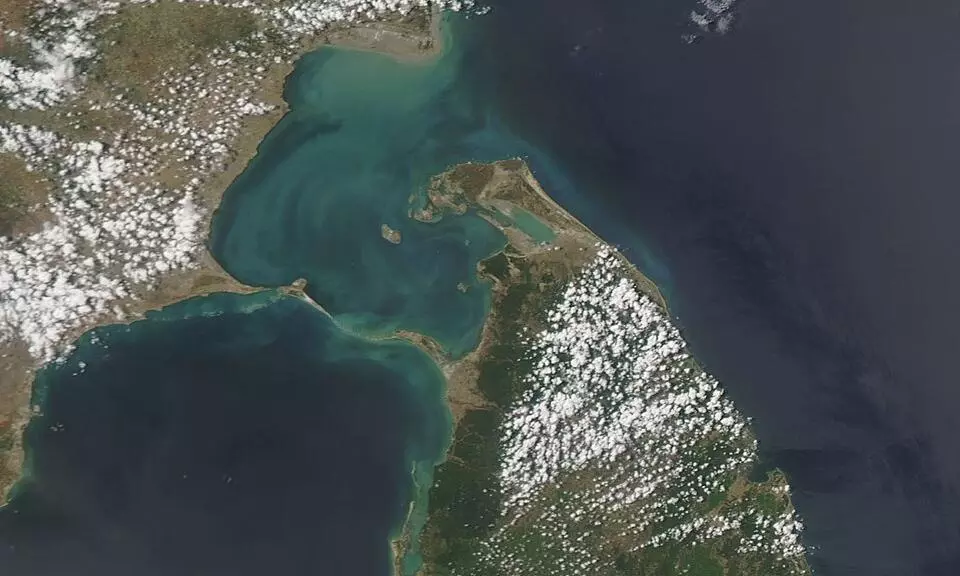
Sri Lanka’s north is separated from India’s Tamil Nadu by a narrow strip of sea called the Palk Strait. File photo: Wikimedia commons
Sri Lanka’s ‘no’ to bridge with India fuels counter: 'Would raise mutual dependence'
While those backing the idea see economic transformation, critics fear a land link with India could threaten Sri Lanka’s sovereignty

A proposed 30-kilometre bridge to link India and Sri Lanka by road and rail has triggered a fierce debate in the island-nation, with those in favour saying it will herald a much-needed economic prosperity and critics arguing it will threaten the country’s independence and sovereignty.
Notwithstanding the positivity in bilateral relations since India provided mammoth economic help to Sri Lanka after its economy collapsed in 2022, the government and sections of the neighbouring country's Sinhalese majority are bitterly opposed to anything that will take away the country’s fortress-like island status.
Security fears
The most extreme Sinhalese nationalist rhetoric, which views India with suspicion, insists that land connectivity (between Dhanushkodi in Tamil Nadu and Talaimannar in Mannar) will enable Indian troops to invade Sri Lanka more quickly than by any other means.
Also read: How Indian-origin Tamils in Lanka are quitting tea estates to carve a new identity
As it is, many Sinhalese believe, wrongly, that the mass of Tamils in India and those in Sri Lanka are out to spoil the Sinhalese-Buddhist peace of mind. Then there are those who say a land bridge may open Sri Lanka to trafficking, especially in drugs.
However, at the same time, many Sri Lankans and Indians dismiss all these concerns as absurd.
India pushes proposal
This month, India’s High Commissioner in Colombo, Santosh Jha, gently departed from diplomatic niceties to publicly underline that the absence of a land link between the two countries was “an anomaly” and that the time for wavering was over.
Speaking at an event in Colombo, he drew the image of two neighbouring houses connected only by a long corridor outside, when a door could be built right through the wall between them. “We need to open that door,” he said, clearly articulating where New Delhi stood on the issue.
Jha’s remarks are significant since Sri Lankan President Anura Dissanayake refused to advance the bridge proposal during a 2024 visit to New Delhi. Again, when Prime Minister Narendra Modi visited Colombo in 2025 and spoke about land connectivity, Sri Lanka dropped it from its agenda.
Colombo’s stand
Sri Lanka, Dissanayake said as a matter of finality last year, was “not yet ready” for a land connection with India, implying he was not ruling it out for posterity.
Sri Lanka’s north is separated from India’s Tamil Nadu by a narrow strip of sea called the Palk Strait.
Also read: India ships 38,000 MT of fuel to Sri Lanka amid West Asia crisis and local panic
The latest stand taken by Colombo is different from when India and Sri Lanka signed a Memorandum of UnderstandingF in 2022 to join the two countries across the Palk Strait by road and rail. Ranil Wickremesinghe, widely seen as pro-India, was then the prime minister of Sri Lanka.
While saying that the fears arising from a land coupling with India were exaggerated, supporters of the plan in Sri Lanka felt the positives that would accrue were far more significant and important.
Connectivity will raise mutual dependence: Think tank
The Pathfinder Foundation, a Colombo-based think tank, has said the bridge would be more of an “economic land corridor” and that such a bond would lead to industrial zones, logistics parks, cold chains and tourism clusters.
This month, the Colombo-based Centre for Policy Alternatives (CPA) came out with a study that said the economic relations that would arise through land connectivity "would increase mutual dependence between Sri Lanka and India" instead of leaving Colombo dependent on New Delhi.
“Greater economic integration with India, soon to be the world’s third largest economy, has the potential to accelerate economic development for Sri Lanka as a whole and in some of its most underdeveloped regions, particularly the north and east,” said the study, Bridging the Palk Strait: Assessing Indo-Lanka Land Connectivity, authored by Shahane de Silva, senior researcher and deputy programme director at CPA.
Benefit for northern region
De Silva was referring to the Tamil-majority Northern Province and the multi-racial Eastern Province, where a separatist war that raged for more than a quarter century has left the sprawling region economically lagging compared to the rest of Sri Lanka.
The CPA study said the land bridge had the potential to improve Colombo Port’s competitiveness in facilitating Indian transshipment, vital to position Sri Lanka as a gateway to India and thereby as the hub of the Indian Ocean.
Also read: VP Radhakrishnan set to face Tamil pressure for provincial polls in Sri Lanka
A rail and road linkage would also facilitate Sri Lankan firms integrating with the supply chains of southern India, consisting of some of India’s most economically advanced states, thereby promoting industrial development in the island, more so in the north and east.
The CPA added that a land connection would also bring more tourists from south India to Sri Lanka, particularly the northern, north-central and eastern provinces, which hardly see visitors from India.
Indians otherwise constitute the largest bulk of foreign tourists to Sri Lanka, but they mostly confine themselves to Colombo, the south coast of the country and the tea-producing central hills.
Trade benefits
According to Paikiasothy Saravanamutu, executive director of CPA, some of the effects of the oil crisis caused by the Iran-US-Israel war could have been mitigated if a land connection between India and Sri Lanka had already been in place.
An earlier 2023 analysis by some Sri Lankan economists too concluded that a land corridor — bridge, tunnel or a combination of both — would cut transport costs in India-Sri Lanka bilateral trade by a staggering half.
Thirteen of the top 15 products India exports to Sri Lanka, including sugar, pharmaceuticals, cotton, vegetables and plastics, are suitable for land transport, meaning they could benefit from cheaper, faster and more reliable logistics.
Historical mistrust
Political analysts admit that Sri Lanka’s fears over deeper connectivity with India are not without basis.
Sri Lanka’s geographical position in South Asia — an island of 22 million people vis-à-vis a mammoth landmass of 1.4 billion people — has traditionally influenced political thinking in the country.
Also read: India-built Bailey bridge in Sri Lanka under strain; Tamils seek permanent structure
The Indian military deployment in Sri Lanka’s north and east in 1987-90, although aimed at ending Tamil separatism, generated a lot of ill-feeling, which persists to this day. India’s earlier decision to harbour and train Tamil militants in an earlier era, too, did not help.
Security risks
Sections of the Sinhalese Buddhists naturally keep alleging that India is out to gobble up Sri Lanka. The current dominant ruling party, the Janatha Vimukthi Peramuna (JVP), once used to dub India “expansionist”.
The CPA made it clear that the likelihood of an Indian military invasion of Sri Lanka was very low and that India had no reason to attempt anything like it.
“India would remain or find itself more dependent on Colombo Port as a transshipment hub. If industries in the service of southern Indian supply chains develop in Sri Lanka, India becomes dependent on Sri Lankan industries for components and other inputs,” the study says.
Experts say problems of drug-smuggling already persist via maritime routes. In any case, there are options available to Sri Lanka to mitigate trafficking via land.
Also read: Why India must honour IPKF’s forgotten war heroes in Sri Lanka
“Many other jurisdictions connected by bridge contend with this problem, such as Malaysia and Singapore via the Johor-Singapore Causeway, from where Sri Lanka can adopt best practices.”
Call for fresh review
The CPA gives adequate weightage to concerns of damage to the sensitive marine ecosystem surrounding the Palk Strait and calls for a comprehensive environmental impact assessment with international consultancy.
“Willingly or unwillingly, what is ignored are the obvious, tangible economic benefits to both countries from such connectivity,” the study said.