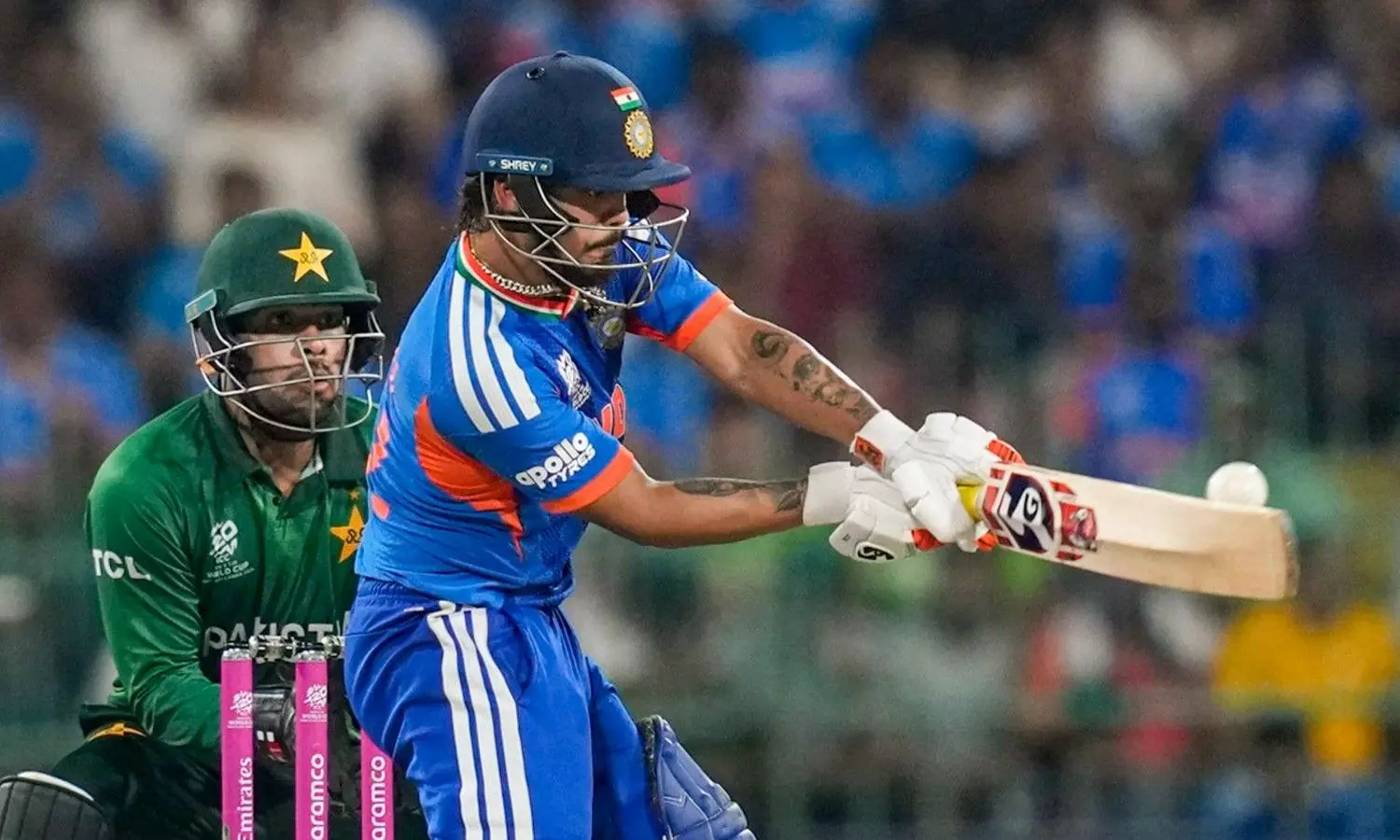
India's Ishan Kishan plays a shot during an ICC Men's T20 World Cup 2026 match between India and Pakistan, at R Premadasa Stadium, in Colombo, Sri Lanka, on Sunday, February 15. PTI
Ishan Kishan's blitzkrieg sinks Pakistan at T20 WC: A comeback beyond cricket
On a tough, “tacky” R Premadasa Stadium pitch, Kishan combined brute power with artistic finesse in a breathtaking assault on Pakistan’s bowling battery

High-voltage India-Pakistan matches have always been much larger than just cricket. They are examinations of temperament in emotional theatres where reputations are made, broken, and sometimes reborn. But in their recent clash at the ICC Men’s T20 World Cup, one innings rose above pressure to become a decisive statement of personal redemption. Ishan Kishan’s brilliant knock in Colombo was a reminder that individual resilience can sometimes shape national sporting moments more decisively than team strategy.
Also read: Ishan Kishan, bowlers hand India 61-run win over Pakistan
Coming into the clash, the stakes were enormous. Every India-Pakistan game carries decades of rivalry and pressure. But given the off-field drama, politics and boycott threats that preceded the match this time, the Indian team carried an extra burden beyond what usually comes with every World Cup encounter against Pakistan.
Controlled aggression
While the build-up was electric, the loss of Abhishek Sharma in the opening over itself threatened to derail the billion hopes watching across screens. That’s when Kishan took charge and his belligerent innings changed the emotional direction of the match. Amid rising tension, Kishan’s approach was neither reckless nor defensive. It was controlled aggression, the kind that tells bowlers you are not here merely to survive. Boundaries were not just runs; they were statements. Each drive through cover, each pull over midwicket, each calculated risk gradually shifted the psychological balance.
On a tough, “tacky” R Premadasa Stadium pitch, Kishan combined brute power with artistic finesse in a breathtaking assault on Pakistan’s bowling battery. Though the left-hander from Jharkhand began with a daring, chin-high pull off pacer Shaheen Shah Afridi over the mid-wicket fence, it was the manner in which he demolished an array of Pakistani spinners that was truly sensational.
Also read: Super 8 schedule at T20 World Cup
Eventually, Kishan’s superlative half-century (77 off 40 balls) took India to an imposing 175 for seven and is now widely seen as the most decisive factor in ensuring an Indian victory. But beyond the match context, Kishan’s innings represents something much larger. Kishan’s journey from the wilderness of 2024 to the heights of the 2026 T20 World Cup stands as possibly one of the finest redemption arcs in the modern Indian game.
Dramatic decline
Till mid-2023, Kishan was everywhere. His fearless strokeplay and infectious energy, gave him the swagger of a young cricketer who looked born for the big stage. Then, almost suddenly, he was nowhere. Out of squads. Out of conversations. Out of the spotlight that Indian cricket showers on its rising stars.
The dramatic decline was due to a rare decision in late 2023 when Kishan did something almost unheard of in the high-stakes world of Indian cricket: he asked for a break. Citing mental fatigue after months of being on the road, often as a travelling reserve, he withdrew from the South Africa tour. While the sporting world is becoming more empathetic towards mental health, the immediate aftermath for Kishan was harsh.
The fallout was swift and public. In early 2024, the BCCI excluded him from the central contract list, a move widely interpreted as a disciplinary message over his absence from domestic cricket. The move also triggered a debate over his ‘Hunger’ for cricket. Public discourse questioned his commitment, with many suggesting that he was prioritising the IPL over the grind of the Ranji Trophy. For nearly two years, the gifted Kishan vanished from the national radar, falling behind a range of keeper-batters like Rishabh Pant, Dhruv Jurel, and Sanju Samson.
His resurgence was highlighted by a historic Syed Mushtaq Ali Trophy (SMAT) campaign in late 2025. Kishan finished as the tournament’s highest run-getter with 517 runs, leading Jharkhand to their maiden title.
Indian cricket has long celebrated physical pain as heroism but rarely knows how to process emotional fatigue. In a system run by a vast institution like the BCCI, performance calendars rarely pause for emotional recovery. The message, even if unspoken, has historically been simple: keep going.
But Kishan stopped which required a different kind of bravery. For a young player fighting for space in the fiercely competitive India national cricket team ecosystem, stepping away is like stepping into professional oblivion. New players arrive every season. Social media moves on instantly. Fans forget faster than selectors sometimes do. And the quiet but brutal message is that Indian cricket had moved ahead.
Leading Jharkhand to maiden SMAT title
For many, that is where careers fade. For Kishan, that is where the story actually began. Rather than engaging in a war of words, Kishan returned to the basics. The 2024-25 domestic season became his crucible. Leading Jharkhand, he didn't just play; he dominated.
His resurgence was highlighted by a historic Syed Mushtaq Ali Trophy (SMAT) campaign in late 2025. Kishan finished as the tournament’s highest run-getter with 517 runs, leading Jharkhand to their maiden title. His century in the final was more than just a statistical milestone; it was a loud, defiant knock on the selectors' door. He proved that his "hunger" was not just alive; it was ravenous!
Unlike an injury, which is a physical hurdle, Kishan’s years in the wilderness were a battle against selectors’ apathy, public perception, and his own mental reserves.
The last IPL season also proved to be a turning point for Ishan. While his start with Sunrisers Hyderabad in IPL 2025 was a rollercoaster (opening with a century followed by a lean patch), it was his technical evolution that caught the eye of experts. He emerged with a more mature approach against spin, a clear byproduct of the ‘simulation training’ he underwent during his time away.
‘Changed man’
His return to Indian colours in early 2026 has been nothing short of cinematic. Since his return, Ishan has maintained a staggering strike rate of over 220 in T20Is! In the six innings he has played after being recalled to Team India, Kishan has scored 296 runs at an average of 49.33. And in his match-winning knock against Pakistan in Colombo, Kishan not only became the first Indian wicketkeeper to score a half-century in T20 World Cup history but also cemented his status as India’s X-factor.
Not surprisingly, Kishan recently reflected. “I think I’m a changed man now. Earlier, I used to enjoy joking 24/7. Now, I’ve learned to focus that energy on my batting and keeping. Everything else is secondary.” Unlike an injury, which is a physical hurdle, Kishan’s years in the wilderness were a battle against selectors’ apathy, public perception, and his own mental reserves. To go from being “contract-less and forgotten” in 2024 to being an “indispensable World Cup star” needs a level of mental fortitude that few possess.
As Kishan walks back on the big stage and plays fearless cricket again, it feels very different. Not just aggressive. Not just explosive. Rather, he feels truly liberated. Like a cricketer who had already faced his worst fear and survived it. His success now proves that a step back is often the best way to gain the momentum needed for a giant leap forward!