








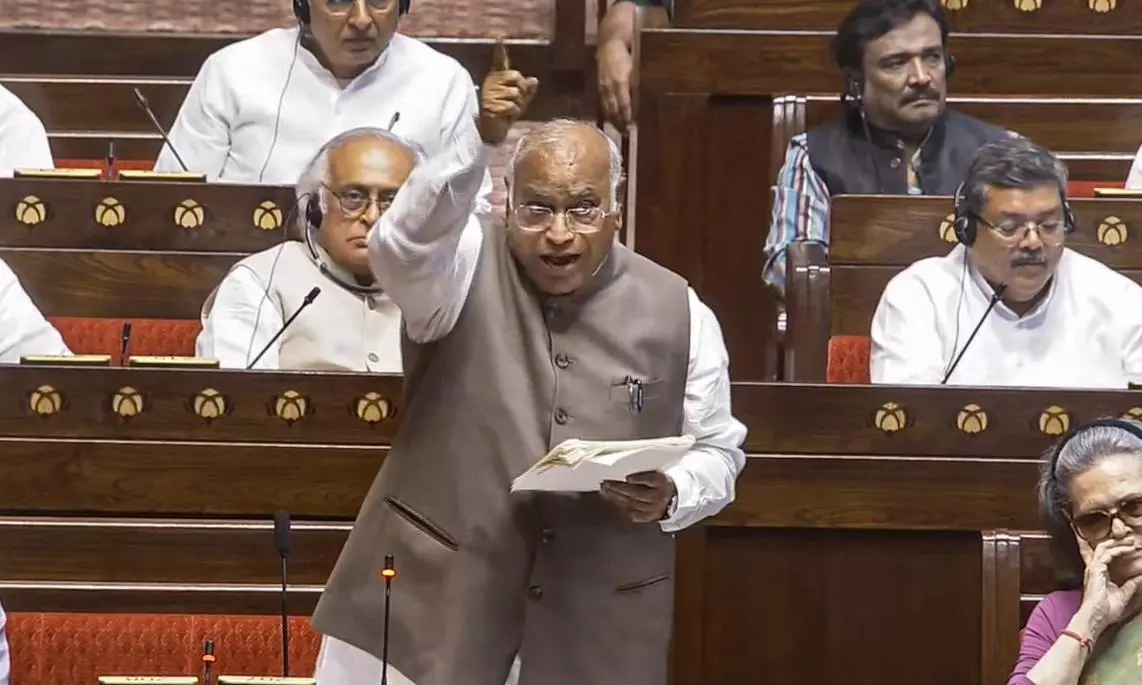
LoP in Rajya Sabha Mallikarjun Kharge speaks in the House during the Monsoon session of Parliament, in New Delhi, Thursday, July 30. (Sansad TV via PTI Photo)
How Kharge's Manusmriti citation turned into a 20-min Rajya Sabha storm
Reading out a controversial Manusmriti verse on caste, Kharge puts the BJP in a bind, it could neither rebut nor disown

Mallikarjun Kharge, Congress veteran and Leader of Opposition in the Rajya Sabha, showed the skills of an old warhorse when he took a rhetorical detour, brought in a reference to Manusmriti, and had the whole ruling BJP in the Upper House in a rage, as it were.
On Thursday afternoon (July 30), he stood up to speak after Union Minister of State (Independent) in the Prime Minister’s Office, Dr Jitendra Singh, introduced the Public Examinations (Prevention of Unfair Means) Amendment Bill 2026.
Kharge pokes fun at PM over Instagram video
Singh, in his own quiet way, enumerated the scores of exam paper leaks that had happened before 2014, and after in states ruled by non-BJP governments. It irritated the Opposition and they insisted that he should mention the leaks in 2024 and in 2026. It was then the turn of Kharge, the first to speak for the Opposition in the debate.
Also read: LS passes Vande Mataram Bill
After poking fun at Prime Minister Narendra Modi’s midnight recording of the Instagram video, he enlarged the scope of his criticism of the Bill by targeting the education system under the BJP dispensation. Citing the lakhs of vacancies in government organisations, he said that the positions were allowed to remain because the government did not want the jobs to go to the Scheduled Castes (SCs), Scheduled Tribes (STs) and the Other Backward Classes (OBCs).
He then targeted the education system specifically and said that the government wanted only people who belonged to the Rashtriya Swayamsevak Sangh (RSS) in the educational setup at all levels, and therefore the educational standards continue to lag behind.
Kharge reads out Manusmriti verse
He then brought in Manusmriti. He said that he cannot read the original text, but he would read out the translation. He read the oft-cited verse by critics of Manusmriti, which says that the ears of Shudras should be filled with wax so that they would not hear the sound of the Vedas. He said that the BJP’s mindset is shaped by texts like these. That turned out to be the proverbial red rag to the BJP members.
Also read: CRPF DG tells personnel to act ‘without fear’ amid Delhi protest pellet gun row
Giriraj Singh, the BJP's outspoken Bihar leader and Minister of Textiles, was the first to react angrily, attempting to shout Kharge down. Congress members quickly rallied around Kharge, shouting back in response. As the din grew, Rajya Sabha Chairman CP Radhakrishnan intervened to restore order, asking both Singh and the Congress benches to stand down, before calling on Leader of the House and Union Health Minister JP Nadda to respond.
Nadda’s response to Kharge
Nadda said that it was not right for Kharge to refer to issues that would incite hatred, and that he should offer his suggestions on the Bill. He also demanded that Kharge authenticate the text he was quoting. He asked his party colleague Sudhanshu Chaturvedi to intervene. Chaturvedi asserted that the passage was not to be found in Manusmriti, and that even Dr BR Ambedkar agreed that it was not part of Manusmriti. It is to be noted that Ambedkar had famously burned a copy of Manusmriti.
The BJP, it appeared, had painted itself in a corner. There was reluctance, as a matter of fact, more than reluctance; there was resistance to showing Manusmriti as the reactionary text of the ‘Hindu tradition’. The BJP, and its ideological mentor, the RSS, had been treading a guarded path in the matter. They maintain an uneasy silence over the casteist and reactionary passages of Manusmriti, which came into prominence only in the late 18th century when the Royal Asiatic Society was founded in then Calcutta, and British philologist William Jones made the famous observation that Sanskrit had linguistic connection with Greek, Latin, German and other European languages.
20-minute commotion
Manusmriti has been an embarrassing text for some Hindus. While modern, secular, and liberal Hindus of the last two centuries do not hesitate in calling out its reactionary aspects, the traditionalists have defended it with equal vigour.
A decade ago, when this writer interviewed Ashok Singhal, the president of Vishwa Hindu Parishad (VHP) in New Delhi, a gentleman from Haryana entered the room and told Singhal that he wanted to organise a function around Manusmriti. Singhal brushed him aside gently but firmly and said that this was not the time for it.
It turned out that the text of Manusmriti that Kharge cited was a publication of Parimal Publications of the Banaras Hindu University. The commotion over Manusmriti, which was not the main argument of Kharge’s speech, lasted for about 20 minutes. Kharge then completed his speech by suggesting that the government should set up an examination calendar among other things.
By bringing in Manusmriti, Kharge managed to put the BJP on the backfoot, which could not denounce the famous law code that Ambedkar had roundly denounced.
