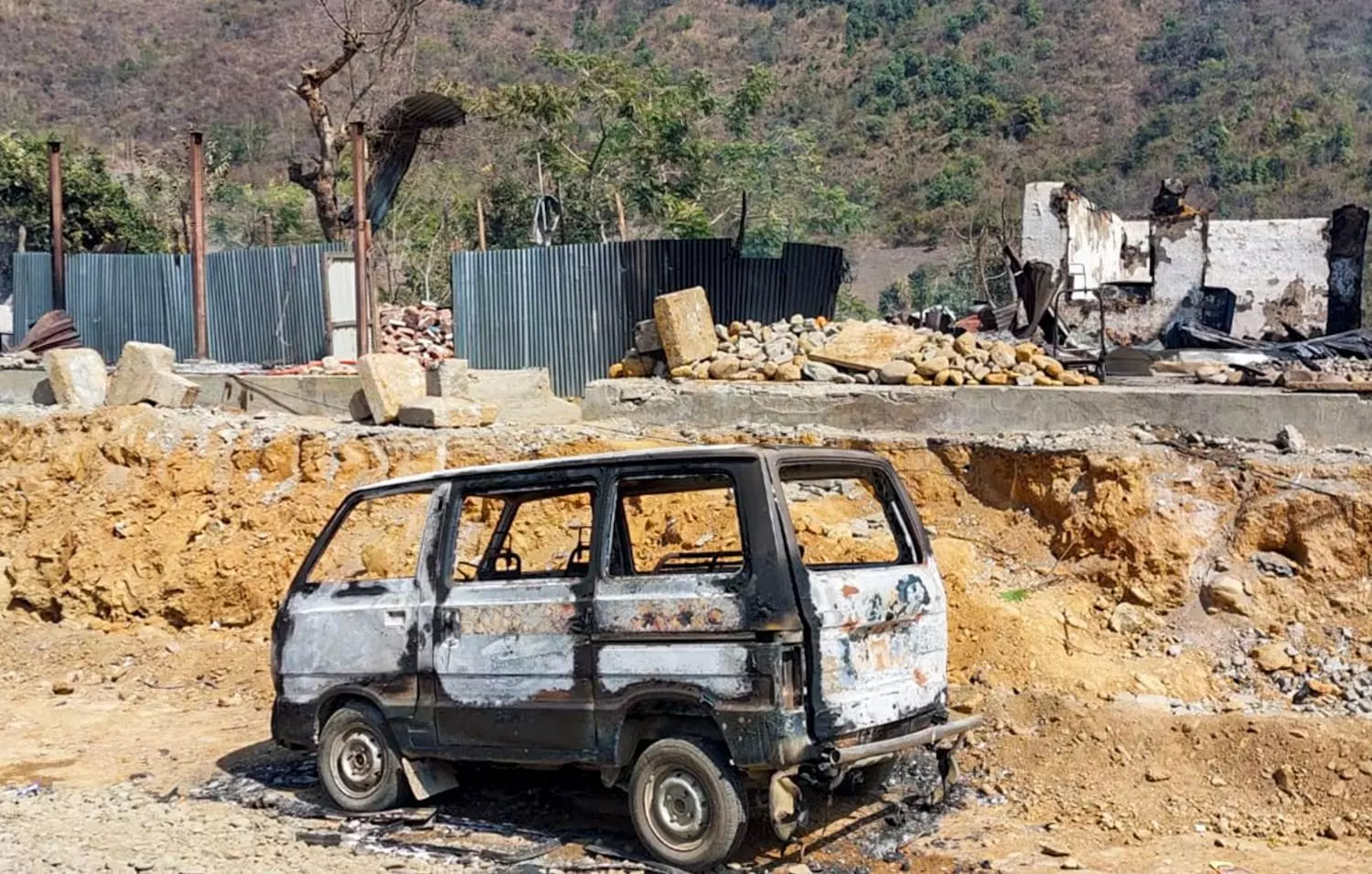
A charred vehicle lying at the site amid violence, at Litan Sareikhong village, in Ukhrul district of Manipur. Photo: PTI
New Delhi’s Manipur script: Is administrative trifurcation the endgame?
The people of the troubled state continue to navigate violence and displacement, with their fate increasingly decided by powers sitting far away

The fragile peace in Manipur's hills was shattered again this week as fresh violence erupted between the Naga and Kuki-Zo communities in the Litan Sareikhong village of the north-eastern state’s Ukhrul district.
Many reportedly had to leave their homes for safer locations. This followed an incident on February 7, where the alleged assault of a Tangkhul community individual by a group of Kuki-Zo individuals sparked localised conflict that quickly spread.
Also read: Yumnam Khemchand: Martial arts master becomes Manipur CM
The violence has disrupted vital road traffic between Ukhrul and the Imphal Valley — an alternative route made necessary because some Kuki-Zo groups have allegedly restricted movement along arterial national highways.
By Tuesday (February 10), officials estimated that many houses had been burnt over three days of conflict, with several people, including policemen, having reportedly been injured.
Manipur continues to burn
- Fresh violence in Ukhrul: Clashes between Naga (Tangkhul) and Kuki-Zo communities in Litan Sareikhong, Ukhrul district, erupted after an alleged assault on February 7, forcing many to flee, burning houses, injuring civilians and police, and disrupting the key Ukhrul–Imphal road link.
- Security measures, tense ground reality: Despite prohibitory orders and deployment of central forces, interior areas remain volatile and hard to access; the new Chief Minister Yumnam Khemchand Singh has appealed for peace, while civil groups warn against communalising the incident.
- A ‘scripted’ political reset in Imphal: Analysts say the BJP’s central leadership has engineered a tripartite leadership — Meitei CM with Naga and Thadou deputies — less as ethnic balance and more as a centrally choreographed political strategy.
- FNTA as a possible template: The recent Frontier Nagaland Territorial Authority (FNTA) deal is seen as a model for Manipur, potentially leading to ethnically defined autonomous regions (Naga and Kuki-Zo areas), amounting to a de facto administrative trifurcation of the state.
- Unity vs ethnic zoning: While pitched as stability through representation, critics warn this could institutionalise ethnic divisions, sideline civic governance, and deepen the humanitarian crisis, challenging the idea of “one Manipur” rather than healing it.
Despite prohibitory orders and the deployment of central armed forces, the situation remains tense, particularly in interior areas difficult for security forces to access.
Chief Minister Yumnam Khemchand Singh, who took charge on February 4, appealed for peace.
The Kuki Organisation for Human Rights Trust urged restraint, noting that the situation “began as an isolated altercation involving a few drunken individuals” but warned against attempts to “communalise the matter” that threaten “to inflame unnecessary divisions between the Tangkhul and Kuki communities”.
Centralised political script
The violence comes against the backdrop of what analysts describe as a meticulously plotted political manoeuvring by the Bharatiya Janata Party's (BJP) central leadership in New Delhi. The appointment of Yumnam Khemchand as the chief minister — a Meitei leader —alongside two deputy chief ministers (a Naga and a Thadou) represents more than ethnic balancing.
Also read: Iron fist and velvet glove: Inside India’s Chanakyan strategy against Naga insurgents
According to observers, this arrangement constitutes a scripted move, likely choreographed by the central leadership in consultation with strategic and national security experts.
This tripartite leadership structure, unprecedented in Manipur's political history, has been interpreted by some analysts as an administrative precursor to a more formal territorial division.
The mainstream discourse has largely framed this arrangement as a delicate “ethnic balancing act”, but this understanding fails to interrogate the goal of this “engineered balance” critically.
The appointment process itself revealed the centralised nature of decision-making. State BJP MLAs recently met in New Delhi under central observer Tarun Chugh in what has been described as not a democratic process, but a ratification of a pre-decided script, a pattern consistent with the BJP-RSS (Rashtriya Swayamsevak Sangh) model of top-down control.
From FNTA to Manipur's future
Critical to understanding New Delhi's apparent strategy is the recent creation of the Frontier Nagaland Territorial Authority (FNTA) in neighbouring Nagaland. This agreement, signed under the supervision of Union Home Minister Amit Shah, grants a significant degree of autonomy to eastern Nagaland's Naga tribes, establishing a precedent that could potentially be replicated in Manipur.
The FNTA model provides a blueprint for how New Delhi might approach Manipur's complex ethnic geography — through the creation of autonomous territorial councils organised along ethnic lines.
Also read: Modi's Manipur visit is a missed opportunity to heal a fractured state
This approach aligns with what critics describe as a form of administrative ethnic zoning, a tactic that can solidify boundaries rather than bridge them.
In Manipur's context, it could translate into the establishment of distinct Naga and Kuki-Zo Territorial Regions with varying degrees of autonomy, effectively implementing a de facto administrative trifurcation of the state.
While the territorial integrity of Manipur might formally remain intact in such a scenario, the grant of substantial autonomy to ethnically defined regions would represent a fundamental reconfiguration of the state's political architecture.
Beyond ethnic framing
The mainstream narrative surrounding Manipur's crisis has largely been reduced to a binary framing of pure ethnic conflict and identity-based politics, thereby obscuring what can be described as the more complex forces of centralised political scripting and geopolitical engineering.
This straightforward ethnic framing aligns with a concerning trend in political analysis: the effort to divide Manipur's intricate political landscape into tidy, manageable ethnic groups.
When one maps the conflict onto a simplistic political category, where the Imphal Valley represents Meitei interests, and the hills represent Kuki-Zo or Naga interests, they engage in what can be called “cartographic shorthand” that removes the profound intra-community diversities, shared spaces, and historical interdependencies.
Also read: Manipur violence: KOHUR urges peace amid fresh violence
More critically, this analytical framework mirrors the very logic of the political scripting it should critique. By replicating cluster-based analysis, media and think-tank discourse risks legitimising ethnic zoning as a natural order, rather than exposing it as a political tool for control.
One Manipur vs ethnic autonomy
The emerging administrative model presents a fundamental contradiction with the long-standing concept of "one indivisible Manipur" — a principle historically championed by Meitei civil society organisations and political groups. While New Delhi may formally maintain the state's territorial integrity, granting substantial autonomy to ethnically defined regions would effectively create multiple administrative entities within a single state framework.
This approach raises critical questions about governance, resource allocation, and political representation. How would inter-regional disputes be adjudicated? How would resources be shared between autonomous regions and the state government? What mechanisms would ensure equitable development across ethnically divided administrations?
The tripartite leadership structure — with a Meitei chief minister and Naga and Thadou deputy chief ministers — may represent an attempt to pre-emptively address these questions by embedding ethnic representation at the highest levels of state administration.
However, such engineered representation can inflame intra-ethnic fissures —smaller tribes or subgroups within these broad clusters feel marginalised by leaders appointed to 'represent' them, potentially triggering new dimensions of sub-ethnic or communal conflict.
Humanitarian costs and political calculations
Amid these political manoeuvrings, the humanitarian crisis continues unabated. Thedisturbance in Ukhrul district represents just the latest episode in a cycle of conflict that has persisted since a major violence erupted in the state on May 3, 2023.
Also read: Unrest continues in Imphal as IDPs protest near Raj Bhavan, seek to return home
The displacement, shattered livelihoods, and generational trauma affecting thousands of Manipur's residents are frequently reduced in mainstream discourse to a mere symptom of 'age-old ethnic tensions’.
This simplistic framing absolves the state and central governments of systemic failure — in law enforcement, justice delivery, and inclusive policy-making. It also shapes the search for solutions, focusing on ethnic quotas and cluster-based talks while undermining the need for the all too pervasive rights of citizens, accountable institutions, and a political process that transcends engineered ethnic boxes.
Beyond engineered division
A sustainable resolution to Manipur's crisis requires moving beyond what analysts describe as the ethnic cluster model and addressing the concrete political economy of conflict: land relations, resource access, and the demilitarisation of society.
It necessitates a peace process built not on bargaining between ethnic representatives, but on civic consensus involving those who have been consistently marginalised in both the political scripting and the media narrative.
Also read: Saffron bridge, broken trust: Decoding RSS's Manipur gambit amid political vacuum
Most critically, it demands scrutinising the centralised political machinery that seeks to manage diversity through division and control. Manipur's tragedy represents not merely ethnic conflict but a crisis of political design in which the scripted installation of leaders is a high-stakes gambit to stabilise the state through controlled representation.
As fresh violence erupts in Ukhrul district, the contrast between ground realities and New Delhi's political engineering becomes increasingly stark. The three-headed government in Imphal, modelled perhaps on the FNTA precedent, represents an unprecedented experiment in ethnically configured administration — one that could either stabilise a fractured state or institutionalise its divisions or what can be called the mainstreaming of ethnicities.
The fundamental question remains whether administrative trifurcation along ethnic lines represents a pragmatic recognition of ground realities or a dangerous precedent that will solidify identities in opposition to one another, making the concept of "one Manipur" increasingly obsolete.
Also read: NSCN-IM chief Muivah returns to native Manipur village after 60 years | Ground Report
As the central government appears to be rolling out its political blueprint for the troubled state, the people of Manipur continue to navigate violence and displacement, their future increasingly scripted by powers far from their ancestral hills and valleys.
The coming months will reveal whether New Delhi's centralised design can genuinely address Manipur's complex crisis or whether it will simply author the next chapter in the state's painful history of conflict.