Modi and Himanta's divide-to-win gambit could haunt India when crisis strikes
From Assam CM's communal blitzkrieg to PM's studied silence, BJP's electoral calculus risks fracturing the national unity that India may need in turbulent times

From the Centre to states, and more so in Assam, the Bharatiya Janata Party (BJP) surely looks foxed and wary.
Tariff tricks being played by US President Donald Trump seem to weigh quite a bit on the party. Trump remains undeterred and is brandishing the tariff threat in several revised forms against India, even as the US Supreme Court struck down his original move made earlier this month on a global scale.
For the BJP, all this is unfolding just weeks before election dates are announced for four states and a Union Territory — Assam, Bengal, Kerala, Tamil Nadu, and Puducherry.
BJP in overdrive
The question is whether the recent jolts inflicted by Trump tariffs on Indian exports will cast a shadow on the upcoming elections, or whether Prime Minister Narendra Modi will sail through both the tariff and electoral tests and emerge unscathed.
The challenge is such that the Union Home Minister and Modi’s point-man, Amit Shah, appears to be in overdrive, seen more in election-bound states than in Delhi.
Also read: India-US trade deal: Opposition plans to keep up pressure on govt in Parliament
Modi is busy too, trying to refurbish his image by hosting world leaders and tech-giants at the recently-concluded India AI Impact Summit 2026, and making trips abroad. He has recently been to Malaysia and is slated to visit Israel shortly. There is little possibility of the Prime Minister visiting any of the poll-bound states in the immediate future.
Managing the optics
Modi and his cohorts have so far tried to keep the US tariff issues not only off Parliament but also away from other public fora, though his Commerce Minister Piyush Goyal did hold a press conference earlier this month to broadly hail the tariff and thereby Trump as well.
The communal fissures the BJP is widening with an eye on votes may soon leave Indians incapable of standing united in times of national crisis — a unity that has, until now, largely held.
This was necessitated by widespread consternation among farmers over the possibility that a new scheme of US tariffs might include some agricultural products within its ambit. Trump’s recent moves after the US Supreme Court intervention has so far gone without any substantial response from India, leaving people clueless about the government’s next step.
From the electoral viewpoint, what farmers think of the upcoming tariff regime is crucial. And, since there are widespread apprehensions among peasants, horticulturists and dairy farmers about American food products flooding the Indian market with zero duty, Modi's party and government have reasons to be worried.
Shortsighted political calculus
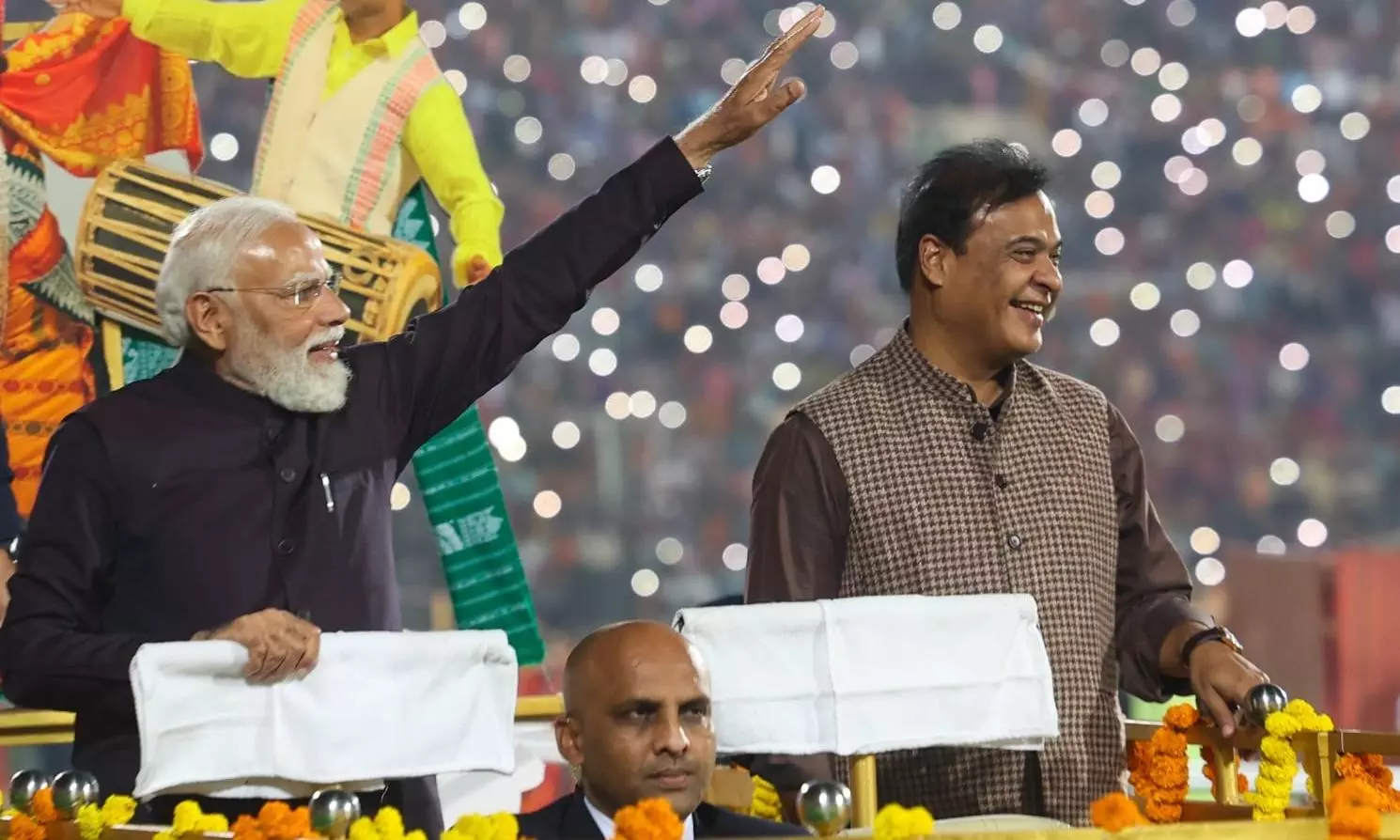
Amid this, Assam's BJP Chief Minister Himanta Biswa Sarma recently fired what he likely considered a pre-poll salvo to grab the electorate's attention — in a rather unconventional way. He exhorted them to cut down their rickshaw fare, say from Rs 5 to Rs 4, to discourage rickshaw pullers, who are mostly Muslims, from making Assam their permanent home.
Also read: Why a Left defeat in Kerala would be good for Indian democracy, and the Left itself
Himanta's sharp and escalating communal blitzkrieg through both regular and social media against the minority community in the state, which he believes to have roots in Bangladesh, has clearly sought to create or reactivate a local and ethnic tiff among communities. He has been trying to cleave the electorate into two distinct camps, hoping his majoritarian overdrive will deliver an easy victory at the polls.
In his utter contempt for Assam's minority community voters, the CM has the full support of his party's higher-ups. Together, this reflects a shortsighted political calculus — one that, amid the current melee over US tariffs, risks doing far greater damage than any electoral gain might justify.
For, the communal fissures the BJP is widening with an eye on votes may soon leave Indians incapable of standing united in times of national crisis — a unity that has, until now, largely held.
Unity in a crisis
When the US imposed sanctions on India following the May 1998 Pokhran nuclear tests, under former Prime Minister Atal Behari Vajpayee’s NDA-I rule, the entire country rallied behind him. The main troubleshooter of the BJP in those times, Pramod Mahajan, noted, "What can US sanctions do to us when everything that's required for life and to run the country is locally available with our billions-strong population?"
Also read: Why Bhupen Borah’s exit is a big ideological churn in Assam politics
Later, not only were the sanctions lifted but India and the US also signed a nuclear deal. In October 2008, the late Manmohan Singh’s government sealed the nuclear deal though Left parties differed and parted ways with the then Congress-led ruling UPA bloc. The polls held in 2009 brought back Manmohan Singh to power.
Will the same hold true for the currently ruling NDA, after India inks a tariff deal with the US? The question may seem premature today, but the deal will face an early test in the state assembly elections due within the next couple of months — well before the 2029 general elections. Further Assembly polls in the years between will offer additional readings of the public mood.