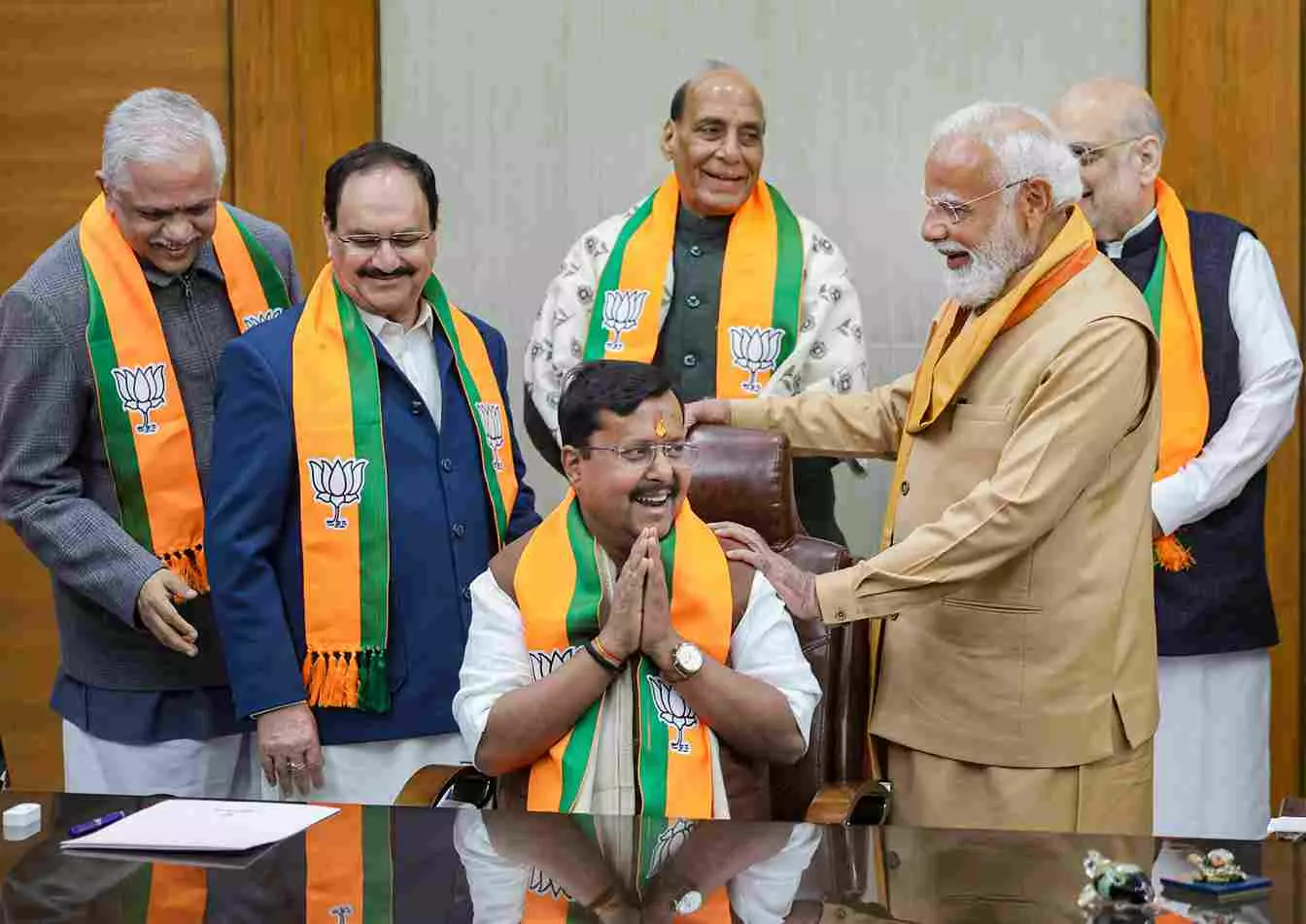
Every move by the ruling party is sycophantically hailed a masterstroke. So, Nabin’s appointment is sign of a timely ‘generational shift’ to prepare future leaders for the party at a time when its electoral dominance allows taking such risks. Likewise, Narendra Modi’s publicity-tailored gesture, like describing himself as an ordinary party ‘karyakarta’ (worker) who shall follow his much-junior adhyakshji (president), is emphasised as the third-term Premier’s humility.
What such admiring analyses conveniently gloss over, however, are the BJP’s own history, and, more importantly, a dispassionate assessment of how the saffron party has changed in its functioning from its earlier avatar of the ‘Atal-Advani era’ to move increasingly like its rival, the Congress, did when it lorded over India’s political landscape.
BJP's young leaders
There is no denying that at 45 years, Nabin is the youngest leader to become the BJP chief and that at this age, he can be counted upon to put in the enormous legwork that Modi famously demands from his colleagues to strengthen the party further. What BJP apparatchiks leave unsaid though is that the party has had a tradition, long predating the Modi years, of propelling younger leaders to key roles.
Modi himself was 52 years of age when he was parachuted back to Gujarat, after spending years in various organisational roles, as the state’s chief minister. Shivraj Singh Chauhan, now 66 years, was only 46 when he became chief minister of Madhya Pradesh for the first time back in 2005, while his Chhattisgarh counterpart, Raman Singh, was 51 when he took charge.
Union defence minister Rajnath Singh was 51 when he became chief minister of Uttar Pradesh and 55 when he became the BJP’s national president for the first time in 2005. Nitin Gadkari, who succeeded Rajnath as the BJP chief in 2005, was just 48 years old at the time.
As such, while Nabin may be the youngest yet to hold the BJP chief’s position, he doesn’t quite break any glass ceiling within his party.
Then there were the late Sushma Swaraj, 44 when she became chief minister of Delhi and 57 when she was appointed Leader of Opposition in Lok Sabha, and late Arun Jaitley, who was 56 when he became Leader of Opposition in the Rajya Sabha in 2009. Other ‘youngsters’ that the BJP elevated to important roles – BJP president, chief ministers and Union ministers – includes Modi’s closest aide, Amit Shah (BJP chief at 49), late Pramod Mahajan, Ananth Kumar and Gopinath Munde, Shahnawaz Hussain, Mukhtar Abbas Naqvi, former chief minister Uma Bharti, Biplab Deb, and scores of others.
Under Modi-Shah's BJP
As such, while Nabin may be the youngest yet to hold the BJP chief’s position, he doesn’t quite break any glass ceiling within his party. What Nabin’s selection – calling it an election is folly for the BJP, in its 45-year history has always had party chiefs picked by consensus and not real elections where there was more than one contender – signals, though, the tightening grip of the Modi-Shah duo; where key decisions, including the appointment of the party’s national president, are taken without any consultation with other party seniors.
As former Union minister Yashwant Sinha, the only leader in the party’s history who once came close to challenging the party’s official presidential candidate recalls, “when I chose to contest the presidential election as a mark of protest against the official candidate (Nitin Gadkari, who was set to get a fresh term when allegations of financial impropriety surfaced against him) in 2013, the entire leadership of the party discussed my concerns threadbare and it was ultimately decided someone else (Rajnath Singh) will be the official candidate... my concerns were addressed and so, even though I had got the nomination papers, I did not contest the election”.
Sinha recalls how, “unlike Modi’s BJP”, the party “under Atal Behari Vajpayee and LK Advani, discussed even the most inconsequential appointments with colleagues and formal, physical meetings of the Parliamentary Board were convened... none of that happens today because two people take the decision and no one in the party has the courage to stand up to them”.
While Sinha’s comments can be dismissed as rants of a disgruntled man who quit the party after months of firing barbs at Modi and Shah’s steering of the party, at least three serving BJP seniors The Federal spoke to conceded, although anonymously for obvious reasons, that “barring the two (Modi and Shah) no one knew about Nabin being made BJP chief, till hours before the official announcement was made”.
It is this reality of today’s BJP that has propelled many an untested, inexperienced and at times controversial or disastrous choices to various leadership roles at the expense of others, who many in the party of the Atal-Advani era may have viewed as ‘deserving’ candidates or a ‘natural choice’.
A senior Union minister, whose name had been briefly speculated about as a potential contender for Nabin’s role, told The Federal, “you have to understand one thing about the way the party is run now; if your name is being discussed it means you are out of the race for that job... only two people know who will get what assignment; theirs is the only view that matters, everything else – seniority, experience, hard work, rapport with colleagues, even relations with the Sangh (the RSS) means nothing.”
Controversial choices
It is this reality of today’s BJP that has propelled many an untested, inexperienced and at times controversial or disastrous choices to various leadership roles at the expense of others, who many in the party of the Atal-Advani era may have viewed as ‘deserving’ candidates or a ‘natural choice’.
Manohar Lal Khattar’s appointment as Haryana CM or the selection of his counterparts around that time and later – Jairam Thakur in Himachal Pradesh, Trivendra Singh Rawat, Tirath Singh Rawat and Pushkar Singh Dhami in Uttarakhand, Biplab Deb in Tripura, Bhajanlal Sharma in Rajasthan, Mohan Yadav in Madhya Pradesh, Mohan Majhi in Orissa, are all examples of this praxis that has now become the accepted convention in a party that sees Modi as its only anchor.
From Congress playbook
A BJP former chief minister, who has long been sidelined in the party, believes that the functioning of the BJP today has become a “photocopy of the very same thing that we all disliked about the Congress under Indira Gandhi... key positions – Union minister, chief minister, national president, state president – were appointed by Indira based on who she liked personally and not on what experience they brought to the table”.
The former CM added, “five decades later, the Congress is paying a heavy price for the kind of people Indira promoted in the party and the template she set for Rajiv Gandhi, Sonia Gandhi and Rahul Gandhi to follow. If we don’t learn our lessons from what the Congress did to itself, we will face a similar crisis in 20, 30, 40 years later; but obviously Modi and Shah don’t care because they may not be around to see the downfall so why bother (sic).”
In fact, promoting youngsters to key leadership roles is a leaf that Modi and Shah seem to have taken straight from the Congress’ playbook.
Through the post-Emergency period of the late 1970s and well into the 1980s, first under Indira Gandhi and then under Rajiv Gandhi, the Congress propelled several young leaders – untested and inexperienced at the time – to various leadership roles in the party hierarchy; rewarding them with Rajya Sabha nominations, cabinet berths and party positions.
Leaders such as Ghulam Nabi Azad, Anand Sharma, Digvijaya Singh, Ramesh Chennithala, Suresh Pachouri, Ambika Soni and several others had got their ‘big political break’ during that phase. In time, some of them proved to be electoral warhorses, some good at organisational work and others outright opportunists who stuck to the party as long as the going was good and defected the moment they saw their stars – and the party’s electoral graphs – decline.
Later, when Rahul Gandhi first took charge, first as party general secretary and later as party vice-president in 2013, a fresh push was given to promoting youngsters over seniors in key roles.
A slew of new appointments were made for posts of PCC chiefs across states – Arun Yadav in MP, Ajoy Kumar in Jharkhand, Pradyot Manikya Debbarma in Tripura, Sachin Pilot in Rajasthan, Amit Chavda in Gujarat – and Union ministers during the UPA era – Milind Deora, Jitin Prasada, Jyotiraditya Scindia, and so on. This fresh churn created the infamous and perennial clash between the party’s old guard (ironically beneficiaries of the same churn in a different time) and the so-called young turks; a clash that cost the party dearly in time and continues to haunt the Congress even today.
Bending to Modi's whim
Nabin, in that limited sense, may be lucky. For, while Modi’s BJP may lack inner-party democracy and function purely on the whims of its mascot, what it can boast of, unlike the Congress, is an abundance of inner-party discipline; inculcated over decades by the Sangh, which prevents leaders brought up through that stream from speaking out of turn or openly rebelling (rare exceptions aside) despite being snubbed, humiliated or bypassed.
When Modi points at Nabin as his chief and calls himself an ordinary karyakarta, he isn’t extolling his personal humility to his colleagues but reminding them that the new party president is ‘my man’ and that anyone in the mood to rebel must ‘fall in line or fall by the wayside’; for the BJP’s disciple is now tethered directly and indistinguishably to Modi’s whim.