Opposition pushback forces Centre to rethink Lok Sabha expansion, delimitation Bills
With Parliament mired in disruptions, the Centre is expected to prioritise its listed Bills over the proposed Lok Sabha expansion, women's reservation rollout and delimitation package

With just nine sittings of the Monsoon Session remaining, the Centre is preparing to push its listed legislative agenda through Parliament beginning Monday (August 3). What it may hold back, however, is its widely anticipated but unlisted legislative package to reconfigure the Lok Sabha’s composition, operationalise women’s reservation and enable delimitation of constituencies.
Also read | Rahul Gandhi turns up heat on Amit Shah as Parliament showdown escalates
The government had listed only seven Bills for the current session. Five new Bills: the Prevention of Insults to National Honour (Amendment) Bill, 2026; Registration of Births and Deaths (Amendment) Bill; Income Tax (Amendment) Bill, 2026; Supreme Court (Number of Judges) Amendment Bill, 2026; and the Micro, Small and Medium Enterprises Development (Amendment) Bill, 2026 – were slated for introduction, consideration and passage. Also listed were the Foreign Contribution (Regulation) Amendment Bill, introduced during the Budget Session, and the Viksit Bharat Shiksha Adhishthan Bill, 2025, which is under consideration by a Joint Committee of Parliament.
Delimitation plans in limbo
Mass defections from the AAP, Trinamool Congress and Shiv Sena (UBT) to the NDA ahead of the session fuelled speculation that the government would make another attempt to pass a revised Constitution (131st Amendment) Bill to expand the Lok Sabha from 543 to 850 members, reserve one-third of the seats for women and bring in a related Delimitation Bill.
The government, embarrassed when its April 17 attempt to pass the Constitution (131st Amendment) Bill failed for want of the required two-thirds majority in the Lok Sabha, did little to quell the speculation. On the contrary, senior ministers and BJP leaders suggested in off-record conversations that a fresh attempt was on the anvil. They also indicated that efforts were underway to secure support from parties such as the DMK and the NCP-SP.
Government sources had said the sparse legislative agenda for the 18-sitting monsoon session was deliberate, leaving enough room to introduce the Constitution (131st Amendment) Bill and the Delimitation Bill in the closing days of the session. Such a strategy would have been consistent with the Modi government’s earlier practice of introducing contentious legislation late in a session, leaving the Opposition little time to respond.
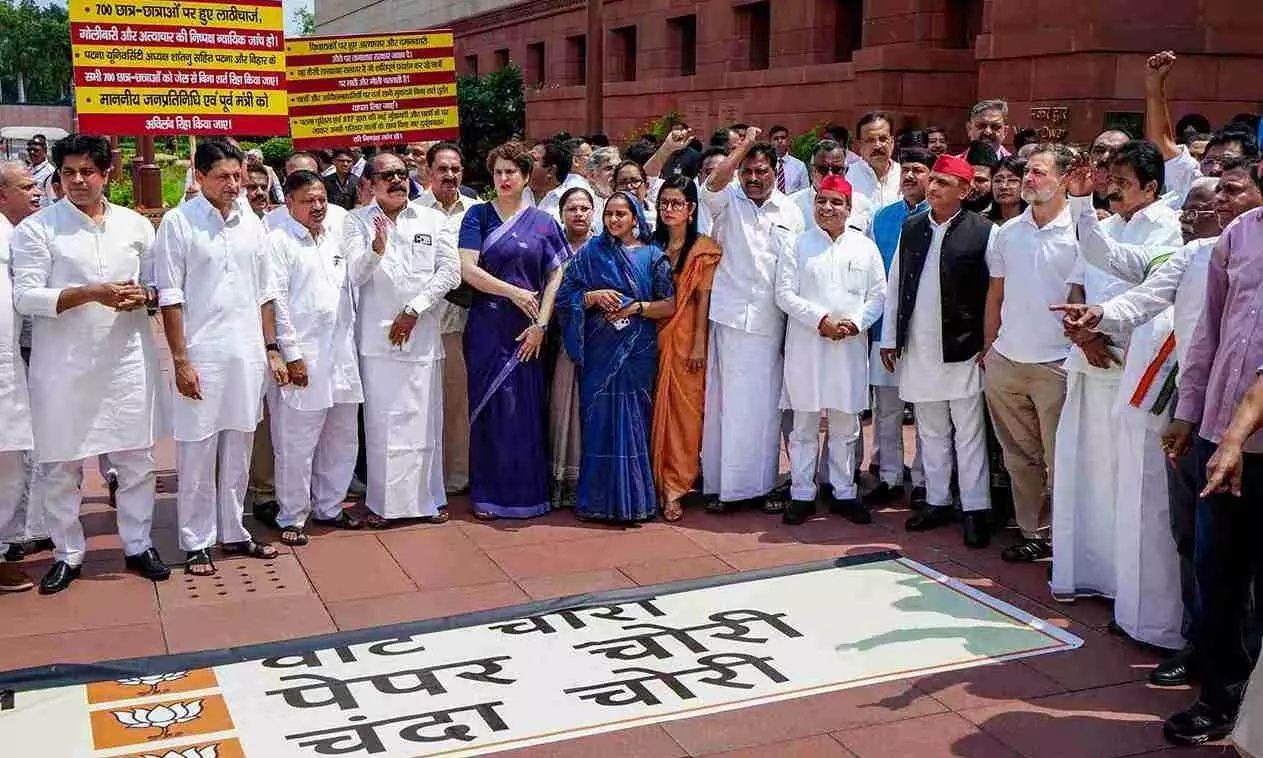
Events since the session began on July 20, however, appear to have disrupted those plans. Government sources told The Federal on Friday (July 31) that with the Opposition continuing its protests over the alleged police brutalities against student protesters and the alleged “chanda chori” (donation theft) at Ayodhya’s Ram Mandir, the Centre would “prioritise clearing the legislative agenda that is already listed”.
Opposition derails govt strategy
Protests by the Cockroach Janata Party and other student and youth organisations over repeated examination paper leaks, which led to Dharmendra Pradhan’s resignation as Union Education Minister on July 25, also forced the government to introduce the Public Examinations (Prevention of Unfair Means) Amendment Bill. Though Parliament passed the Bill, the government came under sustained attack from a united Opposition.
If Modi expected Pradhan’s resignation and the tougher public examinations law to restore normalcy, the calculation failed.
Over the past few days, Lok Sabha Leader of Opposition Rahul Gandhi has rallied Opposition parties behind demands for Union Home Minister Amit Shah’s resignation and an apology from Modi over the student crackdown. Simultaneously, Samajwadi Party chief Akhilesh Yadav has led the Opposition’s offensive on the Ram Mandir donation issue. A preview of this Congress-SP coordination was visible in the Parliament complex on July 31, when Samajwadi MPs and Congress-aligned Independent MP Pappu Yadav staged a skit mocking the BJP over the donation controversy while Congress and its allies protested in close proximity demanding Shah’s resignation.
Also read | How Pradhan’s resignation reshaped politics for Modi, Opposition and India’s youth
Congress Rajya Sabha MP Syed Nasser Hussain and Samajwadi Party MP Ruchi Veera told The Federal that the INDIA bloc would continue pressing both issues when Parliament reconvenes on August 3.
With 10 sittings completed, Parliament has passed only two of the seven Bills originally listed: the Prevention of Insults to National Honour (Amendment) Bill, 2026, and the Registration of Births and Deaths (Amendment) Bill. The latter cleared the Lok Sabha within minutes amid noisy protests, with not a single MP, including Minister of State for Home Affairs Nityanand Rai, who introduced the Bill, able to speak. The National Honour Bill saw a fuller debate in the Rajya Sabha but only a brief discussion in the Lok Sabha, where DMK MP K Kanimozhi sharply criticised the government’s “divisive agenda”.
Numbers no longer assured
Kanimozhi’s intervention, along with Supriya Sule’s unusually combative attack on the government during the debate on the Public Examinations Bill, also appeared to dent the Centre’s confidence about winning over the DMK and the NCP-SP to secure the two-thirds majority needed for the Constitution (131st Amendment) Bill.
With public anger over the student crackdown still simmering and the Opposition escalating its attack on Modi and Shah, government sources now concede they see “no possibility” of the parliamentary stalemate ending during the remainder of the session.
These developments over the past fortnight have forced the Centre to recalibrate its legislative strategy. The signs were visible within the first two days of the Monsoon Session, when the joint committees of Parliament examining the Constitution (129th Amendment) Bill, the Constitution (130th Amendment) Bill and the Viksit Bharat Shiksha Adhishthan Bill deferred adopting their reports despite their chairpersons having indicated only days earlier that deliberations had concluded.
The Constitution (129th Amendment) Bill, which envisages simultaneous Lok Sabha and Assembly elections, was widely seen as the logical extension of the Centre’s delimitation and women’s reservation rollout plan. The JPC, headed by BJP MP and former Union Law Minister PP Chaudhary, has now been given time until the first day of the final week of Parliament’s Winter Session in December to finalise its report.
A similar extension was granted to the JPC examining the Constitution (130th Amendment) Bill, headed by BJP MP Aparajita Sarangi. The committee had reportedly finalised its draft report but deferred its adoption at the last minute. The Joint Parliamentary Committee examining the Viksit Bharat Shiksha Adhishthan Bill has met the same fate.
Focus shifts to listed Bills
Government sources who had earlier maintained that the Cabinet would swiftly clear revised versions of these Bills after the committees submitted their reports now concede that the political situation is “no longer conducive” to pushing these contentious measures through Parliament during the current session.
Instead, the government and its floor managers are now keen to secure passage of Bills already listed but stalled by continuing disruptions, even if that means passing them amid the din without discussion.
The Centre could begin by moving relatively non-contentious legislation, including the Supreme Court (Number of Judges) Amendment Bill, 2026, the Micro, Small and Medium Enterprises Development (Amendment) Bill, 2026 and the Income Tax (Amendment) Bill, 2026.
Also read | 'Congress faces real test once Parliament session ends'
Another view within the government favours taking the Opposition head-on by moving the contentious FCRA Bill for consideration and passage in the Lok Sabha. The Bill, piloted by the home ministry, has already been criticised by the Opposition as another attempt to target civil society organisations and minority institutions that receive foreign funding.
The Centre recognises that the FCRA Bill would provoke further confrontation, but a section of the BJP believes pressing ahead would demonstrate that the Modi government remains politically resolute. With Amit Shah at the centre of the Opposition’s attacks, it remains to be seen whether he will introduce the Bill himself or continue to stay away from the House, as he has since the start of the Monsoon Session, leaving Nityanand Rai to face the Opposition’s protests instead.