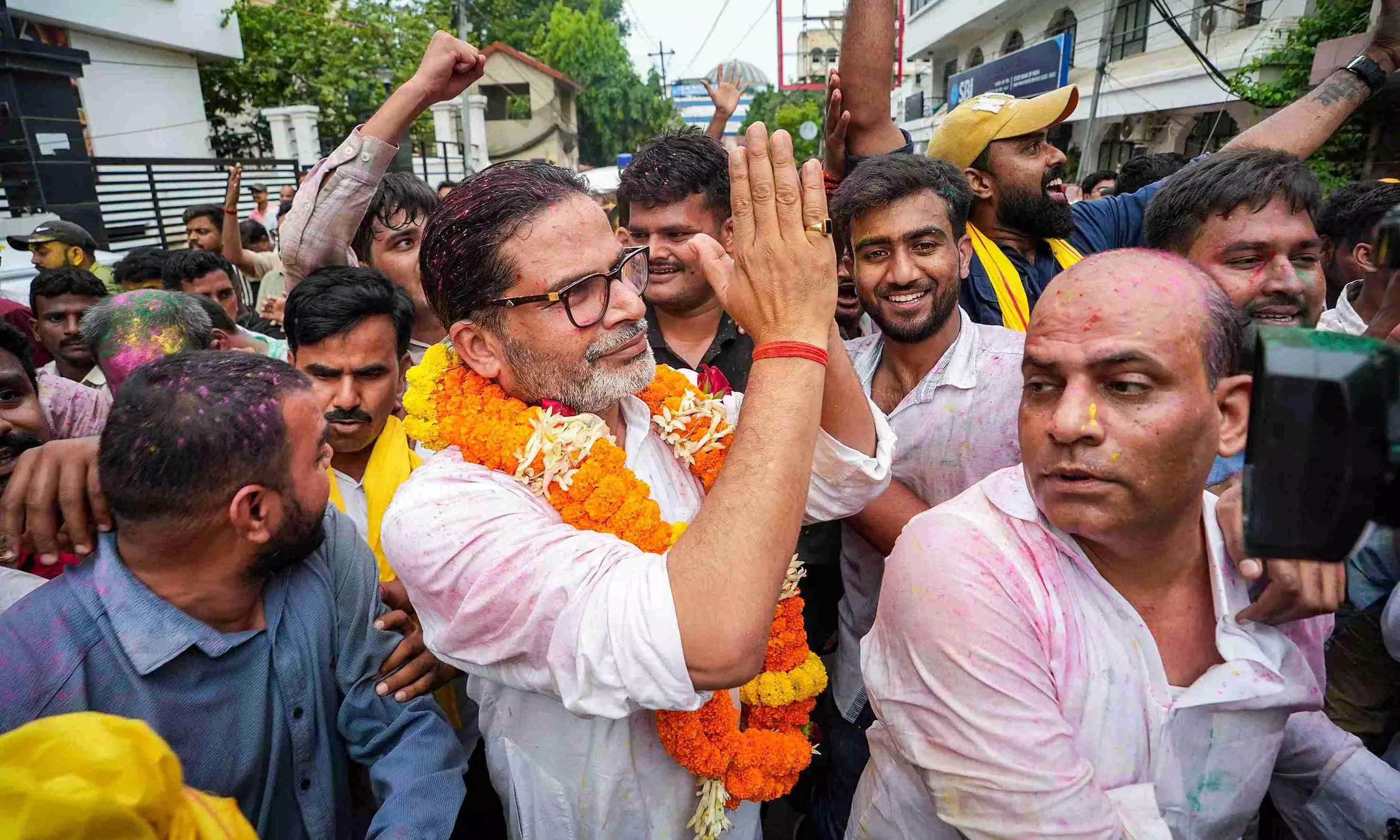
Prashant Kishor's entry into the Bihar Assembly could reshape opposition politics by giving the Jan Suraaj Party a legislative platform in addition to its political campaigns. Photo: PTI
Why did BJP lose Bankipur and Datia bypolls? What analysts say
Political observers say the losses in Bihar and Madhya Pradesh expose vulnerabilities in constituencies once considered politically secure

The results of three Assembly by-elections delivered three different political messages on Monday (August 3), but the biggest headline came from Bihar, where the Jan Suraaj Party registered its first-ever electoral victory by wresting the Bankipur seat from the BJP, ending the saffron party's three-decade dominance in the constituency.
While the Congress retained Datia in Madhya Pradesh and the BJP held on to Gujarat's Manjalpur seat, political observers say the losses in Bankipur and Datia offer important lessons for the BJP ahead of upcoming electoral battles.
Also read: Bankipur bypoll showdown: Why Nitin Nabin's home turf is turning into BJP's biggest test
Bankipur: A fortress falls
Bankipur had long been regarded as one of the BJP's safest urban constituencies in Bihar. Former BJP leader Nitin Nabin represented the seat for five consecutive terms, often securing between 59 and 72 per cent of the vote. The seat fell vacant after he was elevated as the BJP's state president.
Speaking on The Federal's Capital Beat, senior journalist Faizan Ahmed said the BJP's decision to field Neeraj Kumar Sinha instead of a more recognisable face proved costly. "He may have been a dedicated party worker, but he lacked the public profile needed for such a contest. His opponent was Prashant Kishor, who may have been contesting his first election, but was already a nationally recognised political strategist," Ahmed said.
He also said that Bankipur is Bihar's only fully urban Assembly constituency, where voters were looking for a candidate they believed could effectively represent urban aspirations. "The electorate preferred an educated and well-known face. That worked in Kishor's favour," he added.
Also read: Bankipur bypoll: Can PK’s grassroots outreach dent BJP’s urban upper-caste stronghold?
Ahmed described the defeat as a significant setback for both BJP state president Nitin Nabin and Bihar Chief Minister Samrat Choudhary, calling the bypoll their first major electoral test after recent organisational changes within the party.
What went wrong in Datia
The BJP also suffered a defeat in Datia in Madhya Pradesh, where Congress candidate Ghanshyam Singh emerged victorious.
The Federal's political editor Puneet Nicholas Yadav said the contest was shaped by local political equations rather than a statewide trend. Ghanshyam Singh's links to the Datia royal family and his previous stint as MLA gave him a strong local connect, Yadav noted.
He also pointed to the BJP's decision to deny a ticket to senior leader Narottam Mishra as a major factor during the campaign. While stopping short of saying Mishra would certainly have won, Yadav said the veteran BJP leader possessed an extensive organisational network and considerable influence in the constituency.
At the same time, he observed that factionalism was not limited to the BJP. Congress too faced internal discontent after denying a ticket to supporters of former MLA Rajendra Bharati, who was later suspended by the party. Despite those differences, Congress managed to build a comfortable lead.
Also read: Why BJP's lotus blooms in Puducherry, but struggles in Tamil Nadu
Yadav also said the result carried added significance because Chief Minister Mohan Yadav had campaigned extensively in Datia, making the defeat politically embarrassing for the BJP leadership.
Wake-up call for BJP
Senior journalist T K Rajalakshmi described the Bankipur verdict as the most significant outcome of the bypolls.
While Datia could have gone either way due to factionalism in both parties, she said Bankipur represented a much deeper political message because it had long been considered an impregnable BJP bastion.
Rajalakshmi also referred to what she described as an "undercurrent of public anger" that may have influenced voting behaviour. She further speculated that the relatively restrained campaign by RJD leader Tejashwi Yadav may have reflected a tactical understanding to avoid directly confronting Jan Suraaj in Bankipur, though she said there was no evidence to conclusively establish such an arrangement.