With Putin visit, India walks tightrope between Russia-US as China watches
Besides maintaining ties with both Moscow and Washington and avoiding deals that could 'upset' Trump, India now needs to frame the right policy around China

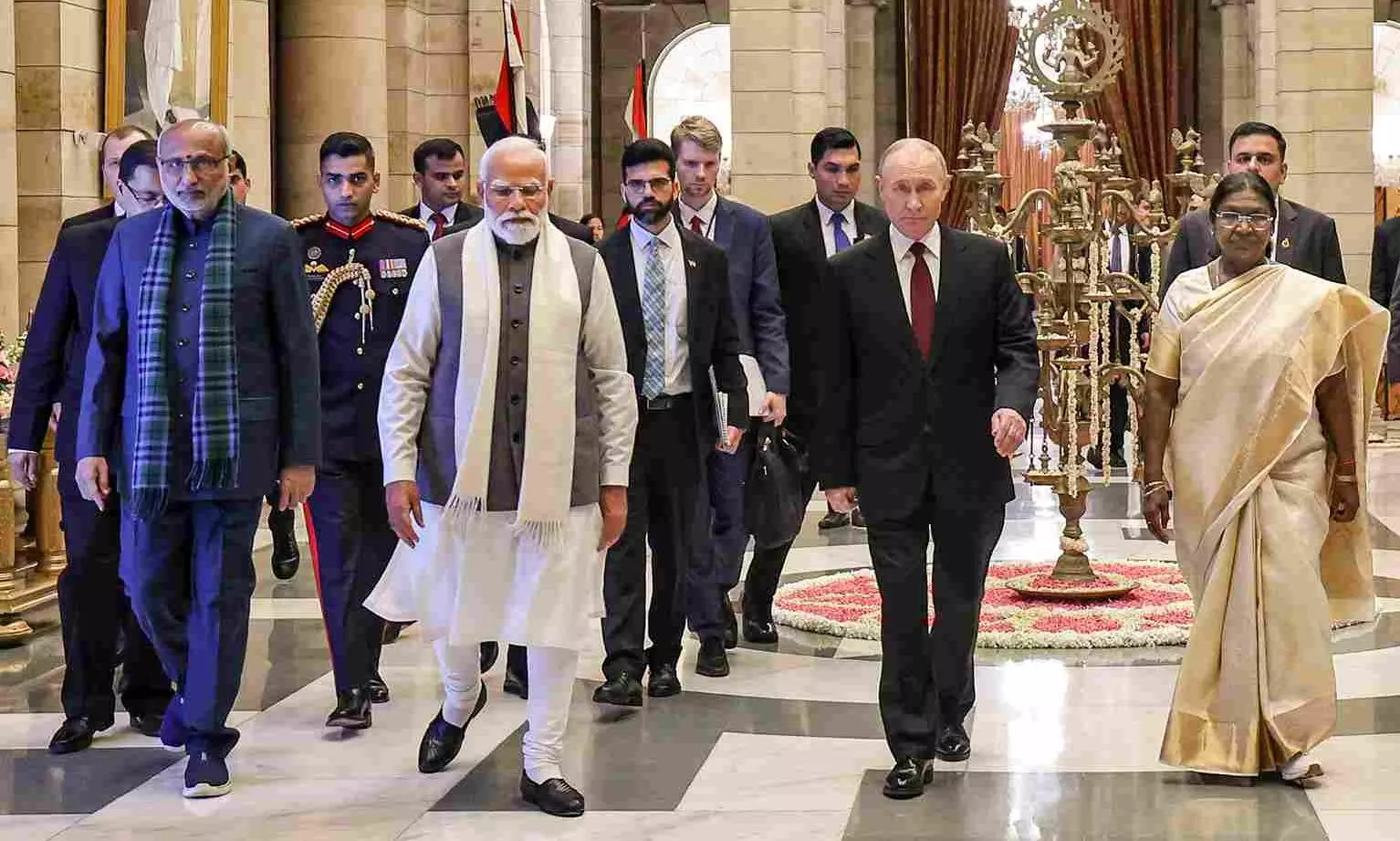
Amid the growing anti-West narrative in India in the wake of Prime Minister Narendra Modi and Russian President Vladimir Putin’s summit, New Delhi has refrained from announcing any agreement that could further aggravate the strained relationship with the US.
This signals that India is unwilling to disturb the diplomatic balance with its two important strategic partners and seeks to benefit from cooperation with both.
American President Donald Trump’s imposition of 50 per cent tariff on India, including a 25 per cent 'penalty' for buying large amounts of Russian oil — which he has deliberately misconstrued as fuelling Putin’s war in Ukraine — has spurred disappointment and anger in India.
Putin's India visit came amid a Trump-led peace initiative to end the three-year-old Ukraine war. It also came when there was an “unprecedented” closeness in Russia-China relations.
No deals
The close cooperation between India and Russia in space, cyber security and defence, including joint ventures to manufacture weapons in India, was mentioned in the joint statement issued at the end of the summit, but no agreements were announced.
“These deals were discussed between the defence ministers. Since they are still in progress, both sides decided not to mention them as they were not final,” said Anil Wadhwa, former Indian diplomat and secretary in the Ministry of External Affairs.
Also read: What the India-Russia summit reveals about shifting global power
Sources told The Federal they were not announced to avoid attracting punitive measures under existing US laws.
Instead, emphasis was placed on strengthening economic partnership beyond energy to raise bilateral trade from $10 billion to $100 billion.
Treading a fine balance
India considers its relations with Russia to be the most stable and reliable, with Modi describing Moscow as a pole star. But India also regards the US to be the most “consequential” relationship.
Putin’s visit to Delhi has provided Modi with an opportunity to reaffirm Indo-Russian relations on the one hand, with room to improve ties with the US on the other.
Also read: Russian President Putin in Delhi: The high-stakes messages behind the optics
Additionally, it has allowed India to reassess its relations with China, which the Indian establishment widely regards as its biggest security threat, and to consider how best to address it.
Russia-China-Pak ties
Some Indian commentators fear that the deepening Sino-Russian ties could pave the way for closer Russian relations with Pakistan. A recent report that Russia is supplying advanced fighter jet engines to Pakistan through China has caused major heartburn in sections of the Indian establishment.
“In both cases, New Delhi should avoid imputing more importance to the relationships than they may warrant,” said Srinath Raghavan, a senior visiting research fellow at Lee Kuan Yew Institute of the National University of Singapore.
If India strengthened its ties with Moscow, keeping China in view, it could shape the Russia-Pak relationship as in the past
He acknowledged that Russia’s dependence on China is unprecedented, but added that it also demonstrates Moscow’s resilience in the face of sanctions, political isolation and a long war. "After the war, Moscow is bound to look for other openings to reduce its dependence on Beijing, and India should be prepared," Raghavan said.
He downplayed the Pakistan factor, saying that for Pakistan, Russia ranks well behind China and the US as its major partners. He added that if India strengthened its ties with Moscow, keeping China in view, it could shape the Russia-Pakistan relationship as in the past.
India's oil imports
India has scaled down its oil imports from Russia. It imported $3.55 billion of oil from Russia in October 2025, against $5.8 billion in October 2024. According to data from the Commerce Ministry, India’s Russian oil imports have also declined in volume — 71.6 lakh tonnes this October, against 103.8 lakh tonnes last October. Thus, there has been a 31 per cent fall in volume terms and 38 per cent fall in value terms.
The annual trade volume had earlier grown from $10 billion to $68.7 billion due to the purchase of large amounts of oil from Russia since the Ukraine war.
Also read: 'Putin–Modi summit won't go down well with Trump and US'
The reduction in Russian oil imports is aimed at appeasing the US and addressing the existing $86‑billion gap in bilateral trade by expanding America's share of the Indian energy market.
India is keen to strike a balance between the two relationships and pave the way for completing the Free Trade Agreements (FTAs), not only with the US, but also with the EU in the coming days.
An early normalisation of US and India relations depends to a large extent on Russia accepting Trump’s peace plan on Ukraine, according to American expert John Mearsheimer.
Russia, at this juncture, will be unable to help India in any way to deal with China, as it is in a 'full‑body embrace' with Beijing because of the Ukraine war
He said in a recent interview with CNN TV18 that India is in a difficult situation and has to walk a fine line. India is keen to deepen economic and defence ties with Russia, but it must avoid aggravating the situation and worsening its relations with the US.
Factoring in China
Mearsheimer pointed out that the main threat to India comes not from the US but from China. He argued that Russia, at this juncture, will be unable to help India in any way to deal with China, as it is in a 'full‑body embrace' with Beijing because of the Ukraine war.
In recent months, India and China have tried to iron out differences and bring down the tension at the Line of Actual Control (LAC) that led to a four-year military stand-off. Both nations want to resume economic cooperation and remain hopeful that other outstanding issues can be resolved in due time, once trust and confidence are restored.
Watch | Putin’s India visit: What are the key takeaways? | Capital Beat
Modi took the first step by visiting China for the Shanghai Cooperation Organisation (SCO) summit, where he met Chinese President Xi Jinping on the sidelines. The two leaders agreed to advance their cooperation for mutual benefit.
Beijing in the picture
Putin’s visit has left India with the challenge of managing its ties with China, while also offering an opportunity to improve relations with Beijing.
He wants the three countries to revive and pursue their engagement in the Russia-India-China (RIC) forum. The Russian President believes that RIC could strengthen ties and help address global challenges that affect all the three nations. He is also hopeful that it could contribute to stabilise India-China relations.
The outcome of Putin’s visit is therefore not only about striking a fine balance between Moscow and Washington. It has also left India with the challenge of formulating the right policy to deal with Beijing.