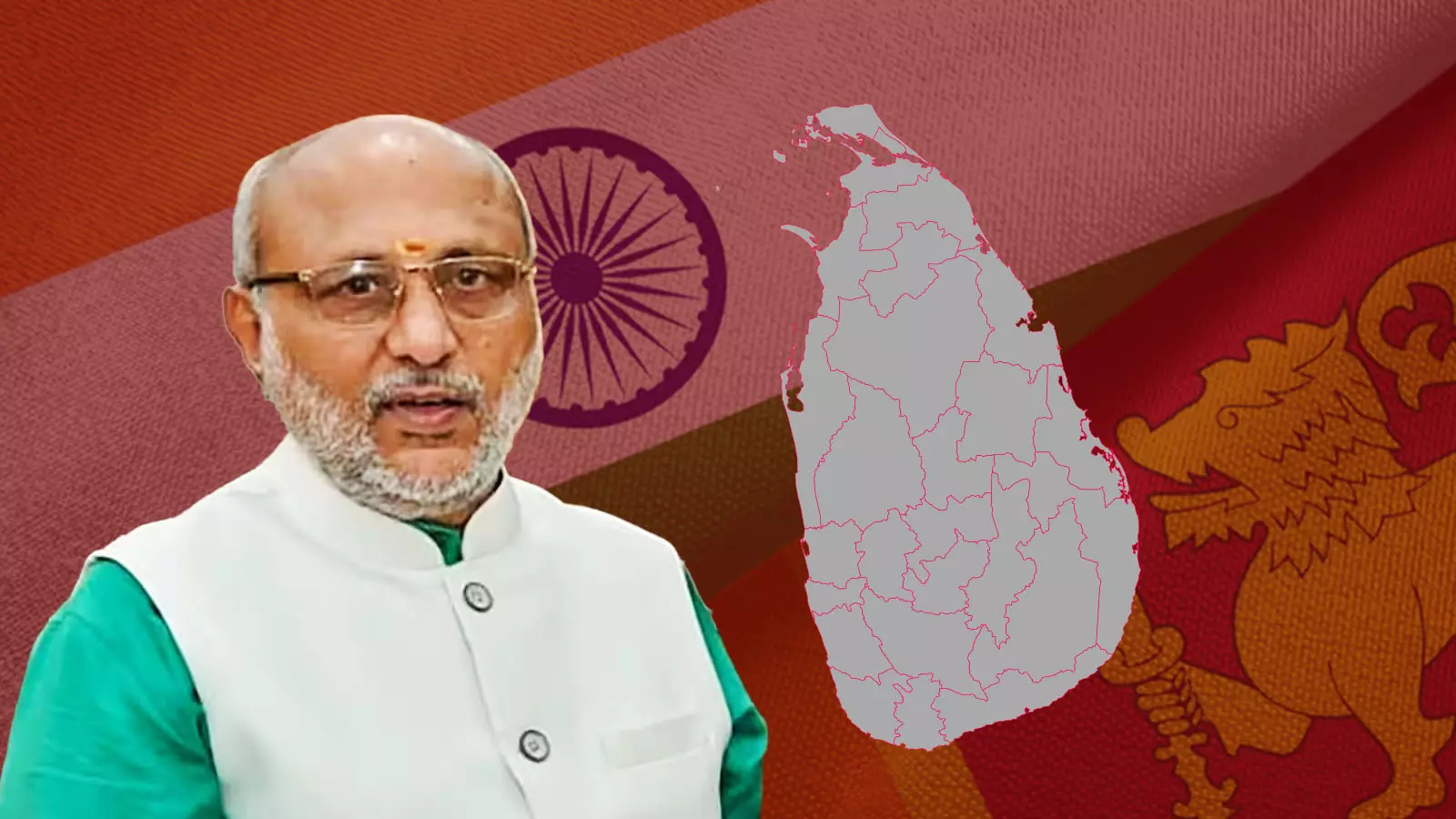
Vice President CP Radhakrishnan will have a testing trip to Sri Lanka on April 19 and 20 ahead of the Tamil Nadu elections.
VP Radhakrishnan set to face Tamil pressure for provincial polls in Sri Lanka
During his 2-day visit starting April 19, the Indian leader will meet a unified push from Sri Lankan Tamil parties to hold Colombo accountable to the 1987 accord

When Indian Vice President CP Radhakrishnan reaches Sri Lanka on Sunday (April 19), Tamil leaders there will press him to make New Delhi exert diplomatic pressure on Colombo to hold long-delayed provincial council elections as part of a legal commitment flowing from a 1987 bilateral accord between the two countries.
Some of the leaders invited by the Indian High Commission in the Sri Lankan capital to interact with Radhakrishnan on Sunday will complain that the island-nation was trying to wriggle out of its obligation to hold the elections, which seek to provide limited autonomy to Tamil and other provinces in the country.
Also read: How Indian-origin Tamils in Lanka are quitting tea estates to carve a new identity
At the same time, leaders of the Indian Tamil community, whose ancestors arrived in Sri Lanka as indentured labourers to work in the tea plantations, have a separate wish list for the vice-president, who took over in September last year.
VP to discuss India-aided projects
During his two-day visit, Radhakrishnan, whose political career began in Tamil Nadu and who is thus aware of key Sri Lankan issues, will meet top leaders and discuss India-aided development projects—those already completed and those still underway across the maritime neighbour.
Invited by the Sri Lankan government, Radhakrishnan will hold discussions with President Anura Dissanayake and also meet Prime Minister Harini Amarasuriya and the main opposition leader, Sajith Premadasa.
Sri Lankan Foreign Minister Vijitha Herath had announced earlier that the Indian leader would make a broad assessment of India-backed projects in fields such as health, infrastructure, energy, and community development.
India and Sri Lanka are expected to sign several agreements during the visit to deepen and expand bilateral relations.
Contrary to published media reports, Radhakrishnan will not be going to the Tamil-majority northern and multi-racial eastern provinces. He will stay put in Colombo, which is also home to thousands of Tamils.
And that’s where Tamil political leaders will call on the vice-president.
“Governments will come and go, but both countries need to honour the agreement they signed in 1987, a large portion of which dealt with the Tamil community,” M A Sumanthiran, a senior leader of the Ilankai Tamil Arasu Katchi (ITAK), Sri Lanka's main Tamil political party, told The Federal.
Also read: Why life today is a struggle of a different kind for former Sri Lankan LTTE fighters
“The agreement has still not been fully implemented, although four decades have passed,” he said despairingly in a telephonic interview.
“Flowing from that, we want some structural changes. The provincial councils are not functional. Elections are being postponed. As a first step, the elections must be held,” added Sumanthiran, also one of Sri Lanka’s best-known lawyers.
Sri Lanka leaders bank on Radhakrishnan
He and other Tamil leaders felt that Radhakrishnan should be in a position to better understand their aspirations as the Indian leader has spoken on issues relevant to them, in particular about the need to grant Indian citizenship to thousands of Sri Lankan Tamils who have lived for decades in Tamil Nadu.
As opposed to Sri Lankan Tamils, who mainly populate the north and east, leaders of the 1.5 million-strong Indian Tamils will urge the vice-president to accede to their request to provide Overseas Citizen of India (OCI) status to all those eligible in the community, as done for the Indian diaspora in Mauritius.
Barath Arullsamy, vice-president of the Tamil Progressive Alliance (TPA), one of the main parties representing the community, said the Indian government will also be asked to expand benefits specifically for the community, vast sections of which are among the poorest in Sri Lanka.
“A lot of assistance comes from India to Sri Lanka but the specific needs of the community need to be addressed,” said Arullsamy, a trusted colleague of party chief Mano Ganesan.
“Some of the possible benefits include teacher training, vocational training, entrepreneur training, besides providing special skills as well as internships to the educated young,” he added.
Also read: Sri Lanka: JVP govt’s reluctance to hold provincial polls deepens Tamil anxiety
India provides high school scholarship of Rs 1,500 a month and Rs 2,500 a month for undergraduate studies to a total of 7,500 students from the tea-plantation community or whose parents work in the tea estates under a 1947 trust, which got a new lease of life about a decade back.
“We are still brainstorming some of the issues (we hope to raise),” Arullsamy clarified.
The Tamil leaders expected to meet Radhakrishnan are likely to include Sumanthiran and others from the ITAK, Ganesan and colleagues from the TPA, leaders of the Ceylon Workers Congress, Gajendra Ponnambalam, Douglas Devananda, Suresh Premachandran, Selvam Adaikalanathan, and Dharmalingam Sitharthan.
VP's visit because of Tamil Nadu elections?
A section of Tamil leaders feels the trip by Radhakrishnan may have been approved by India with an eye on the April 23 Assembly elections in Tamil Nadu, where sympathy for Sri Lankan Tamils runs high.
Nevertheless, Tamil politicians in Sri Lanka feel the Tamil-speaking Radhakrishnan, as a representative of the Indian president, could be the best person to convey to the Indian leaders the Tamil concerns in a country where ethnic strains remain despite the end of a bloody Tamil separatist war.
“India has a duty towards the (Sri Lankan) Tamil community,” said five-time MP Sitharthan of the Democratic Tamil National Alliance (DTNA), echoing the sentiments of Sumanthiran.
'New govt not concerned about Tamil issues'
Referring to the government of Marxist president Dissanayake, Sitharthan said, “The new government doesn’t seem to be concerned about Tamil issues in a meaningful way. They are like the governments earlier when it comes to the Tamil question.”
He underlined that Dissanayake’s Janatha Vimukti Peramuna (JVP or People’s Liberation Front) was the most trenchant critic of the 1987 accord, which sought to provide a measure of Tamil autonomy and did more than anyone else in the island nation to almost stifle it.
Also read: Prabhakaran killed 14 people to marry his love? Even his critics are stunned
The Tamil leaders do not want Radhakrishnan to have the impression that the JVP’s surprise gains in the 2024 parliamentary battle in the Tamil-majority north mean the traditional Tamil political parties are no longer a major factor in Sri Lanka.
“Yes, the JVP made significant gains, and there are many reasons for this, including our disunity,” Sitharthan said.
“Tamil people are realising that the JVP will never give any meaningful concessions to the Tamil community. It is the most extremist when it comes to the Tamil question.”
Sumanthiran, for long a friend of incumbent President Dissanayake, is clear that there is no change in the demand for self-rule in Tamil areas and that this issue continues to resonate with the Tamil population.
“The issue of autonomy cannot be compromised.”