What is behind West Bengal’s violent turn amid electoral churn?
Communal clashes after BJP’s win mark a shift from Bengal’s tradition of political violence, arousing fears of 1946-like tensions

West Bengal has often faced political or electoral violence in the past. Cadres of rival political parties have crossed swords against each other ever since the elections in 1977 that brought a Left Front government led by the late Jyoti Basu to power after Emergency. But never before has it given way to the kind of a violent communal showdown as is the case now after the May 4 Assembly poll results.
Asked about it, a senior analyst from West Bengal, Gautam Lahiri, told The Federal, “It’s rife with potential to spread out to rural parts even as the media is focusing only on violent blips in cities. It’s all the more serious since violence is in the genes of Bengal. It is not like 1977 or 2011 when change through elections took place but reminds of 1946 which culminated into the partition of Bengal.
“The use of bulldozers against Muslims’ shops and homes clearly points to the communal nature of the violence this time unlike any time before in the history of Bengal under independent India.”
Political, electoral and ideological clashes
According to him, the current clashes are clearly political, electoral and ideological and these go beyond settling issues in the normal course even as elections can provide an opportunity for this.
Criminal elements have been allowed to take advantage of the poll-time flux. In Bengal, governments change after a long time and, thus, there may be a fatigue that can give way to violence. But in the past, this led to sporadic eruptions and vandalism rather than large-scale mob attacks and targeted killings as is the case now.
Also read: After Bengal, is Kolkata Municipal Corporation set to turn saffron?
Independent Rajya Sabha member and Supreme Court lawyer Kapil Sibal on May 6 held a Press conference in New Delhi where he also gave a long list of places that have been subjected to post-poll violence in West Bengal. This, among other losses, resulted in the deaths of a few political workers.
Chandranath Rath’s killing
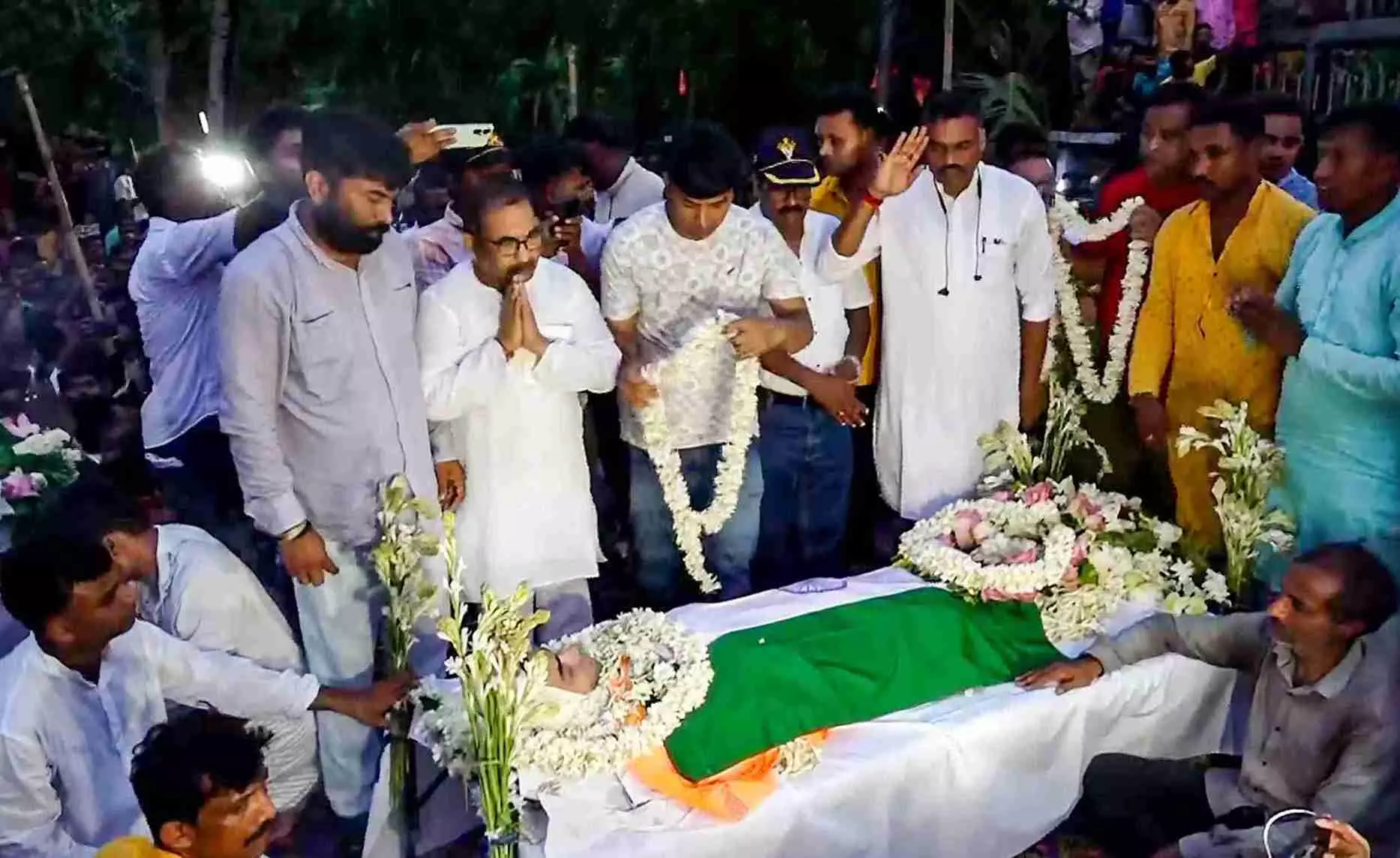
Among those killed is an office point man of BJP leader Suvendu Adhikari. Former Indian Air Force officer Chandranath Rath (41) was on his way home from Adhikari’s office after the day’s work on the night of May 6 when his car, with a West Bengal Assembly sticker on its wind-screens, was intercepted by motorcycle-borne men who shot him dead and left his driver critically injured.
The attack on the car to slay the aide of the person who is likely to become the first BJP chief minister of Bengal took place on a day when the state police had warned the people against venturing out except in the case of an unavoidable urgency.
The vehicle was unescorted and its occupants had no security cover, making them a soft target in rather fraught times, with hundreds of thousands of Central Armed Police Forces (CAPFs) deployed and a former cop and intelligence hand holding the office of Governor in the state.
SIR in a state with deep roots of Partition
The reference to 1946 quoted here before and claims about “violence in genes” are indicative of the fact that Bengal has deeper roots of Partition than any other place in the country. It was the only state that, under British India, underwent partition way back in 1905 into predominantly Muslim East Bengal (and Assam) and overwhelmingly Hindu West Bengal. This was reversed in 1911 (Assam was separated) but done again in 1947 when East Bengal became East Pakistan and West Bengal became a part of India.
Also read: BNP blames Mamata for Teesta Treaty delay, hopes for progress under BJP govt
In 1971, East Pakistan became Bangladesh. The process of its birth also brought hundreds of thousands of refugees to the Indian side of the border from the embattled region. Though most of the refugees went back after Bangladesh was liberated, fears about a demographic change in West Bengal and Assam lurks due to intermittent migrations subsequently.
This was also an issue in the last month’s Assembly polls in the two states. The Special Intensive Revision (SIR) in West Bengal created some bad blood among rival parties contesting the polls. The BJP’s electoral victory on May 4 came amid allegations from the Trinamool Congress (TMC) of widespread deletion of voters’ name from the electoral rolls because of SIR. The BJP called its victory a result of 15-year-long misrule of TMC Chief Minister Mamata Banerjee.
Escalating violence
It is amid these claims and counter-claims that violence erupted where TMC workers were often initially mobbed and hurt. Mamata also claimed of her own harassment and intimidation, as well as her party’s other candidates and agents at the vote counting centres. Though the BJP soon dismissed these claims, the violence has ever since been escalating.
What is important to note is the fact that till the time of voting that ended on April 29, there was no such large-scale violence. It only began from the day of counting, though a Congress worker, Debdeep Chatterjee, was earlier beaten to death in Asansol. This happened following arguments as his car brushed another vehicle early on April 25. Apart from this, there was no major incident through the run-up to the polls held in two phases on April 23 and 29.
Also read: Bengal polls: Mamata’s refusal to resign sparks a constitutional crisis
Thus, the point is, if the Election Commission (EC)-controlled West Bengal administration could keep the state safe until the votes were cast, why couldn’t this be possible under the same administration after the poll results were out? The EC issued a warning to the people against taking to violence and use of force only on May 6 morning when mobs were already milling on the streets of Kolkata with sticks and also in other parts of the state.
The infiltrator narrative
Obviously, the EC’s warnings and administration’s efforts to bring calm did not work. There was already deep resentment among TMC workers over what they called EC’s partisan and biased ways during SIR, through voting and also during counting of votes. The BJP reacted to this strongly, and in some cases, peace became the casualty.
The entire poll campaign was marked by BJP’s allegations about ghuspethiyas or infiltrators trooping into West Bengal from across the borders. Bangladesh took umbrage to this. During the polls, the Foreign Ministry in Dhaka protested to the Indian High Commissioner, though after the polls, Bangladesh’s Foreign office spokesman congratulated BJP’s Suvendu Adhikari for his party’s victory over Mamata’s TMC.
Also read: What happens if Mamata does not resign? West Bengal drama hots up
The spokesman wished that under the new BJP state government in Kolkata, the Teesta water-sharing treaty could well be possible between India and Bangladesh unlike in the times of Mamata who had some reservations about the treaty. Thus, Bangladesh has been quite alert to the developments in its neighbourhood and tried to move on to the right side of the new or upcoming West Bengal government; and also before the outbreak of violent clashes and uncertainty in Kolkata and around.
The border factor forgotten
Unlike this, back home, the recent elections have been fought with such frenzy that sensitivities involved about its taking place in a border state were almost forsaken. So much so that right amid elections in West Bengal, New Delhi indicated that a new High Commissioner, Dinesh Trivedi, would soon be posted to Dhaka.
Obviously, India’s relationship with the neighbouring country came to be under some risk through the polls; and, thus, appointment of a new envoy was rolled out to keep the option to redeem things open in future or post-election.