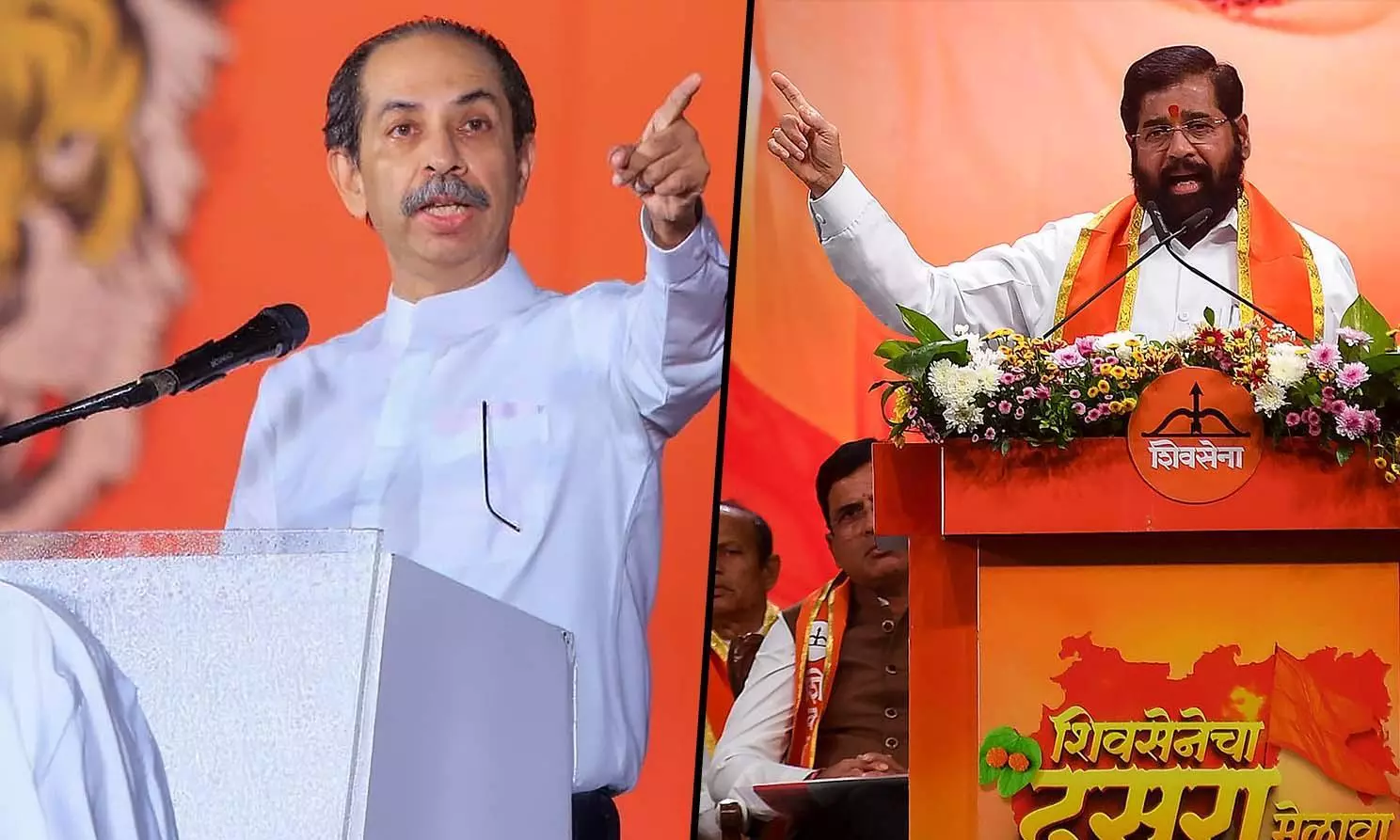
What Shiv Sena (UBT) MPs’ defection means for Shinde, BJP and Maharashtra politics
Operation Tiger boosts the NDA’s numbers and adds to Shinde’s political heft, but it could also reshape alliance equations and pose fresh challenges for the BJP in Maharashtra

At first glance, the implications of six Lok Sabha MPs from Uddhav Thackeray’s Shiv Sena (UBT) defecting to Eknath Shinde’s Shiv Sena seem uncomplicated. Nationally, the increased ranks of the Shiv Sena will aid Prime Minister Narendra Modi’s push to bulldoze through Parliament constitution amendments for which the ruling NDA coalition lacks numbers.
In Maharashtra, the defections add to Shinde’s electoral heft while projecting him and his ‘Shinde Sena’, as opposed to Thackeray’s Shiv Sena (UBT), as the real legatees of the original party founded by Bal Thackeray in 1966.
Politics, however, is seldom as straightforward. There are wheels within wheels in this Maharashtra muddle.
'Operation Tiger' alters equations
In the immediate aftermath of what Shinde and his party colleagues have brazenly owned up as ‘Operation Tiger’, the NDA’s legislative strength in Lok Sabha now stands at 319 MPs (including 20 MPs of Mamata Banerjee’s Trinamool Congress who have ‘merged’ with the obscure Nationalist Citizens Party of India).
Also read | At 60, Shiv Sena battles its biggest survival crisis; will the tiger roar again?
Amid speculations that the Modi government is planning to introduce in the upcoming monsoon session of Parliament a revised version of the Constitution 131st Amendment Bill, which was negated in Lok Sabha last April as the NDA lacked a two-thirds majority, this fresh infusion of turncoats takes the ruling coalition closer to the 360-MP mark it currently needs to push such legislation in the Lower House.
In Maharashtra, the instant consequence lies as much in buttressing Shinde’s position within the BJP-led Mahayuti as in dealing a seemingly fatal blow to Uddhav Thackeray’s party. If sources in the Shinde Sena are to be believed, the party is now egging Shiv Sena (UBT) MLAs and councillors to join its ranks.
The unabashed assertion by at least three of the six defecting MPs – Omprakash Nimbalkar, Sanjay Deshmukh and Nagesh Ashtikar – that they switched parties to secure funds and development in their constituencies baits Opposition MLAs from Sharad Pawar’s NCP (SP), the Congress and also the Shiv Sena (UBT) to consider charting a similar political course.
The justification that the likes of Nimbalkar offer for their “ghar wapsi” to Shinde’s “real Shiv Sena” is, arguably, the most perverse subversion of democracy. In one fell swoop, it seeks to legitimise defection by cloaking it with homilies of ‘good intent’, gives a free pass to elected governments to penalise voters for choosing representatives from the Opposition and weaponises promises of development for horse-trading.
Old rivalries, new alliances
In the short run, this fortifies the Mahayuti (and the NDA at the Centre) in the state. Yet, in time, Shinde’s gamble could come to haunt the BJP as much as his own party electorally and offer Maha Vikas Aaghadi (MVA) constituents, the Congress, the NCP (SP) and the Shiv Sena (UBT), the silver lining they desperately seek in this morass.
Altered with the breaking up of the original Shiv Sena and NCP, Maharashtra’s political landscape has, since 2022, been recast with a ruling coalition and an Opposition alliance, both of which contain factions of these erstwhile regional rivals. The leadership of the undivided NCP and Shiv Sena may have shared deeply personal friendships in the past, but their politics cultivated very different, and often mutually hostile, support bases.
This sharp divide is, arguably, most visible in Nimbalkar’s Lok Sabha constituency of Osmanabad. The constituency has, since the formation of the undivided NCP in 1999, always seen a contest between the Sena and Pawar’s party and prior to that between the Sena and the Congress.
The Osmanabad seat has been nursed as the political fief of former Maharashtra home minister Padamsinh Patil, the elder brother of Sunetra Pawar, wife of the late Ajit Pawar and the current chief of the NCP.
The Nimbalkars and Patils are related but have been sworn rivals ever since Padamsinh was accused in the 2006 murder of then Congress leader Pawanraje Nimbalkar, Omprakash Nimbalkar’s father.
When politics overrides enmity
Nimbalkar’s debut Lok Sabha win in 2019 was against Patil’s son, Ranajagjitsinh Patil, who was then with the undivided NCP and is now a BJP MLA. Five years later, when Nimbalkar retained the Osmanabad seat in 2024 as a candidate of the Shiv Sena (UBT), it was by defeating Ranajagjitsinh’s wife, Archana Patil, who was a nominee of Ajit Pawar’s NCP.
Also read | Sena muddle: Uddhav says ready to quit; Shinde says there is more to come
Over the past week, while Shiv Sena (UBT) MPs Sanjay Deshmukh, Sanjay Dina Patil, Nagesh Ashtikar, Sanjay Jadhav and Babasaheb Wakchaure were ready to defect to the Shiv Sena, it was Nimbalkar who held out. Nimbalkar wanted time till June 20, when a special CBI court was expected to pronounce its verdict in the Pawanraje murder case involving Padamsinh Patil and others. Senior Shiv Sena (UBT) MP Sanjay Raut alleged that Nimbalkar had been promised a “favourable verdict” in return for his defection.
On June 20, however, when the court acquitted the 86-year-old Padamsinh and all co-accused in the Pawanraje murder case for lack of evidence, many believed Nimbalkar would stick on with the Shiv Sena (UBT) as defection would place him in an alliance that includes those allegedly connected with the murder of his father. It was not until the following day that Nimbalkar publicly declared his decision to defect. The announcement, Sena sources say, came after an assurance from top echelons in the state and central government that the CBI would promptly appeal against the CBI court’s judgement.
Politics, as the adage goes, makes for strange bedfellows and Nimbalkar has found his. Come Lok Sabha polls of 2029, it will be interesting to see who between the Shiv Sena, BJP and the NCP get the Osmanabad constituency in the Mahayuti seat-sharing talks. Will Nimbalkar give up the seat he won in 2014 and 2019 by defeating candidates who are kin of the prime accused in the Pawanraje murder and are now divided between the BJP and Sunetra Pawar’s NCP?
Shinde gains political heft
The defections also create a piquant scenario, both at the level of individual constituencies and the state at large, within the already complex relations between the BJP and the Shinde Sena.
Take for instance the Mumbai northeast constituency whose Shiv Sena (UBT) MP Sanjay Dina Patil has now hopped on to the Shinde bandwagon. Once represented by the late Pramod Mahajan, this is a constituency the BJP has never given away to the Sena. “Just because the incumbent MP has defected to Shinde’s party does not mean we will give up this seat which we have been contesting from the days of the Jana Sangh,” a veteran Maharashtra BJP leader told The Federal, while ruling out even the possibility of Dina Patil contesting the next elections on the BJP symbol.
The statewide implications are much more complex as the defections give Shinde and his party added electoral muscle, which would also make it more difficult for the BJP to simply brush aside the Deputy CM’s recurring tantrums within the alliance.
It is no secret that Shinde continues to eye the chief minister’s chair, which he was pressured into ceding to Devendra Fadnavis after the latter steered a Mahayuti wave in the 2024 Assembly polls. Sources in the Mahayuti claim that Shinde is “unlikely” to make a play for the CM’s chair anytime soon since the 132-MLA strong BJP can run the government without his support.
Shinde’s rise worries BJP
However, BJP insiders agree that viewing ‘Operation Tiger’ purely as Shinde’s bid to decapitate Thackeray’s Shiv Sena (UBT) would be “unwise and naïve” for the BJP. “As of now, all this (defection) helps us because it is demolishing the Opposition but, in the long run, a stronger Sena will obviously create problems for us. It has taken the BJP years of hard work to become the senior ally and we have to now guard our ground. If Sena keeps increasing its numbers, Shinde will eventually also get more bargaining power in government and in seat-sharing,” said a senior BJP minister considered close to Fadnavis.
Also read | 'Numerical strength isn't all': Why Sena-UBT thinks it can comment on Ram Mandir funds row
Mahayuti leaders also claim Shinde’s manoeuvres are also a bid to project him as the state’s pre-eminent Maratha strongman; taking over a mantle occupied since long by the aging and ailing Sharad Pawar.
For the foreseeable future, the Maharashtra BJP is expected to have Fadnavis, a Brahmin leader, as its dominant face and this choice, sources say, was driven, at least in part, by the RSS-BJP combine’s concerted efforts to break Maratha hegemony over the state’s political landscape. If Shinde does succeed in pitting himself as the face of a community that represents over 30 per cent of Maharashtra’s population, the Sangh Parivar’s efforts would take a hit.
It is, arguably, for these reasons that the political grapevine is already abuzz with theories about the defection saga being “blessed” by the BJP, suggesting that if the saffron party can aid Shinde in breaking Thackeray’s Shiv Sena (UBT), it could also, if circumstances demand, do the same to the Shinde Sena.