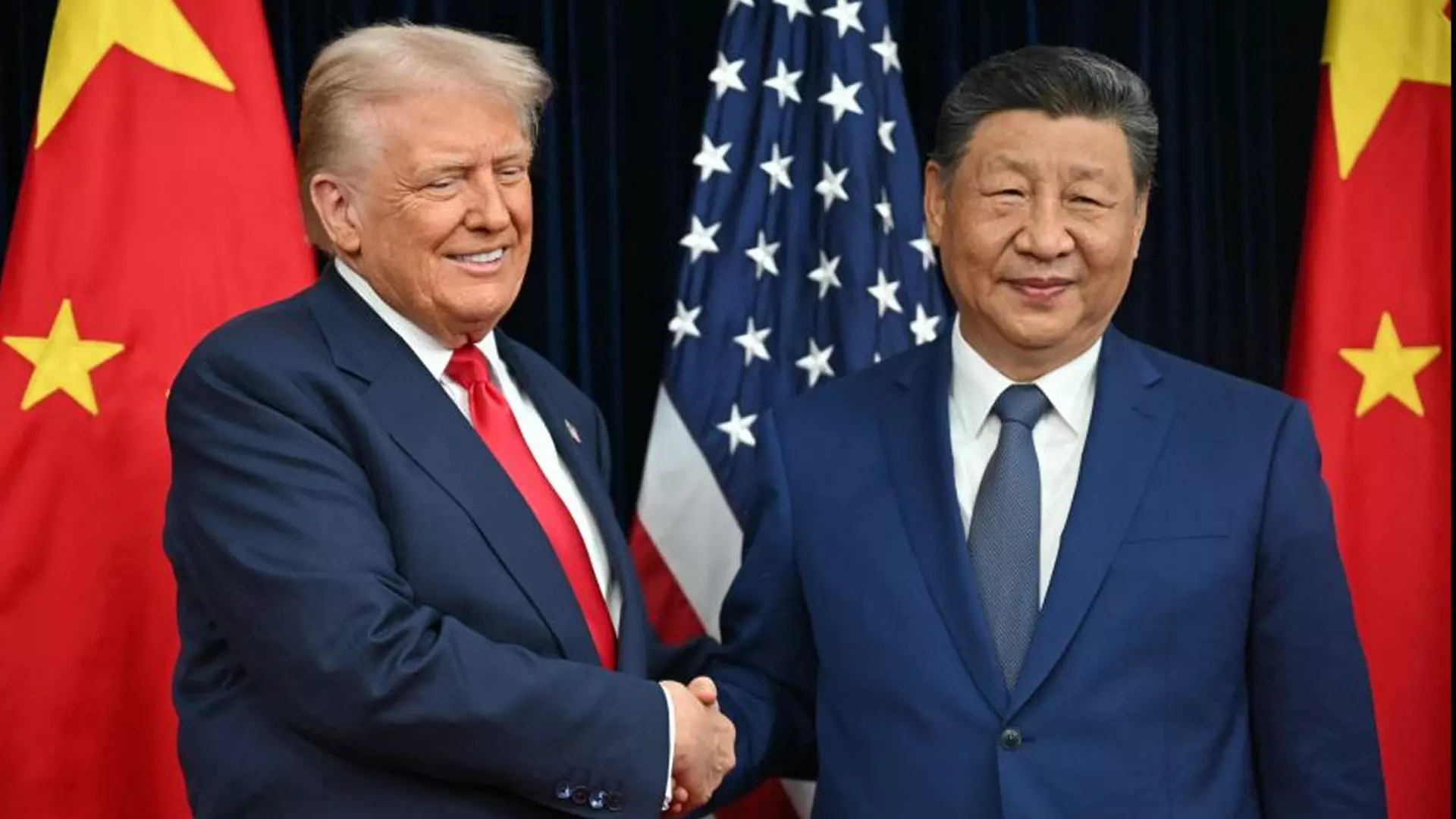
Xi-Trump summit: Why thawing of US-China ties puts India on high alert
As US and China seek to steady trade ties, the 3-day summit will also shape Taiwan's geopolitics, the AI sphere, critical minerals, and the Indo-Pacific

As China’s President Xi Jinping and his wife Peng Liyuan land at Andrews Air Force Base near Washington on Wednesday (September 23) for a three-day summit with Donald Trump, the eyes of the world will be on every move the two leaders make. The relationship between the world’s two biggest powers extends far beyond their bilateral ties, with its impact felt across the global economy, trade, and international security. Every country has a stake in whether Washington and Beijing can maintain a balanced relationship.
For now, there is a fragile pause in the tariff war that has rattled markets and disrupted global trade. As Xi and Trump sit down, the hope across capitals will be that this truce holds and that the summit does not reopen the economic confrontation that has come to define the relationship between the two powers.
India will be watching with interest
New Delhi will also be watching the proceedings with interest. China is India’s most powerful neighbour in Asia with which it has had testy relations, though for now ties have stabilised substantially. An unresolved border dispute has long plagued the two Asian giants. In 2020, a military confrontation in Ladakh led to a near-freeze in ties. India’s strategic relations with the US have much to do with the Quad providing a bulwark against China.
Also Read: US-China hold trade talks ahead of Xi Jinping’s Washington visit
In its turn, Washington recognises China as its main challenger and wants to counter China’s growing military might in Asia by promoting India, another huge and populous country. A major rapprochement between China and the US could be of concern to India.
Talk of G-2, of the US and China taking charge of the world in their respective spheres by bypassing global institutions and traditional alliances has been in circulation for some time. While that is unlikely to happen, the fear of the duo reverberates not just in India, but across Europe, Japan, and South Korea.
'Historic' reciprocal visits within 6 months
Donald Trump and his wife Melania will be at the airport to greet the visitors. Xi’s last trip to the US was in 2017, when he was hosted at Mar-a-Lago, Trump’s Florida home often referred to as the southern White House. The Chinese leader will be given a ceremonial welcome. A state banquet will follow after talks at the White House. The significance of the visit cannot be overstated at a time of global uncertainty.
Also Read: Trump calls US-China ties ‘G-2’ after Xi meeting
The reciprocal visits by the two heads of state within a six-month period are "of historic, milestone significance”, Chinese foreign ministry spokesperson Guo Jiakun was quoted by Reuters as saying ahead of the trip. Donald Trump visited China in May this year.
"China is willing to work with the US to strengthen dialogue and cooperation, properly manage differences, continuously enhance the well-being of the peoples of both countries, and promote world peace, stability, and prosperity," Jiakun added.
Key issues in focus
The discussions between Trump and Xi will focus on bilateral and political ties as well as the economy, AI, and the two wars that continue to disrupt the world. The red lines for China are well known. The key issues are One China and Taiwan, and interference in China’s domestic policies through questions on democracy and human rights.
China is especially wary about Taiwan. Trump had during his first term rattled China by sending American lawmakers to Taiwan, selling arms, and taking a tough stand against Chinese sabre rattling against Taipei. China has repeatedly asked the US to stop selling arms to Taiwan. For the moment, Trump has kept a USD 14 billion arms deal for Taiwan on hold.
Also Read: What does Trump’s China visit mean for Taiwan, Iran and India? | Capital Beat
Trump began his first term in office by taking an aggressive stand against China. He called China out for currency manipulation, stealing intellectual property from US companies, and fraudulent trade practices. Quad - the US, India, Japan, and Australia grouping - resurfaced in 2017 to contain China’s assertive moves in the Indo-Pacific.
Tariffs vs critical minerals
Trump’s second term has been marked by disruptive tariffs and tit-for-tat tariff war with China. However, China’s control of critical minerals stayed Trump’s hand. Critical minerals that are essential ingredients of modern manufacturing from electronics and defence equipment to batteries for electric vehicles, mobiles, and computer screens as well as semi-conductors have given China considerable leverage.
Also Read: China now viewed more favourably than US across most countries: Pew survey
China controls roughly 70 per cent of extraction and 90 per cent of processing of critical minerals globally. China’s counter against Trump was export control of critical minerals. This led to a pause in the trade war and an agreement to cool down was reached by both sides.
High-stakes game for both nations
The talks in Washington will centre around easier access to critical minerals and rare earths for American businesses as well as other trade related issues. AI will also be on the table, as both countries want to stay ahead of the curve in the fast-evolving AI technology. The US at the moment is ahead, but China is equally capable of catching up. All these hi-tech issues will be an important element of the talks.
Also Read: Trump's new economic squeeze on Iran has big challenge: China
Both Trump and Xi know they are playing a high-stakes geopolitical and geo-economic game, with consequences that will extend far beyond their own countries. For now, much of the world will be watching Washington for signs that the fragile truce between the two powers can hold.