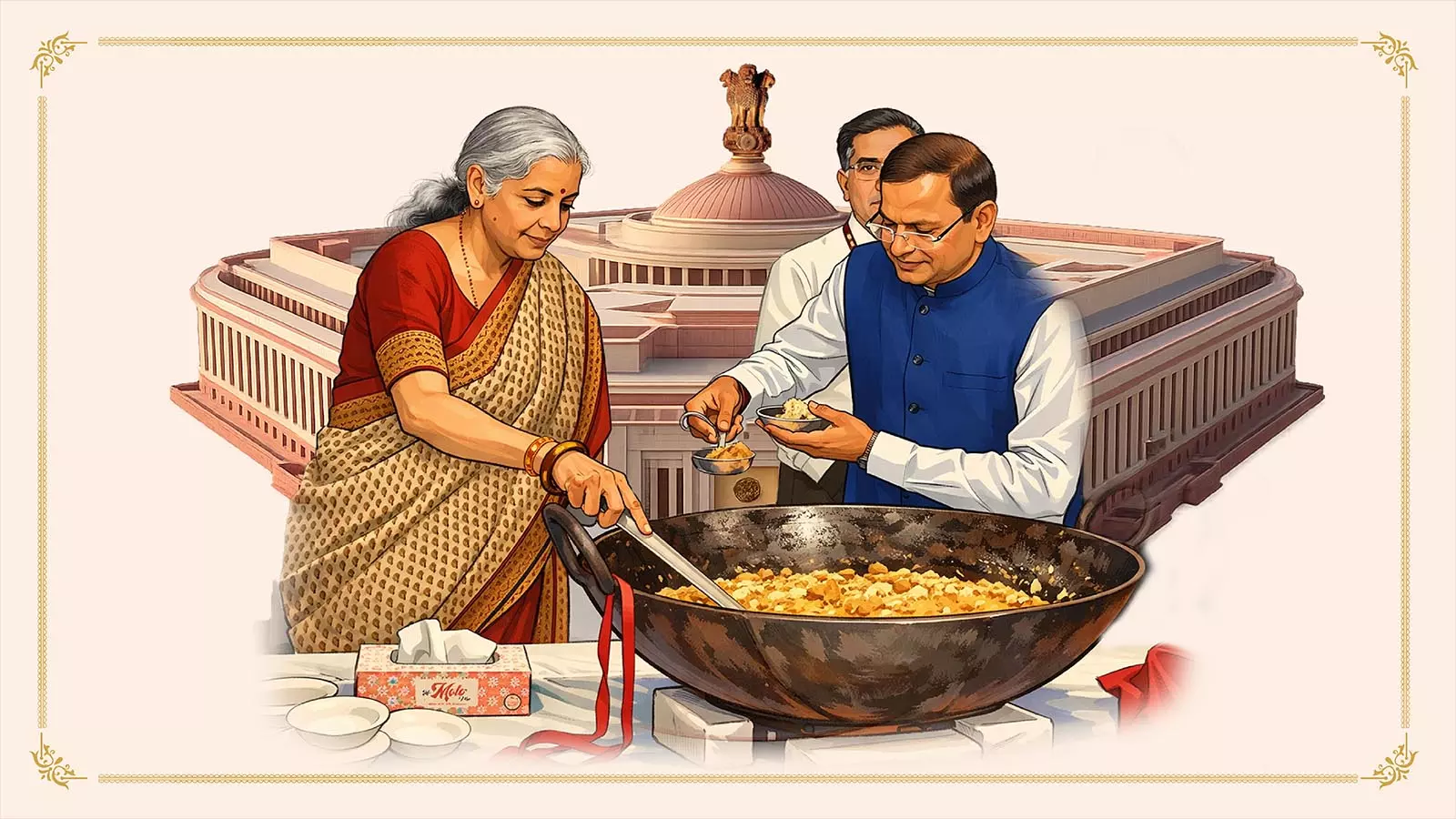
A budget halwa is sizzling: What goes into the dish?
What are its primary ingredients, secondary additions and toppings? How healthy and vital are these for the Indian economy?

Every year, the Union Budget is preceded by a quiet but symbolic ritual in North Block of the Finance Ministry, the Halwa Ceremony. The ceremony marks the commencement of the process of printing the Union Budget.
Also Read: Economic Survey projects 6.8-7.2 pc growth for India in FY27
The sweet dish prepared and served to officials marks the final stage of budget preparation. It marks the beginning of the lock-in period of the officials involved in preparation of the Union Budget, during which they stay in the basement of North Block, cut off from the world outside, with a view to maintaining the secrecy around the final Budget document
Halwa symbolising the Budget
At the centre is the halwa, symbolising the Union Budget — a final product shaped by revenues, spending priorities, borrowing and political strategy.
But beyond tradition, the halwa offers a useful metaphor to understand how the Union Budget is put together.
Using the halwa as an analogy, the Union Budget for 2026-27 can be broken down into its primary ingredients, secondary additions and final toppings, each representing a major fiscal component.
Primary ingredients
Kadhai (pan/wok): Total receipts
The kadhai represents total receipts, the overall pool of money the government has available to spend.
This includes both revenue receipts (such as taxes) and capital receipts (like borrowings). The size of the kadhai determines the scale of the budget.
Ghee: market borrowing or billionaire tax
Ghee symbolises market borrowing or special taxes on the wealthy, which add heft to total receipts.
These inflows allow the government to fund growth and development programmes, effectively “heating up” the budget to drive economic momentum.
Semolina: capital expenditure
Semolina stands for capital expenditure, described as the second major growth engine. Capital spending — on infrastructure and long-term assets — has a higher multiplier effect on growth than routine spending.
When handled well, this ingredient helps the budget turn “golden”.
Also Read: Budget 2026: Will Sitharaman boost defence post-Operation Sindoor?
Water: revenue expenditure
Water represents revenue expenditure — routine costs such as salaries, wages, repairs and maintenance.
While essential to keep the system running smoothly, it has a lower growth impact than capital expenditure and, like water, eventually flows out of the system.
Sugar: transfers to states
Sugar symbolises transfers to states, including tax devolution, grants, loans and funds under central schemes. These transfers “sweeten” the budget by enabling states to spend on welfare and development.
Secondary ingredients
Cashews: corporate or income tax cuts
Cashews represent corporate tax cuts aimed at boosting manufacturing and job creation, or income tax relief for the salaried middle class to spur consumption.
Raisins: industry subsidies
Raisins stand for subsidies for industry, including Production Linked Incentive (PLI), Employment Linked Incentive (ELI) and Design Linked Incentive (DLI) schemes.
For semiconductor plants, for instance, the Centre bears up to 50 per cent of the project cost as subsidy.
Sliced almonds: subsidies for the masses
Sliced almonds symbolise mass welfare subsidies — free ration for nearly 58 per cent of the population, fertiliser subsidies, cash transfers to farmers and women, and subsidised LPG cylinders.
These measures are positioned as development drivers with strong electoral appeal.
Also Read: Will Budget 2026-27 give new and old tax regimes a makeover?
Cardamom powder: cheap credit for MSMEs
Cardamom powder represents cheap credit for MSMEs and exporters, adding “flavour and spice” to the economy by supporting small businesses and boosting exports.
Toppings
Fried nuts: big-ticket projects
The toppings — fried nuts — signify high-visibility infrastructure projects, often in election-bound states.
These include AI hubs, semiconductor plants, roads, bridges, railways and IT parks, aimed at signalling development intent and future growth.