








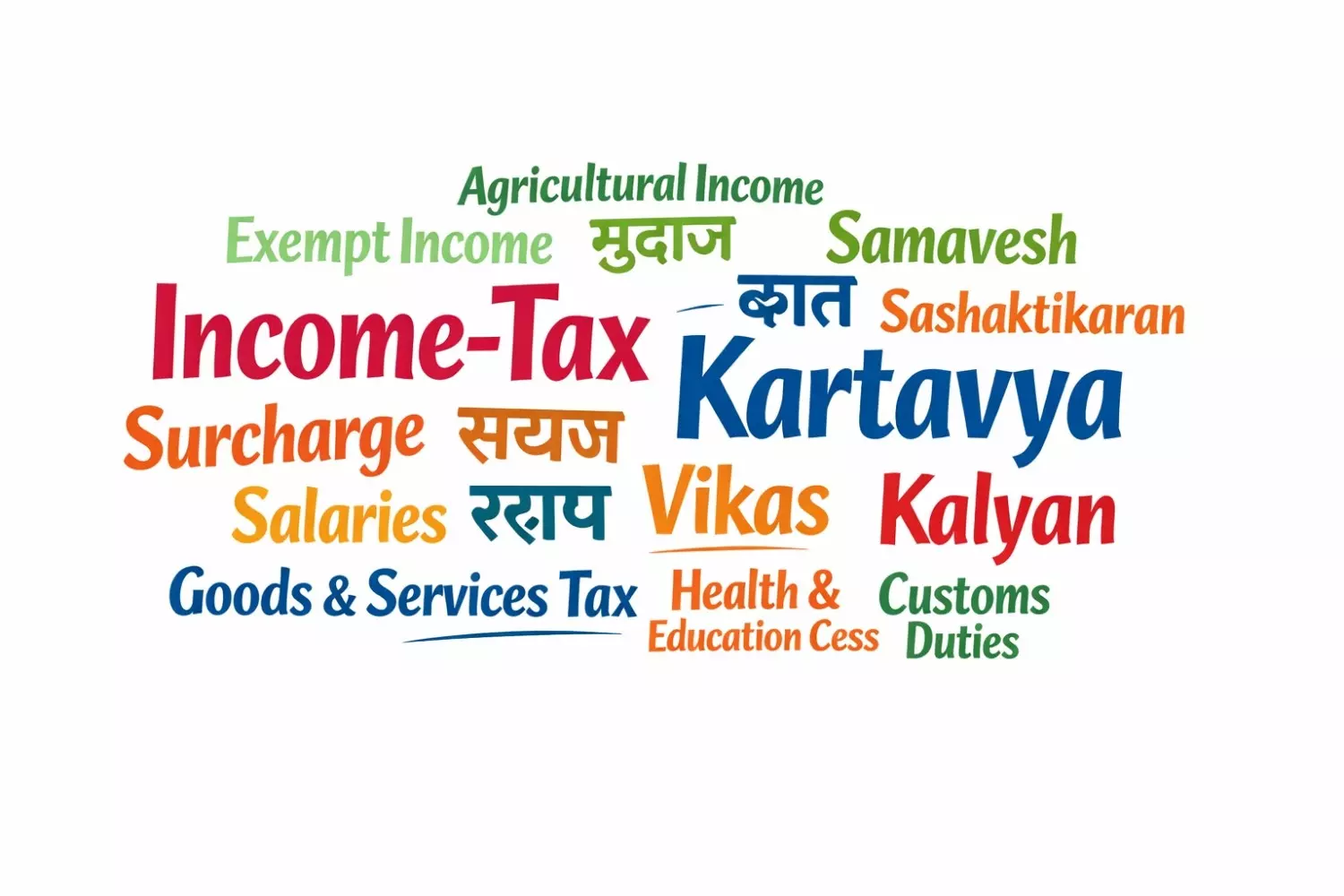
Tax, customs and kartavya: What Budget word cloud tells the Indian citizen
From income-tax and GST to kartavya and kalyan, Budget 2026 frames how families earn, save and spend

The Union Budget 2026 speaks to households less through grand announcements and more through a cluster of recurring words that quietly shape everyday finances. Read together, these terms form a citizen-impact word cloud that explains how the state views families, workers and consumers, and what it expects in return.
Follow Budget 2026-27 Live here
At the centre sits income-tax (I-T), the most direct point of contact between the Budget and households. Changes to tax rates and surcharge levels determine how much money actually reaches homes each month.
For salaried families, this influences not just disposable income but also long-term decisions on spending, borrowing and financial planning. Closely linked is the idea of exempt income, which continues to define what parts of earnings remain protected, signalling where the state chooses to offer relief and where it tightens the net.
For rural households, agricultural income remains a crucial anchor. Its treatment in the Budget reinforces the political and economic sensitivity around farm earnings, ensuring that agriculture stays distinct from other income streams even as the tax base expands elsewhere.
Also read: Repackaged Budget sops for Bengal irk state players: 'Humpty Dumpty Budget'
Meanwhile, salaries as a term reflects the state’s continuing focus on organised employment as a stable and traceable source of revenue.
Household behaviour is also shaped by how the Budget views savings. Tax incentives and cess structures nudge families towards or away from formal saving instruments. The presence of the health and education cess in the citizen word cloud underlines a clear message: households are expected to contribute directly to social sector funding, tying personal finances to collective outcomes in health and schooling.
On the consumption side, goods and services tax (GST) plays a defining role. While the GST is largely invisible at the point of payment, it influences the prices of essentials and services that households rely on daily. Alongside it, customs duties affect the cost of imported goods, from electronics to household appliances, subtly shaping consumption choices and inflation at the retail level.
Also read: Budget 2026-27: What gets cheaper and what gets costlier?
Overlaying these fiscal levers is a narrative layer expressed through Hindi terms that frame the Budget’s moral and political tone. Kartavya, or duty, signals an expectation that citizens comply, contribute and participate responsibly in the tax system.
Vikas, meaning development, positions household contributions as inputs into a larger growth story. Sashaktikaran, or empowerment, suggests that fiscal policy aims to strengthen citizens’ capacity to earn and withstand shocks, even if the immediate experience feels demanding.
Also read: Budget 2026 | The same old grouse: Kerala feels Left out
The emphasis on samavesh, inclusion, reflects an attempt to reassure households that policy design seeks to bring more people into formal systems rather than exclude them. Finally, kalyan, or welfare, anchors the promise that state revenues will cycle back to families through support mechanisms, subsidies and public services.
Taken together, this word cloud shows Budget 2026 as a compact between the state and households. It balances extraction through I-T, surcharges and consumption taxes with assurances of development, inclusion and welfare. For citizens, the message is clear: personal finances are inseparable from national priorities, and the household sits at the heart of the Budget’s economic and ethical design.