








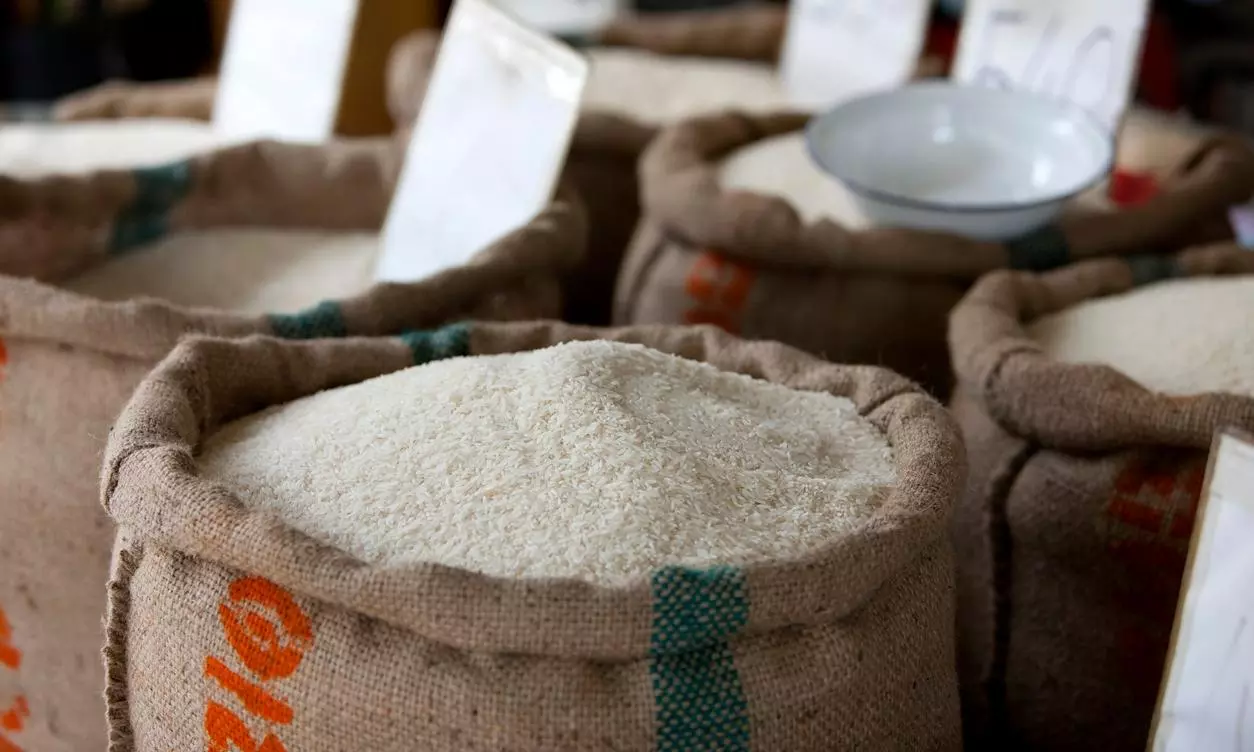
Rice exports remain a strategic economic asset supporting farm incomes, rural employment and the external sector
Rice exporters seek tax relief, freight support in Budget 2026
Rice exporters urge FM Sitharaman to provide interest subvention and duty waivers to tackle high costs and global competition in the 2026 Budget

The Indian Rice Exporter's Federation (IREF) on Tuesday (January 6) urged the government to provide tax incentives, interest subvention and freight support in the upcoming 2026 Budget, to strengthen the sector's competitiveness while addressing sustainability concerns.
The trade body asked Finance Minister Nirmala Sitharaman for 4 per cent interest subvention on export credit, 3 per cent road and rail freight support, and timely disbursal of duty remission schemes (RoDTEP - Remission of Duties and Taxes on Exported Products).
"These measures will directly lower exporters' costs, incentivise sustainability, and encourage scaling of value-added shipments," IREF President Prem Garg said in a representation to the finance minister.
India accounts for roughly 40 per cent of global rice trade and exported about 20.1 million tonnes of rice to more than 170 countries in the 2024-25 fiscal year, he said.
Also read: Trump signals fresh tariffs on Indian rice, alleges dumping in US
"Rice exports remain a strategic economic asset supporting farm incomes, rural employment and the external sector," Garg said, adding that sustained leadership in the staple food commodity strengthens India's economic resilience and diplomatic leverage.
However, the sector faces challenges, including groundwater depletion in major paddy-growing regions, high procurement and storage costs, and market volatility, he said.
"Union Budget 2025-26 can strengthen competitiveness while improving sustainability and farmer outcomes through targeted fiscal and enabling measures," he said.
Key demands
IREF sought support for sustainable rice production through tax and investment incentives linked to verified water-saving and low-emission practices such as Alternate Wetting and Drying (AWD), Direct Seeded Rice (DSR), laser levelling, and energy-efficient milling.
The federation also called for incentives to shift acreage towards higher-value paddy and rice varieties -- premium basmati, GI/organic/specialty non-basmati -- to improve farmer realisation and reduce pressure on MSP procurement.
On working capital, IREF demanded 4 per cent interest subvention on export credit with priority for MSME rice exporters. "This reduces financing costs, eases cash flow, and improves price competitiveness," it said.
The trade body also sought reimbursement of 3 per cent of eligible domestic freight (road/rail) for export-bound rice movements from cluster to port/ICD, with simplified digital claims.
Also read: How coconut shells have sparked trade boom in coastal Karnataka
This, it said, will lower logistics costs, mitigate freight volatility and improve competitiveness for inland clusters.
IREF has also demanded continuation and calibration of duty/tax remission under RoDTEP for rice to offset embedded taxes and preserve export competitiveness.
Waiving of retrospective duty
The trade body also sought a one-time waiver of retrospective duty demands that arose following the imposition of 20 per cent export duty on certain rice varieties. IREF said inconsistent interpretation of the duty base and calculation methodology across field authorities and exporters led to inadvertent discrepancies.
"This has resulted in large, retrospective duty demands and prolonged disputes, despite exports being undertaken in good faith and without any undue gain. A waiver will reduce avoidable litigation, provide immediate relief to compliant exporters, and support sector stability and export competitiveness," it said.
The federation has also called for strengthening export finance guarantees and compliance infrastructure -- testing, traceability, and quality assurance -- to protect India's reputation in premium markets.
(With agency inputs)