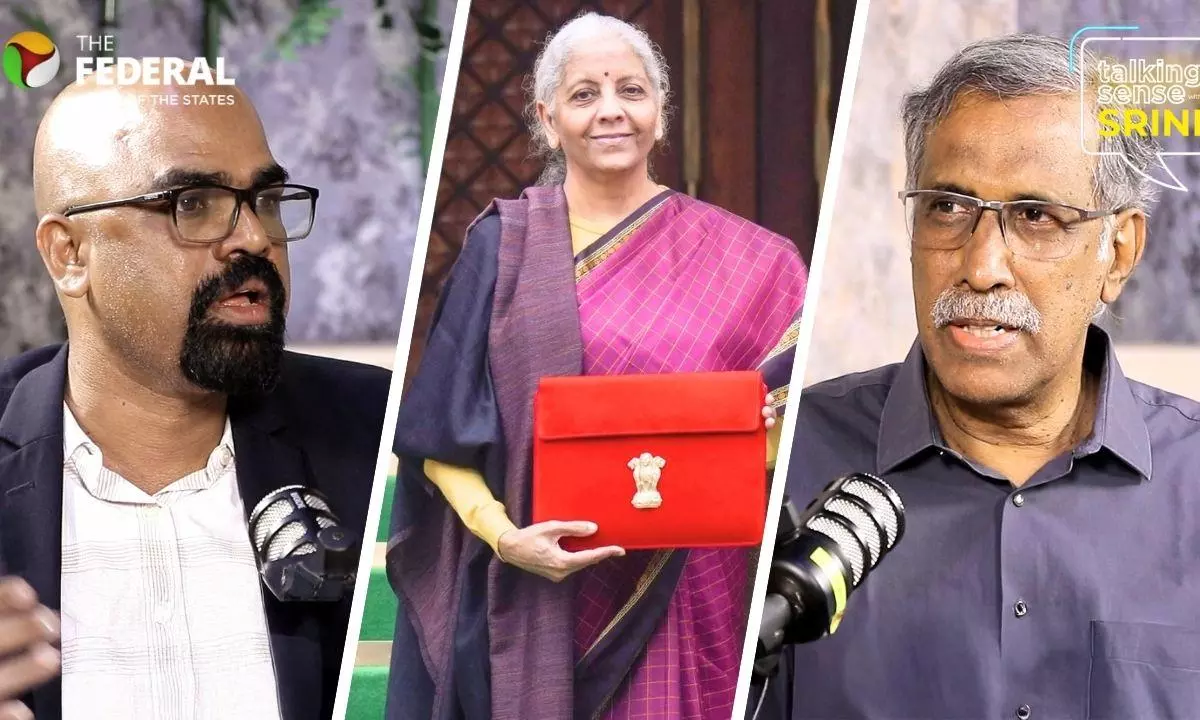
Is India’s Goldilocks economy leaving states high and dry? | Talking Sense With Srini
Fiscal consolidation anchors the Budget, but questions remain over whether it can build long-term productive strength amid intensifying global headwinds

India’s 2026 Budget is less about headline-grabbing announcements and more about tightening screws at a time of rising global uncertainty. Finance Minister Nirmala Sitharaman has pitched the Budget as another step in India’s long reform journey towards becoming a developed nation by 2047. Critics, however, say it falls short of offering a credible roadmap for navigating a rapidly shifting global economic order.
“This is a workmanlike budget, filling in the blanks rather than breaking new ground,” said S. Srinivasan, Editor-in-Chief of The Federal, during Talking Sense With Srini. He noted that the government appears to have doubled down on fiscal discipline and macro stability rather than deploying big-bang stimulus measures.
The Budget targets a fiscal deficit of 4.3 per cent of GDP for the next financial year, down from 4.4 per cent, while projecting economic growth of about 7 per cent. Infrastructure spending has been increased by about Rs 1 lakh crore, taking total capital expenditure to over Rs 12 lakh crore. Defence outlays rose 15 per cent, with capital procurement up nearly 22 per cent.
Global headwinds
“These numbers reinforce the government’s claim of macroeconomic strength,” Srinivasan said. “But the question is whether this is enough when global headwinds are getting stronger.”
Those headwinds include rising protectionism in the West, intensifying geopolitical tensions, and rapid technological disruption driven by artificial intelligence. While India’s inflation remains low, what the Reserve Bank of India calls a “Goldilocks” scenario, economists warn that stability alone may not deliver sustained growth.
Also read: Why 2026 could be a testing year for India | Talking Sense With Srini
“The economy looks healthy today, but that doesn’t automatically prepare us for tomorrow,” said economist Kalaiyarasan, professor at the Madras Institute of Development Studies. “The Budget addresses short-term macro stability, but it is less clear on the long-term strategy for building productive capacity.”
Gap between Economic Survey and Budget
Kalaiyarasan pointed to a disconnect between the Economic Survey and the Budget itself. While the survey highlighted the need for technological upgrading, manufacturing expansion and institutional capacity-building, the budget offered few specifics on how these goals would be achieved.
“One of India’s structural weaknesses is that foreign exchange reserves are built largely on capital inflows, not export surpluses,” he said. “That makes the economy vulnerable to sudden capital outflows, unlike China, which accumulated reserves through sustained manufacturing exports.”
MSME sector
The renewed emphasis on micro, small and medium enterprises (MSMEs) was one of the budget’s key themes. The government announced a Rs 10,000-crore equity fund, expanded credit guarantees and promised professional and technology support for select “MSME champions.”
“MSMEs need two things above all, access to finance and access to technology,” Srinivasan said. “While the budget addresses financing, the technology question remains unresolved.”
Also read: Budget 2026 bets on long-term growth, but is it politically ambitious? | Capital Beat
Kalaiyarasan was more blunt. “India has not been able to replicate the pathway where micro firms grow into small, then medium, and eventually large firms,” he said. “Without deeper linkages between MSMEs, large firms and foreign investors, productivity will remain low.”
Both Srinivasan and Kalaiyarasan argued that India’s challenge is not just self-reliance in high-end strategic sectors such as semiconductors or defence, but also mass-scale manufacturing of low-cost consumer goods, an area where China continues to dominate.
“The budget signals intent,” Kalaiyarasan said. “But intent without a clearly articulated long-term roadmap is unlikely to deliver the strategic resilience India needs.”