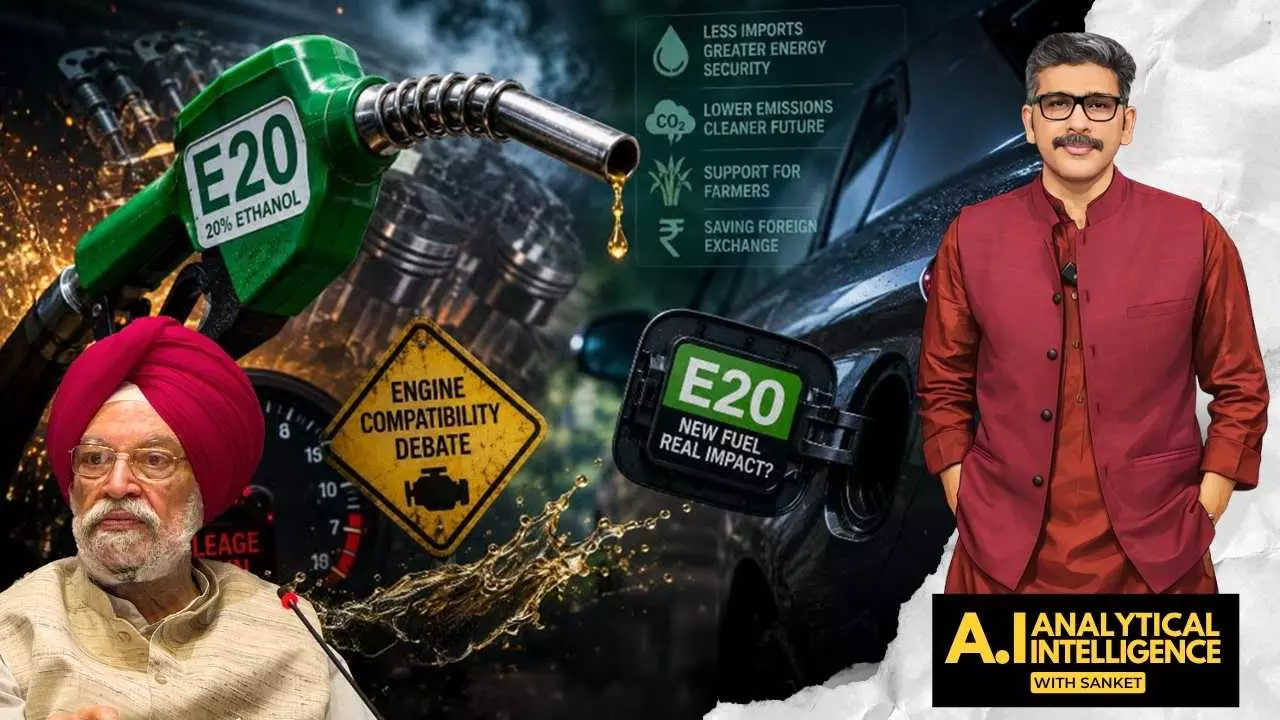
Policy over choice? Experts flag consumer risks in E20 fuel rollout | AI With Sanket
Auto experts Amit Khare and Nikhil Chawla argue that India's E20 rollout should not come at the cost of consumer choice, older vehicles and transparency

The government's push for E20 petrol has raised serious concerns among automobile experts, who argue that the issue is no longer just about ethanol blending but about consumer choice and policy transparency.
They contend that while promoting cleaner fuels is a legitimate objective, forcing E20 on owners of older vehicles without offering alternatives could have unintended consequences.
Also read: 'E20 costlier to produce than pure petrol at current crude prices', says Centre in FAQ
In this episode of AI With Sanket, The Federal spoke with Amit Khare, Founder of Ask CarGuru, and Nikhil Chawla, columnist and creator covering technology, automotive and aviation, on whether India's accelerated E20 rollout has overlooked the concerns of millions of vehicle owners.
Both experts maintained that the discussion should remain focused on policy rather than politics, questioning whether the government's communication has adequately addressed concerns over vehicle compatibility, fuel availability and long-term maintenance.
Not petrol but ethanol lobby?
Opening by contrasting expert concerns with the government's E20 defence, and noting unanswered questions on vehicle compatibility, consumer choice and technical studies, Khare said he found little evidence of a "petrol lobby" driving criticism of E20. He instead pointed to a visible ethanol lobby shaping policy, arguing that public criticism of E20 arose organically from consumers and experts, not organised industry interests.
No consumer choice
Chawla argued that the larger issue was not ethanol itself but the absence of consumer choice. Drawing comparisons with Brazil, often cited by policymakers as a successful ethanol model, he said consumers there can choose from multiple ethanol blends depending on their vehicle compatibility and budget.
He noted that Indian consumers currently have no such flexibility.
"If my car supports E20, I may choose it. But if I own an older Mercedes or BMW that isn't designed for E20, why should I be forced to use it?" he asked.
Also read: India must have strategic thinking on ethanol production: Ashok Gulati | Interview
According to Chawla, consumers should be free to pay more for fuel that matches the manufacturer's recommendations rather than having only one blended fuel available.
Unanswered questions
Both panellists questioned why India fast-tracked the E20 rollout years ahead of schedule despite most vehicles being built for E10. It was noted that sticking to the original timeline would have let older vehicles naturally phase out, easing the transition. Instead, the early rollout has left existing owners uncertain, the experts said. Khare called the introduction of the E20 much earlier an avoidable problem, introduced before the vehicle fleet was ready.
One extra nozzle
A recurring theme during the talks was that offering both E10 and E20 at fuel stations could resolve much of the debate. Khare said consumers weren't seeking E5 or ethanol-free petrol, just continued E10 availability, questioning why choice exists for cars, clothing or premium fuels but not for fuel grades. Chawla agreed, noting stations already offer multiple grades, so adding E10 wouldn't require overhauling infrastructure. Both argued that retaining E10 alongside E20 would balance environmental goals with consumer interest.
Another issue discussed was the apparent inconsistency between different official recommendations.
The panel referred to recommendations associated with the policy process that suggested E10 should continue to remain available because many older vehicles, especially two-wheelers, were not designed for higher ethanol blends.
The discussion questioned why these earlier recommendations appeared to differ from the government's current public position.
Chawla argued that consumers deserve a clear explanation reconciling differing technical assessments instead of conflicting public messaging.
Mileage, maintenance concerns
Mileage was another flashpoint. Government officials called E20's fuel-efficiency loss minor, but Khare disagreed, citing real-world drops of 10-12 per cent for two-wheelers and 8-10 per cent for cars under 1500cc, with larger engines less affected. The discussion also raised consumer reports of clogged fuel pumps, contaminated systems and rising maintenance costs.
Chawla said the impact extends beyond fuel economy.
Vehicle owners, he argued, purchase cars expecting them to last well over a decade. If components such as gaskets and fuel-system parts require earlier replacement because of higher ethanol content, owners bear additional costs through no fault of their own.
He added that rising servicing costs, combined with increasing living expenses, make even small increases in maintenance significant for ordinary consumers.
Also read: Are automakers misleading E20 consumers? | AI With Sanket
The discussion stressed that many vehicle owners had purchased cars based on manufacturer specifications available at the time, and changing the fuel ecosystem midway created uncertainty.
Hybrid question
Chawla asked why policymakers haven't emphasised hybrids as transitional technology, noting global markets have expanded hybrid use while shifting to electric mobility. This author noted that policymakers see hybrids as merely temporary, preferring a direct electric push.
Also read: From mileage loss to rising repair bills: What a survey on E20 fuel found
Chawla said that hybrids could provide consumers with a practical transition while reducing fuel consumption without forcing abrupt technological shifts.
Concluding the discussion, both experts reiterated that they were not opposing ethanol blending itself. Instead, they argued that the government should provide consumers with options and answer technical concerns more transparently.