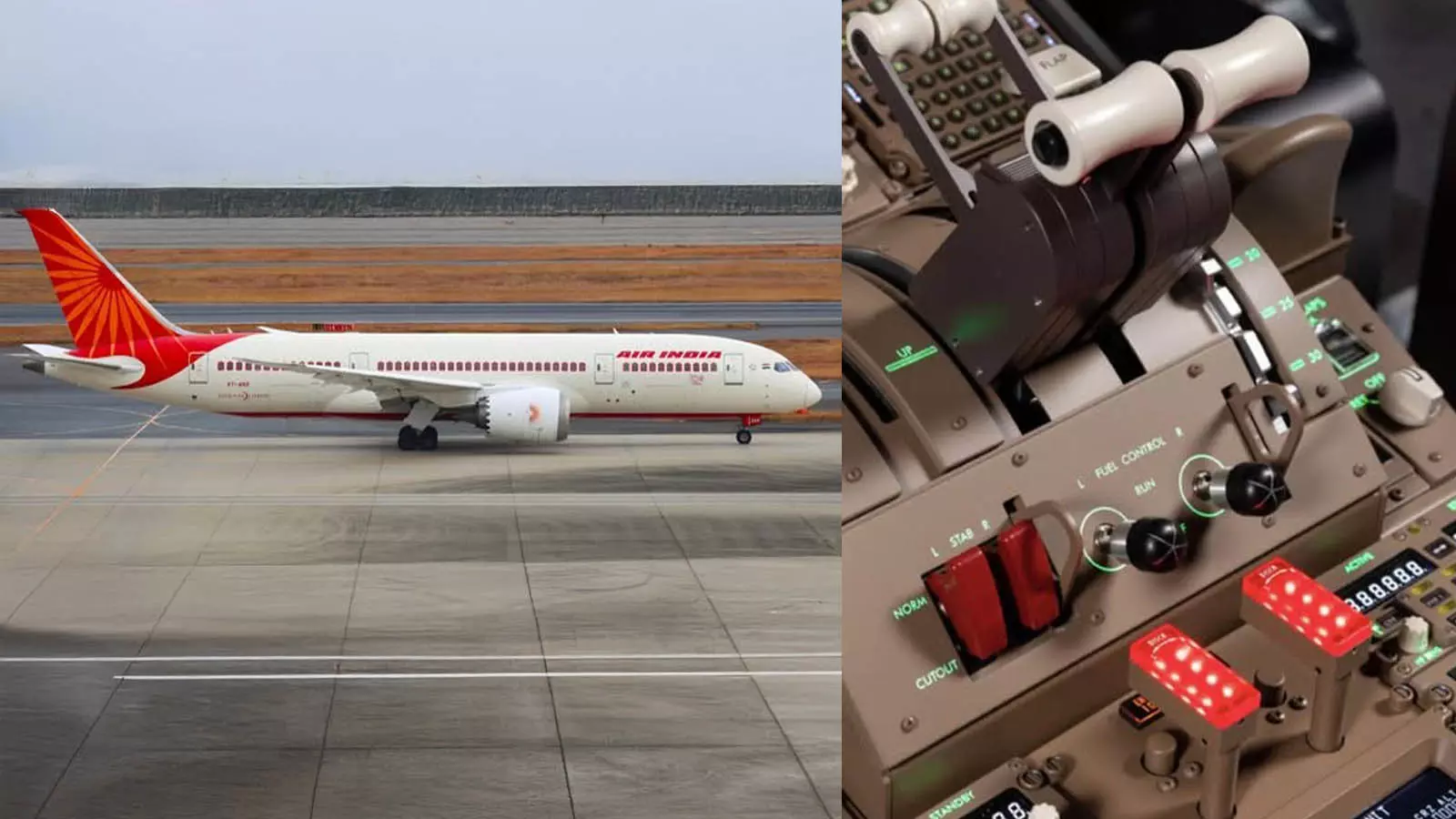
Pilot alert prompts Air India checks on all Boeing 787 fuel control switches
Move revives scrutiny of fuel switches in June 2025 Ahmedabad crash probe; The Federal has published an exclusive investigative series on this

Air India has commenced inspections of fuel control switches across its Boeing Dreamliner fleet, after one of its pilots recently reported a possible defect on a Boeing 787-8 aircraft.
The development has renewed scrutiny of the system, which has been central to the investigation into the fatal crash of Air India flight AI 171 in Ahmedabad last year.
The aircraft involved in the latest incident was operating as flight AI 132 flying from London Heathrow airport to Bengaluru, when a pilot flagged that a fuel control switch did not behave as expected during ground operations. Following the report, the aircraft was grounded as a precaution, and the matter was escalated to the aviation regulator, the Directorate General of Civil Aviation (DGCA).
Fuel control switch issue
In a statement issued subsequently, an Air India spokesperson said the airline was “involving the OEM to get the pilot’s concerns checked on a priority basis”, and confirmed that the regulator had been informed.
The spokesperson added that Air India had earlier checked the fuel control switches across its Boeing 787 fleet after a DGCA directive and found no issues at the time, reiterating that passenger and crew safety remained the airline’s top priority.
Fuel control switches regulate the flow of fuel to an aircraft’s engines and are designed to remain positively locked in the RUN position during normal operations. Movement of a switch to CUTOFF shuts down fuel supply to the engine. While such switches are primarily used when the engine is started and shutdown on the ground, their behaviour has been a point of intense focus since the June 12, 2025 crash of Air India flight AI-171, which killed 260 people.
Govt response in RS
Meanwhile, the government told Parliament that all probable causes of last year’s Air India crash are being studied as part of the ongoing investigation.
In a written reply to the Rajya Sabha earlier this week, the Ministry of Civil Aviation said the Aircraft Accident Investigation Bureau (AAIB) is probing every possible factor, including technical, operational and human elements, and that conclusions would be drawn only after the investigation is completed.
Also read: Exclusive | AI-171 crash triggered by fuel switches or engine failure?
The government added that the inquiry is being conducted in accordance with international aviation norms and that safety recommendations, if any, would be issued based on evidence and analysis. The statement comes amid sustained public and legal scrutiny of the probe, with critics arguing that selective disclosures and emphasis on certain explanations have left key technical questions unanswered.
AI 171 and fuel switch debate
AI 171, a Boeing 787-8 registered as VT-ANB, crashed seconds after take-off from Ahmedabad. In its preliminary report, the Aircraft Accident Investigation Bureau (AAIB) said both engine fuel control switches were found to have transitioned from RUN to CUTOFF shortly after lift-off, leading to a dual loss of thrust.
A cockpit voice recording captured one pilot asking the other why the engines had “cut off”, with the response indicating that the action had not been taken intentionally. The AAIB has not yet concluded whether the switch movements were the result of pilot action, mechanical behaviour, electrical events or other system interactions. A final report is still awaited.
Since the preliminary report was released, the fuel control switches have become the focal point of public and media debate, with some reports leaning toward pilot action while others, including technical experts and pilot groups, have cautioned against drawing conclusions before the full dataset is disclosed.
Concerns raised
Aviation safety specialists say the AI 132 incident does not establish a direct link to the AI 171 crash. However, they argue that any abnormal behaviour reported by pilots involving a critical engine control system warrants close examination, especially when the same component is featuring prominently in an ongoing fatal accident investigation.
Captain Amit Singh of the Safety Matters Foundation, a non-profit aviation safety group that has been analysing technical data related to AI 171, said that repeated attention on the same system underscores the need for transparency and comprehensive testing. Capt Amit Singh is also one of the petitioners, along with Capt Sumeet Sabharwal's father Pushkaraj Sabharwal for the Air India 171 case in the Supreme Court.
“Fuel control switches are not high-frequency pilot inputs in flight,” Singh said in an earlier statement on the crash investigation. “Any scenario where engine fuel supply is interrupted needs to be examined in the full context of aircraft systems, power stability and flight control logic; not in isolation.”
Also read | What India, and the world, can learn from AI-171 Dreamliner crash report
The Foundation has previously pointed to multiple electrical and system faults transmitted by AI 171 in the minutes before take-off, raising questions about whether cascading system effects could have influenced engine behaviour.
Those issues were documented in earlier reporting by The Federal, which highlighted pre-existing electrical anomalies on the aircraft that crashed in Ahmedabad prior to departure.
SC case on AI 171 crash
Meanwhile, the renewed focus on fuel control switches comes even as the AI 171 investigation is under judicial scrutiny.
The matter is currently before the Supreme Court of India, where two separate petitions on the AI 171 crash are being heard.
One petition was filed by Captain Amit Singh, a commercial airline pilot and the other by AI171 pilot Sumeet Sabharwal's 91-year-old- father and the Federation of Indian Pilots. They sought greater disclosure of technical data, clarity on the investigation’s direction and an independent judicial probe. During a previous hearing on November 13, 2025, the SC directed the government and aviation authorities to respond on specific issues raised by petitioners.
But the government did not respond to the SC directive by December 13, 2025, the deadline set by the court. And, in the latest hearing on January 28, 2026, there was no representation from the government. Lawyer Prashant Bhushan, representing the NGO Safety Matter told the court that neither the government nor the Aircraft Accident Investigation Board (AAIB) had responded to the petition.
He said, "Thousands of pilots have pointed to electrical faults in the Boeing 787 aircraft."
The court is yet to give a date for the next hearing.
Air India inspections
Meanwhile, the DGCA has not issued a fresh public directive following the AI132 report, even as officials are expected to review the findings of Air India’s inspections once they are submitted.
According to sources familiar with the process, inspections are being conducted across Air India’s Dreamliner fleet as a precautionary measure. Any findings will be shared with the regulator and the aircraft manufacturer for further evaluation.
Read The Federal's exclusive investigative series across Part 1, Part 2, Part 3 and Part 4.