Gender Budget 2026 shrinks at revised stage, exposing Rs 51,000 crore gap
Cuts to women-focused schemes in housing, nutrition and welfare raise questions over government priorities despite higher budget promises

The Union government’s Gender Budget for 2025-26 saw a sharp contraction at the Revised Estimates (RE) stage, revealing a gap of over Rs 51,000 crore between promise and provision. While the Budget Estimates (BE) projected a gender allocation of Rs 4.49 lakh crore, actual spending fell to Rs 3.98 lakh crore, according to the Gender Budget Statement in the Expenditure Profile.
Also read: Budget 2026-27: Sitharaman unveils SHE-Marts, Mission Shakti boost for women
“The slash between the BE and RE, which you see in the gender budget, you also see it in most of the social sector schemes. What it's telling us is that their tax revenue collection was lower than what was anticipated, given the GST cut and the income tax relief that they gave last time. The fiscal consolidation continues to remain the top priority. So what gets affected is things like this, which clearly are not priority for the government,” Economist Dipa Sinha, Associate Professor at Azim Premji University, told The Federal.
Deconstructing Gender Budget
The Gender Budget Statement is divided into three parts. Part A includes schemes with 100% allocation for women and girls, such as women’s safety programmes and targeted housing or livelihood schemes.
Also read: Budget 2026-27 leaves transgender welfare largely untouched
Part B covers schemes where 30-99% of the allocation is assumed to benefit women, including large welfare programmes like food, education, health, and employment schemes. Part C consists of schemes with less than 30% gender allocation, where women are indirect or partial beneficiaries.
The largest cuts were within Part A, around Rs 30,000 crore, concentrated in care, housing, and protection interventions. The Department of Women and Child Development, covering Mission Shakti, Anganwadi, and maternity-linked programmes, saw a Rs 1,000‑crore reduction.
The Ministry of Rural Development’s women-targeted housing and livelihood components were slashed by Rs 1,271.4 crore, and the Ministry of Housing and Urban Affairs’ women-focused housing and safety schemes dropped Rs 819.9 crore.
“Last year, after the budget, there was a lot of hype about how the gender budget have increased. But actually, if you look at the revised estimates now, nothing has happened. As a percentage of the total budget, it's actually slightly higher, but that's because of Parts B and C. If you look at only Part A, it's lower. And this B and C, we can't just take it at face value because the definitions keep changing each year, and it's not very transparent,” said Sinha.
Housing, water budgets slashed
Rural housing under Pradhan Mantri Awas Yojana-Gramin saw one of the steepest revisions, dropping from Rs 54,832 crore at BE to Rs 32,500 crore at RE, a cut of over Rs 22,000 crore. Urban housing under PMAY was similarly scaled down, with allocations reduced from Rs 19,794 crore to Rs 7,500 crore. The interest subsidy for PMAY-Urban, often cited as enabling women’s home ownership, was slashed from Rs 3,500 crore to Rs 300 crore.
Drinking water provisioning also saw major contraction. The gender component of the Jal Jeevan Mission fell from Rs 20,476 crore at BE to Rs 8,306 crore at RE, a reduction of over Rs 12,000 crore. Yet, the budget estimate for this year is again at Rs 33,022.96 crore.
Also read: 12 states to spend Rs 1.68 lakh crore on women’s cash schemes: PRS Report
“Between last year’s and this year’s budget estimates for the Jal Jeevan Mission, there’s a huge jump in the gender budget. But if you look at the actual mission budget, the numbers are more or less the same: Rs 67,000 crore. Clearly, this year they’ve decided that drinking water benefits women more than they thought last year.”
“This is the problem with Parts B and C; it’s not transparent how these decisions are made. For some schemes, like MGNREGA, you can justify it based on the proportion of women working. But tap water? One year you show it as 30%, next year 80%. It is arbitrary,” said Sinha.
Cuts in welfare schemes
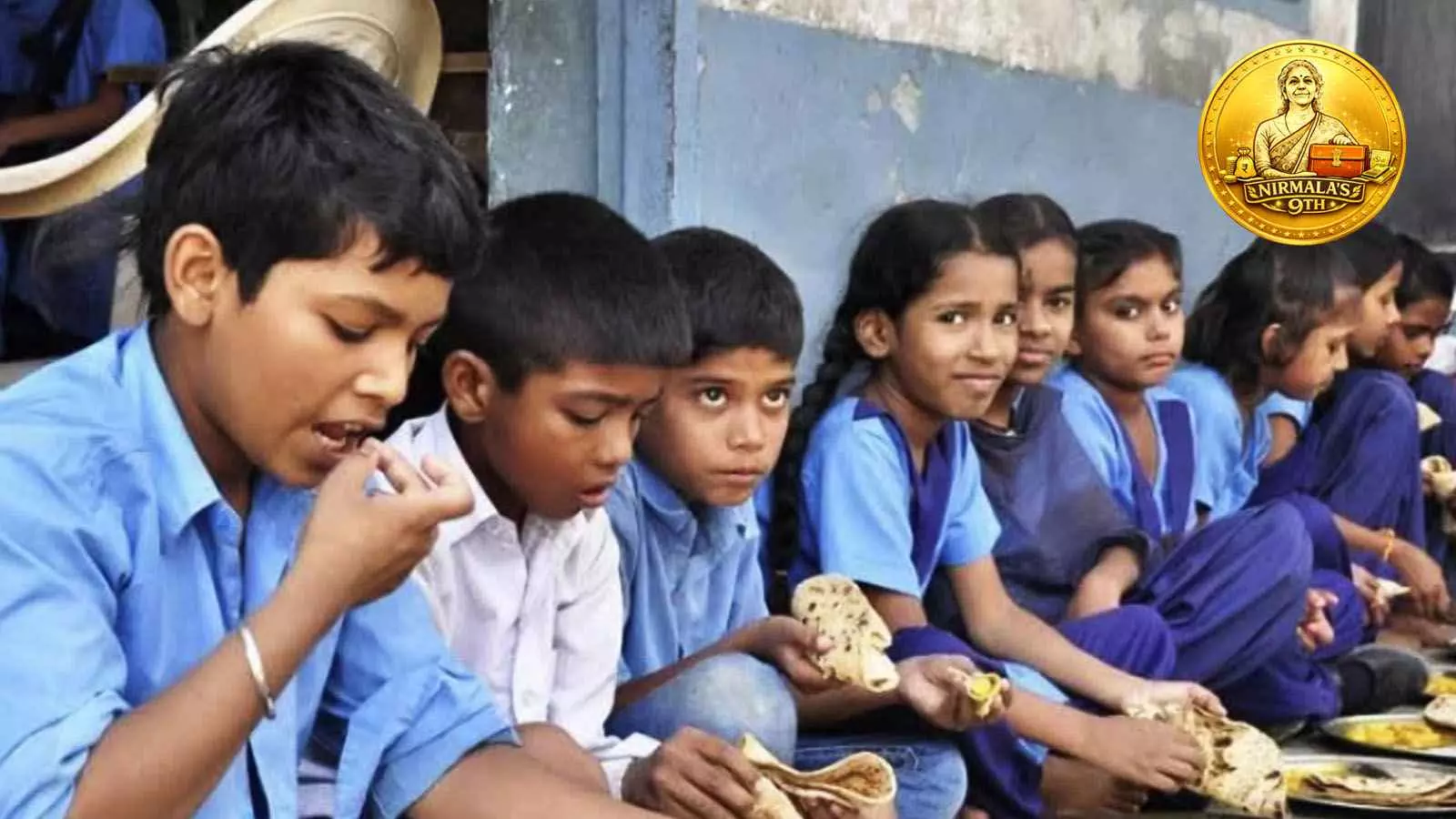
Allocations for PM POSHAN, critical for girls’ school attendance and nutrition, were reduced from Rs 6,250 crore to Rs 3,180 crore, while Samagra Shiksha fell by nearly Rs 1,000 crore at the revised stage. In higher education, several centrally funded institutions recorded marginal changes, but the overall trend showed restraint rather than expansion.
Even schemes explicitly framed as women-centric were not insulated. Mission Shakti, the flagship umbrella programme for women’s protection and empowerment, was revised down from Rs 3,150 crore to Rs 2,000 crore. The pattern across ministries shows that cuts were not incidental, but clustered around housing, care, nutrition, and basic infrastructure, areas that feminist policy frameworks identify as foundational to gender equality.
Also read: National Girl Child Day highlights rights, education and empowerment of girls
The All India Democratic Women’s Association (AIDWA) criticised the contraction, saying, “The estimates of Gender Budget show a decline from 1.61% of GDP to 1.38 % of GDP in real terms and Rs 51,144 crores in nominal terms. This is gross denial to women when the deprivation is evident in all statistics of the country.”
“Expenditure in Part A of the Gender Budget, which is 100% women-oriented schemes, is 0.30 % of GDP. Expenditure under Parts B (30-99% allocation) and C (less than 30% allocation) of the Gender Budget together constitute 1.08 % of GDP. Major budgetary increase has been declared for Part C of the Gender Budget where allocation is less than 30% for women. This has shown a nominal increase to Rs 29777.94 crore from Rs 24299.97 crore, which is meagre. This shows a complete lack of commitment of the government for gender budget and 100% women- oriented schemes.”