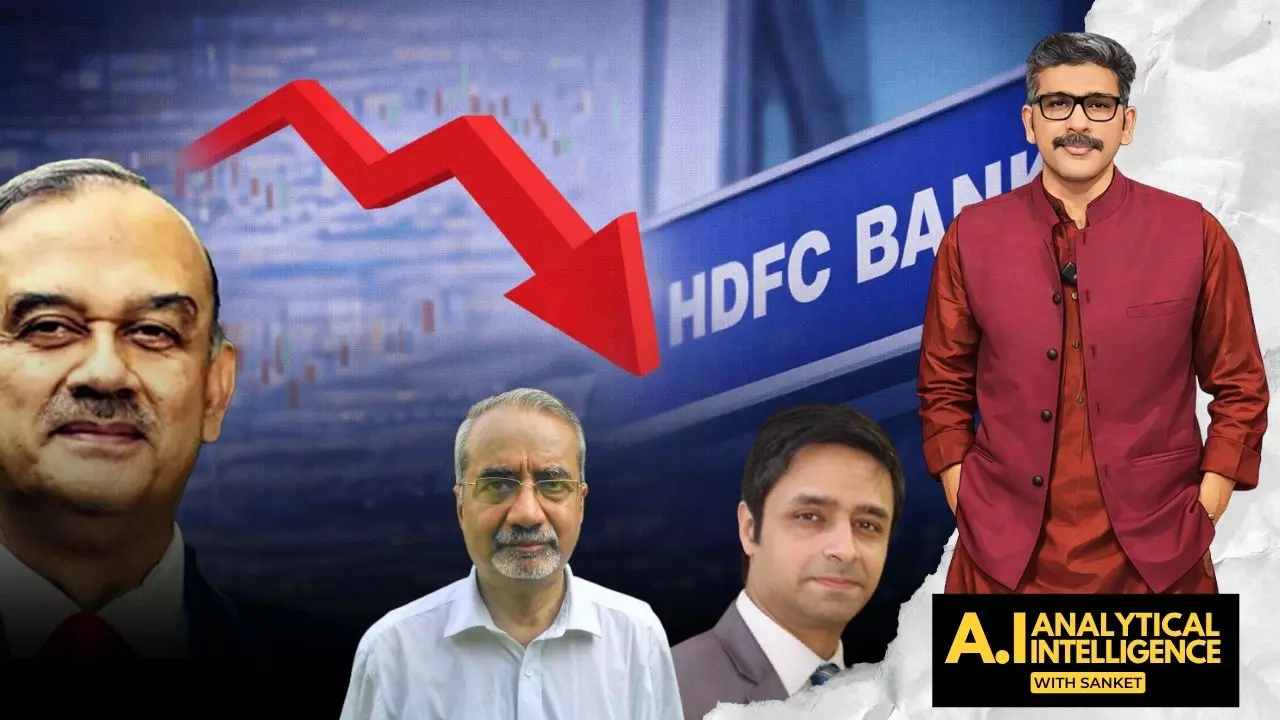
‘HDFC must come clean’: Experts seek transparency in ₹45-cr payout probe | AI With Sanket
Former ASG Biswajit Bhattacharya and banker Nasser Salim raise concerns over alleged governance lapses at HDFC Bank and demand greater transparency.

HDFC must come clean on the alleged ₹45 crore payout that is under investigation, and the matter should be taken to its logical conclusion with complete transparency, former Additional Solicitor General Biswajit Bhattacharya said, warning that public trust in the banking system cannot be compromised.
The controversy stems from an internal vigilance probe at HDFC Bank into an alleged payment linked to the Maharashtra State Road Development Corporation (MSRDC). The Federal spoke to Bhattacharya and Nasser Salim, Managing Partner at Flex Capital, about the implications of the case for depositors, investors and the broader banking system.
In this episode of AI with Sanket, the discussion centred on allegations that HDFC Bank may have structured payments in a manner that effectively enabled a higher return to a major client while formally remaining within regulatory limits on deposit rates. Both panellists stressed that the allegations remain under investigation, but argued that the questions raised are significant enough to warrant a full public explanation.
Public trust
Bhattacharya said banks occupy a special position in India's economy because they handle public funds and act as critical institutions for economic development.
He argued that HDFC Bank, as the country's largest private lender, carries a greater responsibility to maintain the highest standards of transparency and integrity. According to him, institutions of such scale are expected to lead by example and reassure customers whenever questions arise regarding governance or accounting practices.
Referring to reports on the resignation of former chairman Atanu Chakraborty and the subsequent vigilance findings, Bhattacharya said the bank should dispel all doubts by putting the facts in the public domain. "There should not be even an iota of compromise," he said while discussing the trust reposed in banks by depositors.
Alleged scheme
The controversy centres on allegations that HDFC Bank made payments totalling ₹45 crore to MSRDC while pursuing a banking relationship reportedly worth around ₹25,000 crore.
According to the discussion, the client allegedly sought returns above the prevailing rate that the bank could officially offer. The alleged arrangement involved classifying payments as part of a road safety campaign rather than as interest payments. Reports have also alleged irregularities in supporting documentation connected to some of the payments.
Salim cautioned that the allegations are still being investigated and have not been conclusively proven. However, he said that if established, the case would represent a serious compliance failure.
"There is no point using flowery language," Salim remarked, arguing that the allegations raise important regulatory and governance concerns.
Compliance concerns
Salim identified several areas where the allegations could have implications if substantiated.
The first, he said, relates to regulatory compliance. RBI rules are designed to ensure consistency and fairness in deposit rates. Any attempt to circumvent those rules through alternative structures could amount to regulatory evasion.
There is currently no indication of a solvency or liquidity problem at HDFC Bank. The bank's financial position remains strong, he argued, and customers should not confuse the governance controversy with a balance-sheet crisis.
The second concern relates to accounting and disclosure practices. Salim noted that categorising payouts as marketing expenditure instead of interest payments would raise questions about the integrity of financial disclosures if done intentionally.
A third issue involves corporate governance. According to Salim, the allegations suggest possible failures in oversight, compliance review and internal controls. Given HDFC Bank's size and importance in financial markets, governance lapses would have implications extending beyond depositors to equity investors and market participants.
He also pointed to allegations regarding duplicate invoices and weak documentation, describing them as indicators that internal audit and control mechanisms may not have functioned effectively.
Need for transparency
Bhattacharya argued that the investigation should establish a benchmark for the entire banking sector.
He noted that India's banking system handles amounts that exceed the country's projected nominal GDP and therefore depends heavily on public confidence. Any perception that accounting practices are not transparent, he said, could damage trust in financial institutions.
The former ASG repeatedly emphasised that transparency remains the central issue. Whether the allegations ultimately prove true or false, he said, the public deserves a clear explanation because banks are custodians of public money.
Also Read: Explained: What does Rajesh Exports do? Why is SEBI alleging a scam?
He also praised investigative journalism for bringing the issue into public discussion and argued that scrutiny of powerful institutions strengthens accountability.
Chairman's role
The discussion also examined the role of former HDFC chairman Atanu Chakraborty, whose resignation letter reportedly referred to developments that were not aligned with his ethical principles.
The host questioned whether Chakraborty should bear responsibility given that the alleged activities occurred during a period when he served as an independent director.
Responding to that point, Salim referred to whistleblower mechanisms that exist within financial institutions. While noting that liability questions would depend on the outcome of investigations, he said whistleblowers can play an important role in exposing governance failures before they become larger problems.
Salim argued that one of the key questions is whether the alleged issues would have surfaced at all without concerns being raised internally.
Wider implications
The panellists agreed that the matter extends beyond a single payment.
Bhattacharya said the concern is whether the alleged transaction represents an isolated incident or points to broader practices that require scrutiny. He argued that only a detailed investigation can answer that question conclusively.
Salim similarly stressed that the case has implications not only for depositors but also for shareholders and investors. HDFC Bank is a major component of market indices and is widely held by institutional and retail investors.
Because of this, he said, governance concerns can affect perceptions of the bank's credibility and influence investor confidence.
Trust versus stability
Toward the end of the discussion, Salim drew a distinction between governance risk and financial risk.
Based on publicly available information, he said there is currently no indication of a solvency or liquidity problem at HDFC Bank. The bank's financial position remains strong, he argued, and customers should not confuse the governance controversy with a balance-sheet crisis.
At the same time, he maintained that trust has been affected by the allegations and that restoring confidence will require a transparent, evidence-based resolution.
Both panellists concluded that the ultimate priority should be protecting the interests of depositors and ensuring confidence in India's banking system. They argued that only a thorough investigation, public disclosure of findings and regulatory oversight can achieve that objective.
The content above has been transcribed from video using a fine-tuned AI model. To ensure accuracy, quality, and editorial integrity, we employ a Human-In-The-Loop (HITL) process. While AI assists in creating the initial draft, our experienced editorial team carefully reviews, edits, and refines the content before publication. At The Federal, we combine the efficiency of AI with the expertise of human editors to deliver reliable and insightful journalism.