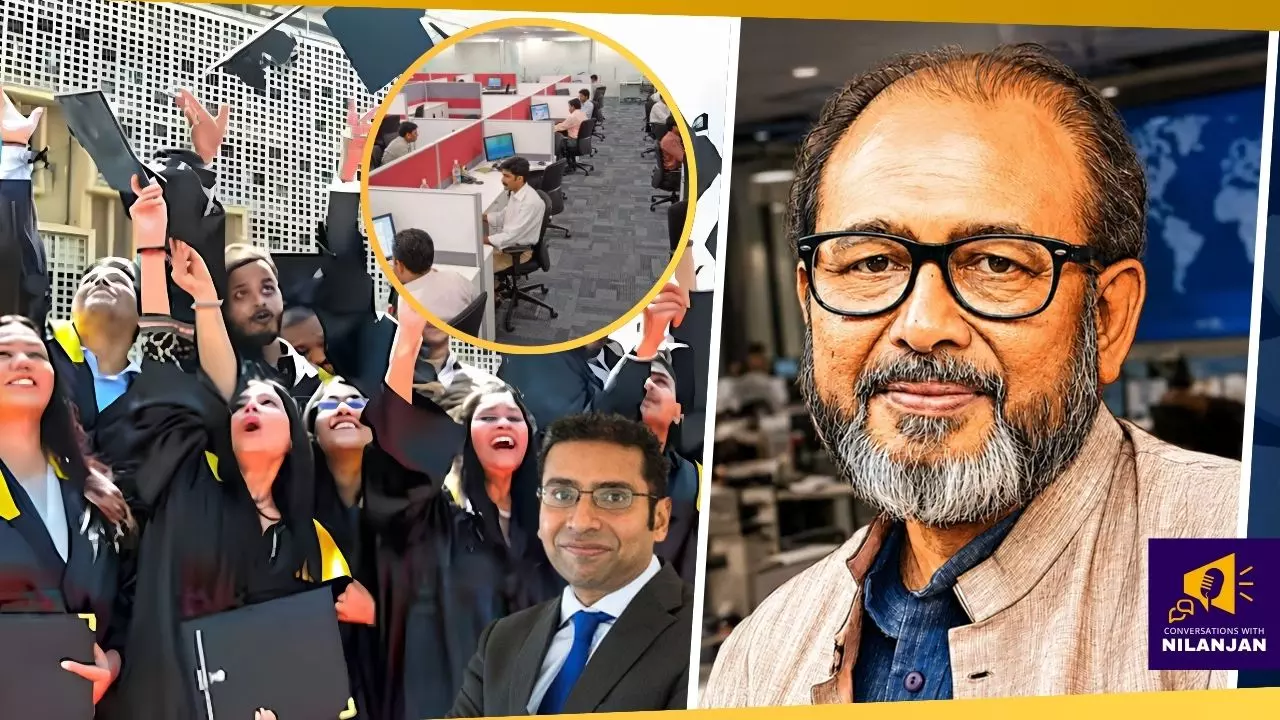
'Forget lifelong jobs, save more, expect less from govt': Expert's message to middle class
Rising debt, weakening wages, and an unsustainable government borrowing spree: Saurabh Mukherjea explains why India's middle class needs a new playbook for AI era

India's economic model is undergoing a structural break, and the country's middle class must prepare for years of disruption instead of expecting a quick recovery, according to investment expert Saurabh Mukherjea. He argues that artificial intelligence, automation, and the collapse of the white-collar employment boom are fundamentally changing the way Indians will work, earn, and build wealth in the coming decades.
Speaking to The Federal, Saurabh Mukherjea, founder and Chief Investment Officer of Marcellus Investment Managers and co-author of Breakpoint, said the country has reached a turning point where long-established economic trends are beginning to reverse. He believes the transition will be painful, but could eventually create the conditions for a manufacturing-led revival.
Mukherjea made these observations during a conversation with Nilanjan Mukhopadhyay on The Federal Conversations.
Why 'Breakpoint'?
Mukherjea explained that the title of his book reflects what economists describe as a "break point"—a moment when long-term trends abruptly change direction.
According to him, multiple indicators that shaped India's middle-class prosperity began weakening between 2018 and 2021. He pointed to white-collar employment as the clearest example. For nearly three decades after the economic reforms of 1991, white-collar jobs doubled roughly every six years. That trend, he argued, has now almost disappeared.
Also Read: The white-collar jobs India built its economy on are now most at risk from AI
Alongside slowing employment growth, he said household debt has surged while wage growth has weakened, signalling that India's traditional middle-class growth engine is no longer functioning the way it once did.
However, Mukherjea said the title also borrows from tennis, where a "break point" presents an opportunity for the receiving player to change the course of a match.
He argued that while the current disruption appears damaging, it could ultimately become the beginning of a new economic model centred on manufacturing rather than services.
End of one model
Mukherjea said India's post-1991 development strategy relied heavily on producing skilled graduates whose services could be sold globally through the IT industry. The foreign exchange earned from software exports fuelled domestic consumption and kept the economy expanding for decades.
He believes that model is now being dismantled by artificial intelligence and automation, both of which are reducing demand for traditional IT services and middle-class jobs. As software exports weaken, he argued, the rupee is likely to depreciate, making Indian manufacturing significantly more competitive in international markets.
Also Read: AI won't trigger job cuts, it will automate manual jobs: Sr VP, HCL Tech
Mukherjea said this transition could allow India to compete more effectively in industries such as engineering goods, pharmaceuticals, footwear, automobiles, and industrial components — sectors that previously drove the economic rise of several Southeast Asian countries.
Rather than viewing the decline of the IT-led economy as purely negative, he described it as an opportunity for India to rebuild its economy on a broader industrial foundation.
Government's limited role
Asked whether government policy could ease the transition, Mukherjea argued that modern governments have far less influence over economic outcomes than many people assume. Drawing comparisons with advanced economies, he said governments today operate within highly globalised markets where capital, businesses, and skilled professionals can relocate easily across borders.
According to him, multinational corporations can shift operations if tax policies become unfavourable, while skilled professionals increasingly have opportunities to work internationally.
Because of these structural changes, Mukherjea said governments no longer possess the level of economic control they once exercised during the decades following the Second World War.
Instead, he believes free-market forces will increasingly determine how India's economy adjusts to technological disruption.
Three major adjustments
Mukherjea outlined three major adjustments he believes India will experience over the coming years.
First, he expects the rupee to weaken as software export earnings decline, making manufactured exports more competitive globally.
Second, he anticipates significant corrections in residential property prices, particularly in cities where expensive housing has been supported by well-paid middle-class professionals working in IT, banking, and financial services.
Also Read: AI set to take over desk jobs in 18 months, warns Microsoft AI CEO amid scepticism
He argued that slowing job creation is already affecting housing demand in cities such as Bengaluru, Hyderabad, Gurugram, and Mumbai.
Third, Mukherjea expects government spending to come under increasing pressure as tax revenues struggle to keep pace with rising expenditure. According to him, maintaining current levels of borrowing indefinitely is financially unsustainable, forcing governments to eventually reduce spending commitments.
Unsustainability of govt spending
Mukherjea argued that one of the biggest challenges ahead is the sustainability of government spending. Responding to concerns that welfare programmes have expanded sharply since the COVID-19 pandemic, he said governments at both the Centre and the states are borrowing at levels that cannot continue indefinitely.
He estimated that the Centre, states, and public sector undertakings together are expected to borrow well over Rs 30 trillion in the current fiscal year. According to him, India's banking system alone cannot finance borrowing on that scale, forcing the Reserve Bank of India (RBI) to inject liquidity into the system.
Mukherjea argued that as more money is created to finance government expenditure, the supply of rupee increases, putting further pressure on the currency.
"If the country wants to continue spending at the current pace, then it has to accept that the currency will weaken further," he said.
While acknowledging that welfare programmes remain politically important, Mukherjea questioned whether the current model can continue for many more years. He said governments would eventually have to restrain borrowing, reduce the cost of capital, and create conditions that allow manufacturing to become globally competitive.
Real estate correction
Mukherjea reiterated that India's residential property market is approaching a major correction. According to him, expensive urban housing has been sustained by high-paying white-collar jobs in IT, banking, and financial services. As those employment opportunities become fewer, demand for multi-crore homes is already slowing in certain cities.
Industrial land prices are another concern, he said.
Also Read: India to generate 8 million jobs yearly for next 10-12 years: CEA Nageswaran
Mukherjea argued that industrial land in many parts of India is significantly more expensive than in manufacturing hubs such as Vietnam and China, making Indian exports less competitive.
He said lower land costs, easier regulations, and better free trade agreements would be essential if India wants manufacturing to emerge as the country's next growth engine.
Politicians must adapt
The discussion also turned to politics and the growing dependence of political parties on welfare promises. Mukherjea argued that politicians across party lines increasingly rely on cash transfers, subsidies, and welfare schemes because they have limited ability to directly influence broader economic forces.
He said globalisation has significantly reduced the economic power of governments, leaving political leaders with few policy tools beyond welfare programmes, protectionism, and nationalist rhetoric. However, he believes even welfare politics could become difficult to sustain if governments continue facing shrinking tax revenues and rising debt.
"The entire construct of democracy may have to be rethought," he remarked, arguing that governments everywhere are losing the fiscal capacity they once enjoyed.
Practical skills more valued than academic degrees
One of Mukherjea's strongest arguments concerned the future of higher education. He claimed that India's university system is increasingly failing to prepare students for employment.
According to him, graduate unemployment is substantially higher than unemployment among people without formal education.
He also argued that many fresh graduates earn less than skilled construction workers in major cities, suggesting that university education no longer guarantees either employment or higher incomes.
Also Read: 40 pc of India's graduates cannot find jobs: Azim Premji University report
Mukherjea said employers increasingly value practical skills over academic degrees. As artificial intelligence transforms industries, he believes continuous vocational learning and self-directed education will become far more important than traditional university qualifications.
Rather than depending on formal institutions, individuals will increasingly learn through online platforms, digital communities, and practical work experience.
Rise of 'global gig workers'
Mukherjea predicted that India's future workforce will increasingly consist of independent professionals serving clients around the world. Instead of joining large IT companies, many skilled workers will operate from smaller cities and towns, offering technology services, digital marketing, software development, and online education through global freelance platforms.
He said he is already seeing this transition in cities such as Coimbatore, Nagpur, Dehradun, and Indore, where former IT professionals are building independent businesses after leaving corporate employment.
According to him, artificial intelligence is making it easier for skilled individuals to compete globally without working for large organisations.
He described this emerging workforce as "global gig workers" capable of earning from international clients while living anywhere in India.
Painful and disruptive transition
Mukherjea compared the current technological disruption to the Industrial Revolution. He cited the invention of the electric light bulb by Thomas Edison as an example of how technology initially destroys jobs before creating entirely new industries.
The disappearance of candle makers and gas-lamp workers, he said, was eventually followed by the rise of nightlife, entertainment, electrical manufacturing, and numerous new professions.
Also Read: Modi's interview on AI and jobs was a masterclass in saying nothing
Similarly, he believes artificial intelligence will eliminate many existing occupations before creating new opportunities that cannot yet be fully imagined.
However, he acknowledged that the transition could be painful and disruptive.
He described the present moment as a period of "Sankat Kal" and "Sagar Manthan"—a phase of churn during which India will leave behind one economic model before building another.
Three lessons for middle class
Mukherjea concluded the discussion with three recommendations for India's middle class.
First, he urged households to increase savings instead of assuming that the prosperity of the past two decades will continue. He pointed to RBI data showing that net household savings are close to multi-decade lows, and said families should prepare for more uncertain economic conditions.
Second, he advised people to rethink careers and prepare for a future where entrepreneurship, freelancing, and gig work become increasingly common. Rather than expecting lifelong employment with regular promotions, workers should continuously acquire new skills and adapt to changing technologies.
Also Read: Amid rise of AI in job market, 84 pc of Indian professionals feel unprepared: LinkedIn report
Third, Mukherjea urged citizens to lower their expectations from governments. He argued that technological change and globalisation have substantially reduced the ability of governments to create jobs or shield people from economic disruption. While politicians will continue making promises, he said individuals must increasingly rely on their own skills, savings, and adaptability to navigate the changing economy.
Mukherjea acknowledged that his assessment may appear pessimistic, but insisted it is grounded in economic data presented in Breakpoint.
He argued that while India faces difficult years ahead, the disruption could ultimately lay the foundation for a stronger manufacturing economy and new forms of employment better suited to a technology-driven world.
(The content above has been transcribed from video using a fine-tuned AI model. To ensure accuracy, quality, and editorial integrity, we employ a Human-In-The-Loop (HITL) process. While AI assists in creating the initial draft, our experienced editorial team carefully reviews, edits, and refines the content before publication. At The Federal, we combine the efficiency of AI with the expertise of human editors to deliver reliable and insightful journalism.)