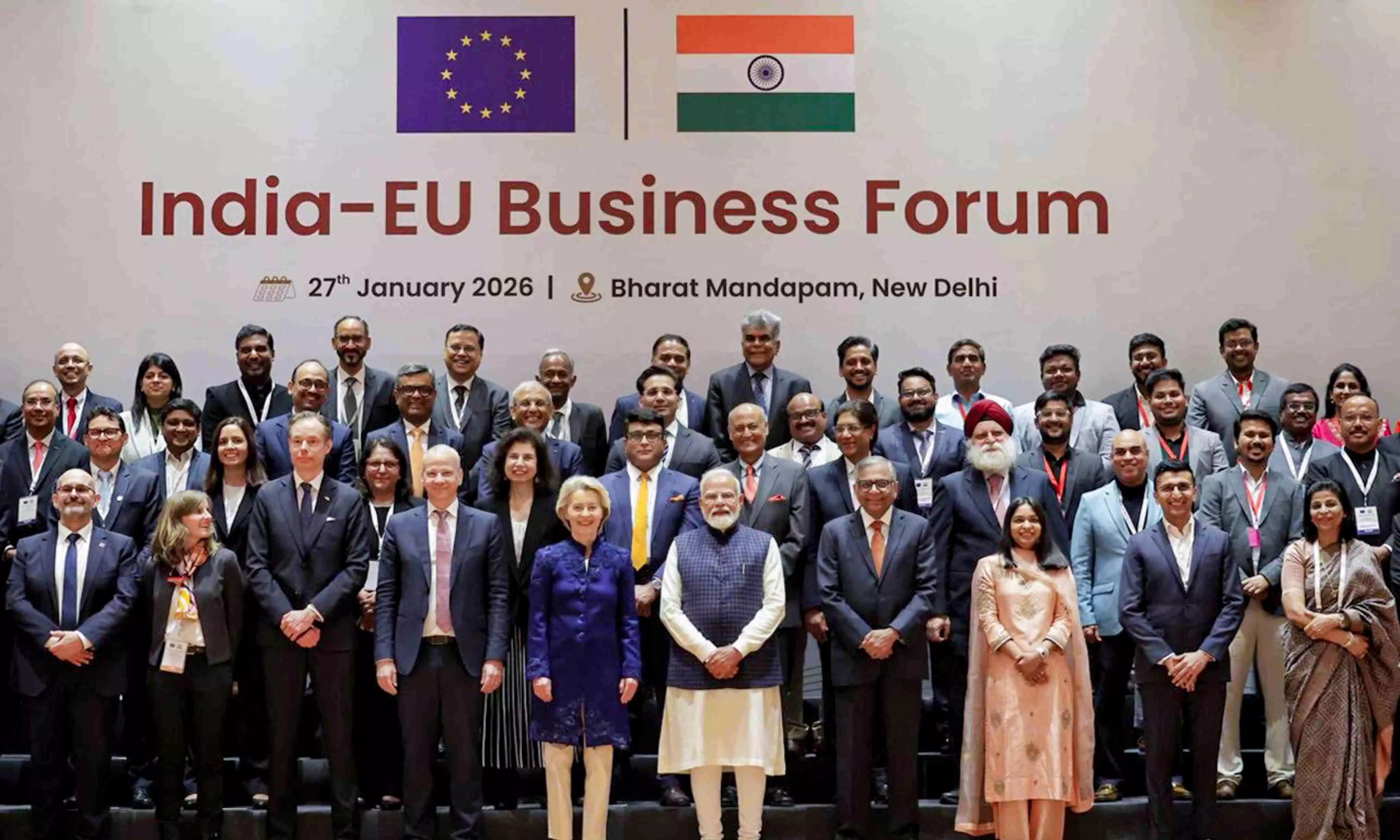
Prime Minister Narendra Modi and European Commission president Ursula von der Leyen pose for a group photo with top leaders and officials during the India-EU Business Forum. PTI Photo.
India-EU FTA: Good beginning, but don’t count the chickens yet
The India–EU FTA offers market access and tariff cuts, but unresolved regulatory, carbon tax, and compliance hurdles may delay any meaningful trade gains

The conclusion of the India-European Free Trade Agreement (FTA) on Tuesday brings psychological relief to India, which has been reeling under the stiff 50 per cent US tariffs for several months. The FTS also has potential gains from better access to the big market the 27-member bloc offers. The EU accounts for 14.7 per cent of global GDP and 15.8 per cent of global trade (2024).
However, it would be premature to count the gains because the key hurdles remain unresolved, and the negotiations will continue over the next few months –– after which the details will be made public. It would take a few more months for the FTA to be ratified by the respective parliaments before it is operationalised.
But before getting into those aspects, let’s first look at what is known about the outcome.
India gets access to 99 per cent exports, eliminates or reduces tariffs on 96 per cent
The Ministry of Commerce & Industry issued a statement that indulges in generalities that often make no sense.
For example, it said India secured market access for “more than 99% of Indian exports by trade value”, bolstering its ‘Make in India’ initiative and unlocking high-value commitments in services, complemented by a comprehensive mobility framework to enable the movement of skilled professionals. It doesn’t explain what the market access was earlier.
Also Read: India-EU FTA sends strong global cooperation message: European Commission chief
It claimed India’s labour-intensive sectors, such as textiles, apparel, leather, footwear, marine products, gems and jewellery, handicrafts, engineering goods and automobiles received a “decisive boost”, without explaining why or how.
It also claimed India’s agricultural and processed food sectors “are poised for a transformative boost”, “creating a level playing field” for Indian farmers and agrarian enterprises in areas such as tea, coffee, spices, fresh fruits and vegetables, and processed foods etc. Again, no details to substantiate the claims.
On the other hand, the European Commission was very specific and detailed.
The commission said India “eliminated or reduced tariffs” on “over 96% of EU goods exports”, including prohibitive tariffs on key EU’s agri-food products like wine, olive oil, chocolate and pastries – all of which “save around €4 billion” a year in duties on European products.
Compared to Indian goods, EU goods face stiffer tariffs from India.
Some of the key tariff concessions India granted are:
• Motor vehicles from 110 per cent to 10 per cent
• Wine from 150 per cent to 20-30 per cent (premium and medium range), beer from 110 per cent to 50 per cent
• Olive oil, margarine and other vegetable oils from up to 45 per cent to nil; kiwis and pears from 33 per cent to nil
• Processed food from up to 50 per cent to nil
• Machinery and electrical equipment lowered from up to 44 per cent to nil
• Aircraft and spacecraft from up to 11 per cent to nil
• Pearls, precious stones and metals from up to 22.5 per cent to 0-20 per cent
• Iron and steel from up to 22 per cent to nil
• Pharmaceuticals from 11 per cent to nil, etc.
These were high in the EU’s demand list.
With respect to services trade, the details are wrapped in generalities. The commission, however, claims the FTA will grant EU companies privileged access to the Indian services market, including key sectors such as financial services and maritime services— going “beyond” what they have given to other partners.
Unresolved areas and EU’s stringent regulatory oversight
Beyond the tariffs and claims that the FTA is “mother of all trade deals” lie the real challenges.
All the major hurdles remain unresolved: Carbon Border Adjustment Mechanism (CBAM) or carbon tax that the EU imposed from January 1, 2026, its tighter regulatory oversight on goods and services, its stringent data privacy law and immigration-related restrictions.
On the carbon tax, the ministry said “commitments have been secured, including a forward-looking most-favoured nation assurance extending flexibilities if any granted to third countries under the regulation, enhanced technical cooperation on recognition of carbon prices, recognition of verifiers, as well as financial assistance and targeted support to reduce greenhouse gas emissions and comply with emerging carbon requirements.”
A carbon tax will hang over Indian exports, particularly steel, due to carbon-intensive processes. The US, on the other hand, had secured an exemption in its FTA, signed a few months earlier.
The commission says the FTA entails India to “commit to work together on climate change issues and the sustainable management of natural resources”, which India will find tough to do. India may claim to adopt renewable energy or aim to achieve zero emissions by 2070, but in actual practice, it is doing the reverse-keeping renewable energy plants idle, cutting down forests, setting up more coal-fired plants, etc.
Also Read: India-EU FTA: Tariffs on European cars to be gradually cut to 10 pc from 110 pc
The other big challenge is related to regulatory oversight. Unlike the US, the European Union imposes strict and uncompromised regulatory conditions that include financial and quality auditing, adherence to all international laws on workers’ rights, human rights, ILO conventions like decent working conditions, labour inspection and environment protections or what are known as the WTO’s Sanitary and Phytosanitary Measures (SPS Agreement) that calls for adopting or enforcing measures necessary to protect human, animal or plant life or health.
The commission says, “The EU has very stringent, science-based standards to protect human, animal and plant health. All products imported from India under the agreement will have to respect these standards.” And that, “All imports from India to the EU will continue to be subject to the EU's strict health and product safety rules, with no exception.”
In contrast, India’s statement is vague. It says, “The FTA provides measures to tackle non-tariff barriers through strengthened regulatory cooperation, greater transparency, and streamlined customs, Sanitary and Phytosanitary (SPS) procedures, and Technical Barriers to Trade disciplines.”
Similarly, the EU has the toughest data protection law, in sharp contrast to India’s non-existent one. Immigration is another hot issue for the EU. All these need to be resolved for the trade to take off to the next level.
It should also be borne in mind that some of India's major rivals had a head start. The EU recently signed FTAs with Vietnam and Mercosur (Latin American countries of Brazil, Argentina, Paraguay, and Uruguay. Its ties with Bangladesh in textiles and apparel are deeper, given the tariff advantage it enjoyed as a least developed country (LDC), which willend in a year or two. The EU is currently engaged in post-LDC trade negotiations with Bangladesh.
FTA might not deliver instant gains
Given these circumstances, expecting a quantum jump in trade because of this FTA would be presumptive. The EU is already one of the largest trading partners of India, with a total trade of $137 billion in FY25.
Taking it beyond that in the short-run will be a big ask. Ask Indian exporters, and they will tell you it will take a couple of years for onboarding, compliance audits and volume scaling to bring results with the EU.