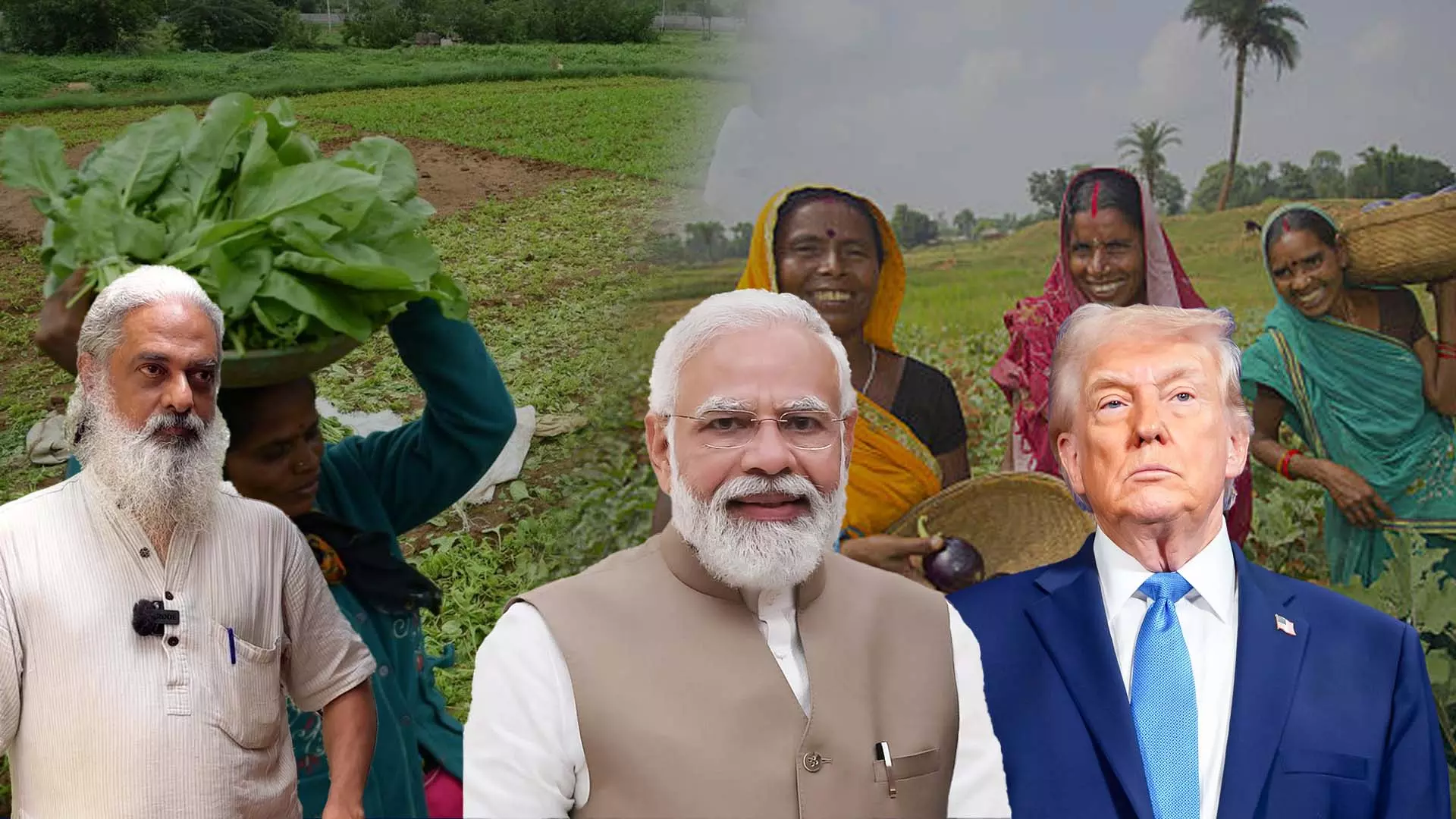
India-US trade deal | Dumping, GM crops, other fears: Expert explains
US Agriculture Secretary says deal will boost rural America; what about rural India, shouldn't Indian govt address fears, asks Ananthoo of Safe Food Alliance

“This can be disastrous. It could mean dumping across India, hitting our farmers, our health, our ecology and our environment,” warns M Ananthoo, member of the Safe Food Alliance, reacting to US President Donald Trump’s announcement of a new trade understanding with India.
With claims of lowered reciprocal tariffs and India committing to “buy American” goods worth over $500 billion, concerns are mounting over agriculture, dairy, food safety, and transparency. The Federal spoke to Ananthoo on what the deal could mean for Indian farmers, consumers, and food sovereignty.
US President Donald Trump announced the tariff cut on social media. What does this new trade deal and reciprocal tariff mean for an ordinary Indian citizen?
First and foremost, this has been announced on social media. Where was it discussed? What is the background? What was in contention, what was talked about, and what exactly is being signed — nobody knows. That itself is the biggest question.
There is an announcement, suddenly talking about $500 billion. Earlier, we were buying around $50 billion worth of American goods. Now it is being projected as a tenfold jump. How confident is anyone about that, and what is India compromising in return? We do not know.
Who will be hit? We actually know, but it is not being discussed. That is the primary concern. What are the products, and what kind of push is going to happen? For a long time, our Commerce Minister and the Prime Minister have said agriculture and dairy will not be compromised. Has that promise been kept? That is the second big question.
Also read: India-US trade deal: Is it a win or strategic compromise?
Trump has said that the Prime Minister has committed to “buy American” goods. Why is this worrying?
Donald Trump has openly stated that the Prime Minister has committed to buying American goods at a much higher level — over $500 billion in energy, technology, agriculture, coal and other products.
That can be disastrous. It raises fears of dumping across India. They are eyeing 140 crore people purely as consumers. Trump might be taking a decision that is good for the US. But we are supposed to look at what is good for us. That is how a trade deal should work.
In the last two decades, many FTAs and trade deals have been extremely one-sided, favouring rich and developed nations. They look at India only as a market. Their producers are heavily subsidised, whether farmers or industries, and they impose lopsided rules that constrain us.
Also read: Why India-US trade deal raises fears of one-sided concessions
The US has earlier objected to India’s restrictions on agricultural imports like milk, pork and fish. Will this deal force India to change its food safety norms?
That is one of the most important concerns. One side is economic impact, but the other side is ecological and health-related.
India has strict standards and rules. For example, genetically modified products are not allowed. Anyone exporting to India must comply with GM-free certification. We already have rulings on this.
The big question is whether these standards have been compromised or will be compromised. There are concerns about food safety, ecological balance, commerce and health. These are not small issues.
Does this deal mean American fruits and vegetables could flood Indian markets?
Yes, that is one of the biggest concerns. Production is the first issue. The second is whether genetically modified products will be allowed.
There has been strong pressure from the US for American corn, wheat, canola and soy. If these products enter India, it will hit our farmers, our markets, our health, our ecology and our environment.
This is not only about seed sovereignty or farm livelihoods. It is about collective public health. A lot more is at stake if these compromises are real.
There is talk of zero tariffs on certain agricultural products. How do you see this?
First, let us understand the tariff narrative. Trump increased tariffs dramatically and then reduced them. Before this, tariffs were around 3 per cent, 5 per cent, 10 per cent or 15 per cent. Increasing it to 50 per cent and then bringing it down to 18 per cent is not a great deal for us.
Second, for products that India has deliberately kept at higher tariffs due to health or safety concerns, the demand now is zero tariff. That means dumping of unhealthy products with larger consequences.
This is not just about trade. It distorts everything, including public health.
The US Secretary of Agriculture has said this deal will boost rural America. What about rural India?
We should actually thank her for being honest. She has clearly said this deal benefits rural America, their farmers and their economy.
That is exactly what we are saying — India should be concerned about Indian farmers, Indian agriculture, rural livelihoods and rural India. Unfortunately, Indian farmers will be critically affected if dumping happens.
Can you explain how dumping affects Indian farmers with examples?
There are many examples. When wheat or cotton was imported, it came at prices lower than the MSP announced by the government. MSP itself is not fair, but imports were even cheaper.
Take pulses — at what price will they enter? Or spices. When tariffs were cut under an FTA with Sri Lanka, dumping happened from Vietnam. Overnight, Vietnam became the largest exporter of pepper. Indian farmers in Karnataka and Kerala were devastated, and they have not recovered even after 15 years.
This is the reality of dumping.
How will this deal affect Indian farmers compared to American farmers?
American farmers are massively subsidised. If Indian subsidy is Rs 10, theirs is Rs 1,000. That is a hundred times more.
Their farmers will benefit. Their economy will benefit. That will be at the cost of Indian farmers. As consumers too, we need to wake up, because what comes to us could also be unhealthy food.
This impacts health, environment, ecology, economy and consumers. Everybody will be hit.
How is this different from the EU trade deal that India is negotiating?
The common factor is secrecy. Nobody knows what is being signed.
The EU negotiations have been going on for nearly two decades. What has been given up and what has been retained is unclear. Now we have a sudden overnight announcement with the US.
India has already signed FTAs with countries like Australia and New Zealand, which are affecting dairy. You may not allow raw milk, but processed products are entering and distorting the dairy market.
The same will happen in agriculture. It is an ominous sign. India has to wake up. There must be public discussion, transparency and safeguards to protect our ecology, economy, farmers and agriculture.
(The content above has been transcribed from video using a fine-tuned AI model. To ensure accuracy, quality, and editorial integrity, we employ a Human-In-The-Loop (HITL) process. While AI assists in creating the initial draft, our experienced editorial team carefully reviews, edits, and refines the content before publication. At The Federal, we combine the efficiency of AI with the expertise of human editors to deliver reliable and insightful journalism.)