








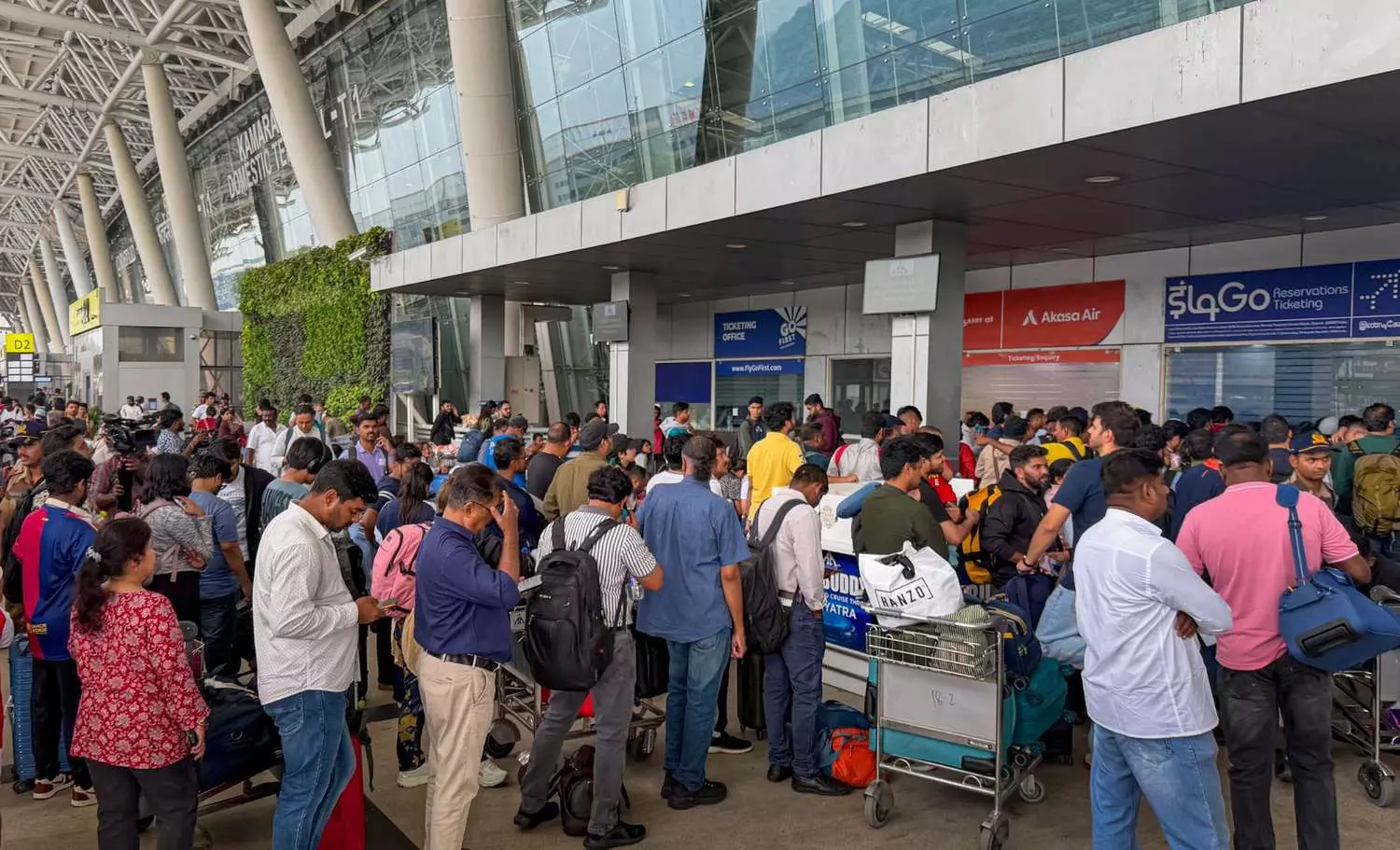
A chaotic scene at Chennai airport. PTI Photo
IndiGo effect: Domestic airfare shoots up; Kolkata-Mumbai at Rs 90,000
Operations expected to normalise in the next 10 days; chaos at airports across the country

Airfares reached levels never seen before on Friday, with a one-way, one-stop economy-class SpiceJet Kolkata-Mumbai flight ticket for December 6 costing up to Rs 90,000, and a similar ticket on Air India for Mumbai-Bhubaneswar reaching Rs 84,485, according to the airlines' websites. A similar trend was noted on many other high-traffic routes. Bengaluru-New Delhi also shot up to Rs 88,000.
Indigo said operations are expected to normalise in the next 10 days, as the country's largest airline received flight duty norms relaxation from watchdog DGCA, which will probe the disruptions that have impacted thousands of passengers for four straight days. As a large number of flights got cancelled and delayed, chaos continued at major airports across the country, with frustrated passengers scrambling for updates and searching for their baggage. Many passengers vented out their anger on social media.
IndiGo's operations, which control about two-thirds of the country's domestic traffic and generally operate around 2,300 flights daily, failed to plan properly for the new flight duty norms that provide for increased rest periods and fewer night landings.
Also Read: DGCA eases pilot fatigue-protection rules as IndiGo crisis deepens
With chaos all over, domestic airfares tripled and quadrupled, a travel industry executive said.
On one of India’s busiest corridors — New Delhi to Mumbai — fares have shot up to as much as ₹48,972 for a one-way trip, according to reports.
Fares on the Delhi–Bengaluru route have skyrocketed, with airlines charging between ₹80,069 and ₹88,469 per passenger before taxes, a staggering jump.
"The situation is such that you can't predict what the ticket prices are going to be when you book a flight. It may be two times, three times or even more than the normal fare range," he said.
IndiGo operates around 2,300 flights a day and has been cancelling flights in hundreds over the last four days as it struggled to secure adequate crew to operate its widespread and dense network.
"The last-minute fares are generally 2-3 times of the normal average fares. But in this situation, we have seen them surging even six times," the source said.
'It is black marketing'
"If a Rs 10,000 ticket is being sold at Rs 60,000, at any place, I would call it black marketing, profiteering. So there is a dire need to look at it," said Nomad Travel CEO and Travel Agents' Association of India former president, Ajay Prakash.
Slamming the surge in airfares, he said it appears that the business of civil aviation is aimed only at making money.
A market where one airline has 64-65 per cent of the market share is as good as a monopoly, Prakash said, advocating for capping of fares to prevent such high fares in times of crisis.
Delhi-based Stick Travel's founder and former president of Indian Association of Tour Operators (IATO) Subhash Goel said, "I have written to the civil aviation ministry that there should be capping on airfares like it was during the Covid-19 pandemic." he said.
DGCA relief for Indigo
Meanwhile, Aviation watchdog DGCA provided a raft of exemptions to crisis-hit IndiGo to help normalise its operations.
Apart from the Flight Duty Time Limitations (FDTL) exemptions, the regulator has provided certain other relaxations that will help IndiGo have more pilots for duty to reduce the disruptions and normalise operations.
"Pilots who have been deployed elsewhere or are under Designated Examiner (DE) refresher training and standardisation checks may be used for flying duties till February 2026," the regulator said.
A market where one airline has 64-65 per cent of the market share is as good as a monopoly, Prakash said, advocating for capping of fares to prevent such high fares in times of crisis
Currently, the watchdog has 12 FOIs (Flight Operations Inspectors) on deputation from IndiGo.
"These FOIs have been allowed to take up flying duties to facilitate Indigo pilot scheduling for a week. All these pilots are A320 type-rated and hold valid licenses," DGCA said in a statement.
The 12 FOIs have been released for flight duties and simulator checks to IndiGo for one week.
"DGCA has deployed its team at IndiGo's operational control centres for real-time monitoring of flight operations regarding delays/cancellations, passenger facilitation, etc. In addition, teams from DGCA regional offices are monitoring the situation at the airports," the statement said.
Amid concerns in certain quarters about the FDTL relaxations given to IndiGo, DGCA said the one-time exemption on specific requirements was granted on February 10 solely to facilitate operational stabilisation.
"Based on the submission of IndiGo, review of operational constraints during the winter season and in order to normalise operations, DGCA has granted a one-time exemption on specific requirements of FDTL norms to IndiGo till 10th February 2026. This exemption has been granted solely to facilitate operational stabilisation and in no way amounts to dilution of safety requirements.
"During this period, DGCA would review after every fifteen days, the action taken by IndiGo to address the situation, including hiring of adequate crew to ensure FDTL compliance," the statement said.
Interestingly, the lack of adequate planning in implementing the second phase of the FDTL norms is a key reason for the flight disruptions.
With the temporary relaxations, IndiGo will not have a cap on night landings for a pilot. As per the norms, a pilot can have up to 6 landings per day.
Temporarily, for IndiGo, the nighttime will be defined as from 12 am to 5 am. These two exemptions will help ensure more pilots are available for operations.
(With Agency inputs)