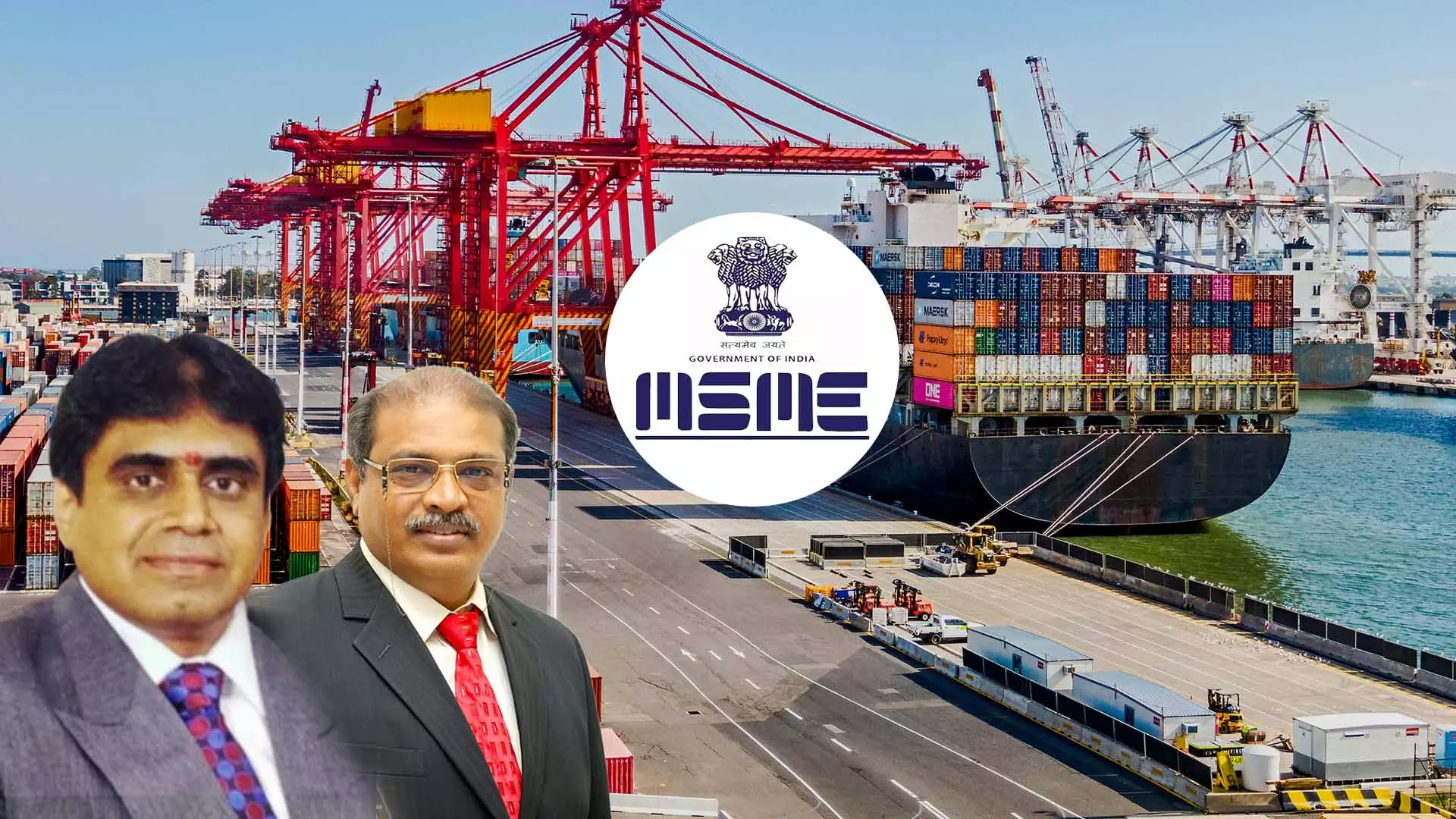
MSME export credit push: How govt plans to cut costs for small exporters
With interest subsidies and credit guarantees, the Centre aims to ease export finance for MSMEs amid global uncertainty. Will it be enough?

For thousands of small Indian businesses, exporting is not just about demand but about access to affordable finance. High borrowing costs and lack of collateral often decide whether an export order moves forward or stays on paper.
Government data underline the central role of smaller firms in India’s export economy. Micro, small and medium enterprises (MSMEs) accounted for nearly 50 per cent of total exports before the pandemic in FY20, dipped through FY22 and FY23, and then recovered to about 45.7 per cent in FY24. Latest figures show their share rising again to 48.55 per cent in FY25.
Despite this, MSME exporters continue to struggle with high interest rates and limited bank credit. To address these barriers, the Union Cabinet approved a new export credit support package under the export promotion mission in November 2025, with an outlay of over Rs 25,000 crore till FY 2030–31. The objective is to make export finance cheaper and easier for MSMEs.
Cheaper loans
A key element of the package is an interest subsidy to lower borrowing costs. The government will offer a 2.75 per cent interest subvention on export loans, covering both pre-shipment credit and post-shipment credit until payments are received.
Also read: Rahul Gandhi accuses Modi govt of destroying MSMEs for monopolies
This measure is designed to directly reduce the cost of funds for small exporters, helping them stay competitive in global markets where rival countries often enjoy cheaper credit support.
Raja M Shanmugham, former president of the Tirupur Exporters Association, said high financing costs have long hurt India’s competitiveness. “The cost for making exports is very high compared to our competing countries across the globe,” he said, noting that earlier interest subvention had been reduced from 5 per cent to 3 per cent before being revived now at 2.75 per cent.
Collateral relief
The second major intervention focuses on collateral, another major hurdle for MSMEs. Many small exporters lack assets to pledge for loans, making banks hesitant to lend.
Under the new scheme, the government will guarantee a significant portion of export loans. The guarantee cover will go up to 85 per cent for micro and small enterprises and up to 65 per cent for medium enterprises, with a cap of Rs 10 crore per exporter per year. This backing is meant to give banks greater confidence to extend credit.
Also read: MSME NPAs to rise moderately to 3.9 pc by FY26 amid US tariff impact: Crisil
Calling the no-collateral provision a “big game changer”, Thomas K Varghese, MSME chairman of the Southern India Chamber of Commerce and Industry (SICCI), said, “Already our collateral will be used in the bank. If exporters can get no-collateral credit just based on exports, that will really help.”
Speed matters
While the policy intent is clear, exporters stress that timely execution will be critical. Varghese pointed out that delays in loan processing remain a serious concern. “Generally banks take 10 to 15 days to get things organised. If that delay is reduced, it will be a big help for MSMEs,” he said.
Shanmugham also welcomed the interest support but flagged its limits. He noted that the subsidy comes with a cap of Rs 50 lakh per unit and argued that it may still be insufficient compared to the advantages enjoyed by exporters in countries such as Bangladesh, Vietnam and Cambodia.
“The differential between our competitors and India has to be taken as a mean value and given as a subsidy,” he said, warning that delays and cost pressures were already affecting buyer interest, especially from the US market.
Volatile backdrop
The support package comes at a time of global trade uncertainty and currency volatility. In 2025, reports highlighted a sharp weakening of the rupee due to global trade pressures.
Also read: GST 2.0, US tariffs could reshape investment and trade dynamics: Josh Felman
While a weaker rupee can benefit exporters, it also raises the cost of imported raw materials, squeezing margins for MSMEs. In such conditions, exporters say stable and affordable credit becomes even more critical for sustaining operations.
Both the interest subvention and the credit guarantee will begin as pilot programmes, with detailed guidelines to be issued by the Reserve Bank of India and the Credit Guarantee Fund Trust for Micro and Small Enterprises.
Awareness gap
Beyond cost and collateral, exporters highlight another challenge: awareness. Varghese noted that many MSME owners are often unaware of new schemes when they are launched. “If the government works through associations and industry bodies, we can take it to the industry. Awareness is very important,” he said.
Also read: GST reforms are mere tokenism, don't address systemic issues: TN MSMEs
For MSME exporters, access to timely credit often determines whether an order ships or stalls. The success of this export credit push will depend on how quickly banks adopt the schemes and how easily small businesses can access the promised benefits.
(The content above has been transcribed from video using a fine-tuned AI model. To ensure accuracy, quality, and editorial integrity, we employ a Human-In-The-Loop (HITL) process. While AI assists in creating the initial draft, our experienced editorial team carefully reviews, edits, and refines the content before publication. At The Federal, we combine the efficiency of AI with the expertise of human editors to deliver reliable and insightful journalism.)