



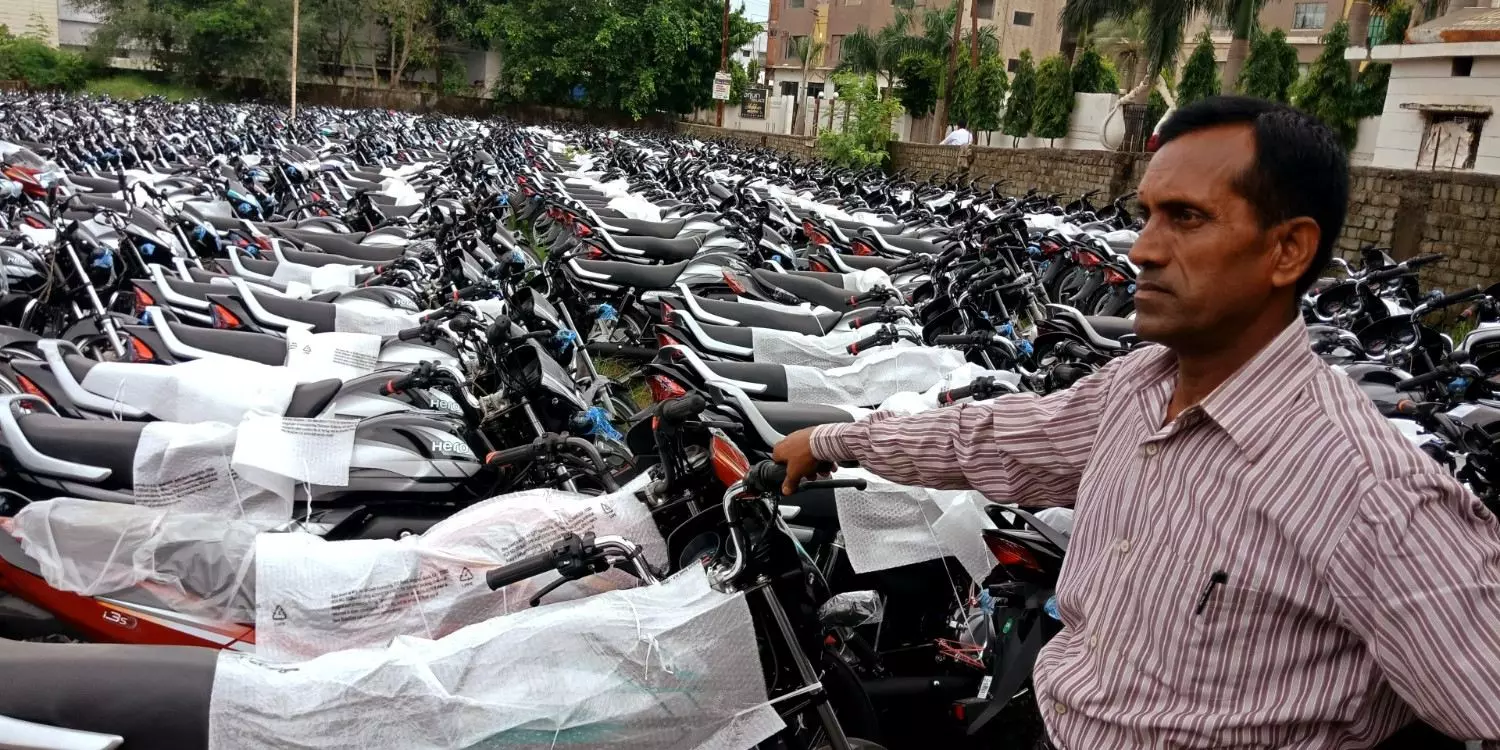
Navratri vehicle retail falls 6.5 pc as passenger car sales slump 22 pc, EV demand stays strong
Two-wheeler and passenger vehicle sales weaken year-on-year, while electric vehicle retail grows 27 per cent; comparison is partly distorted by an additional festive day last year.

Vehicle retail sales in India declined 6.52 per cent year-on-year during Navratri this year, with a sharp contraction in passenger vehicles and two-wheelers offsetting modest gains in commercial vehicles and tractors, according to provisional data released by the Federation of Automobile Dealers Associations (FADA) on Wednesday (October 21).
Total vehicle retail stood at 11.23 lakh units during the 11-day Navratri period, compared with 12.01 lakh units a year earlier. However, sales remained 26.76 per cent higher than the 8.86 lakh units recorded during Navratri in 2024, when the festival fell across a different calendar window.
Also read: India auto sector records USD 1.7 bn in deals in Q3 as EV investments drive growth
The year-on-year decline needs to be viewed in the context of a longer festive selling period last year. Navratri 2025 covered 11 days, compared with 10 days this year, FADA said, making the headline contraction an imperfect indicator of underlying demand.
Commercial vehicle sales rise
Passenger vehicle retail fell 21.91 per cent to 1.83 lakh units from 2.34 lakh units a year earlier. Two-wheeler sales declined 2.79 per cent to 8.34 lakh units, while three-wheeler retail dropped 7.51 per cent to 45,735 units.
Commercial vehicle sales rose 1.12 per cent to 35,618 units, while tractor retail increased 0.89 per cent to 22,690 units. Construction equipment vehicle retail declined 1.97 per cent to 2,240 units.
The divergence suggests that the festive period did not generate a uniform demand recovery across vehicle categories. Passenger vehicles, which accounted for a substantial share of last year's retail volumes, recorded the steepest decline among the major segments. Two-wheelers, the largest category by volume, also remained below year-ago levels.
FADA president Sai Giridhar said the comparison was affected by the difference in festival duration and the timing of the implementation of the goods and services tax (GST) 2.0 reforms. He attributed part of the decline to demand being brought forward into an earlier buying window.
Also read: Core sector growth jumps to 7.9 per cent in September, led by iron ore and electricity
The data, based on vehicle retail information compiled in collaboration with the Ministry of Road Transport and Highways (MoRTH), covered 1,468 of 1,469 regional transport offices. FADA said registration data for Telangana was unavailable for three-wheeler, commercial vehicle and tractor categories during the period.
Electric vehicles outperform the broader market
Electric vehicle retail continued to grow even as overall vehicle sales weakened. EV retail across the reported categories rose 26.78 per cent to 1.17 lakh units during Navratri, against 92,628 units in the corresponding period last year.
Electric two-wheeler sales increased 33.41 per cent to 75,758 units, while electric three-wheeler retail rose 10.51 per cent to 28,086 units. Electric passenger vehicle sales grew 25.97 per cent to 12,305 units.
Electric commercial vehicle retail nearly doubled, rising 96.04 per cent to 1,288 units. Although the category remains small in absolute terms, the growth points to expanding adoption in selected commercial applications.
The comparison with 2024 was even stronger. Total EV retail was up 83.06 per cent from 64,153 units during that year's Navratri period. Electric passenger vehicle sales were nearly four times their 2024 level, while electric commercial vehicle retail was more than four times as high.
EVs accounted for approximately 10.5 per cent of total vehicle retail during Navratri 2026, up from around 7.7 per cent a year earlier. The increase indicates that electrification is gaining share despite the weakness in the broader market.
However, the figures do not establish that EV demand is insulated from the factors affecting conventional vehicle sales. The mix of products available, price points, financing, policy support and the timing of registrations can all influence short-period comparisons.
Festive demand remains the key test
The Navratri figures offer an early, but incomplete, reading of the festive season. Dealers and automakers will look to the Dhanteras-Diwali period for evidence that consumer demand has held up beyond the initial festival window.
The key question is whether the passenger vehicle and two-wheeler weakness reflects purchases shifting between weeks or a more sustained moderation in demand. Retail data covering the broader festive period should provide a clearer picture than a single festival comparison.
For automakers, the results also underline the uneven nature of the market: conventional vehicle retail remains under pressure in some high-volume categories, while electric models continue to expand from a smaller base.
A stronger performance over the full festive season would help establish whether the Navratri decline was largely a calendar and timing effect. Until then, the headline figures point to a mixed market rather than a broad-based festive sales surge.