Partnership or predation? How the India-EU FTA tilts the playing field
India appears to be trading Macaulay’s East India Company for a multi-member European colonization project—this time under the aegis of the Modi government

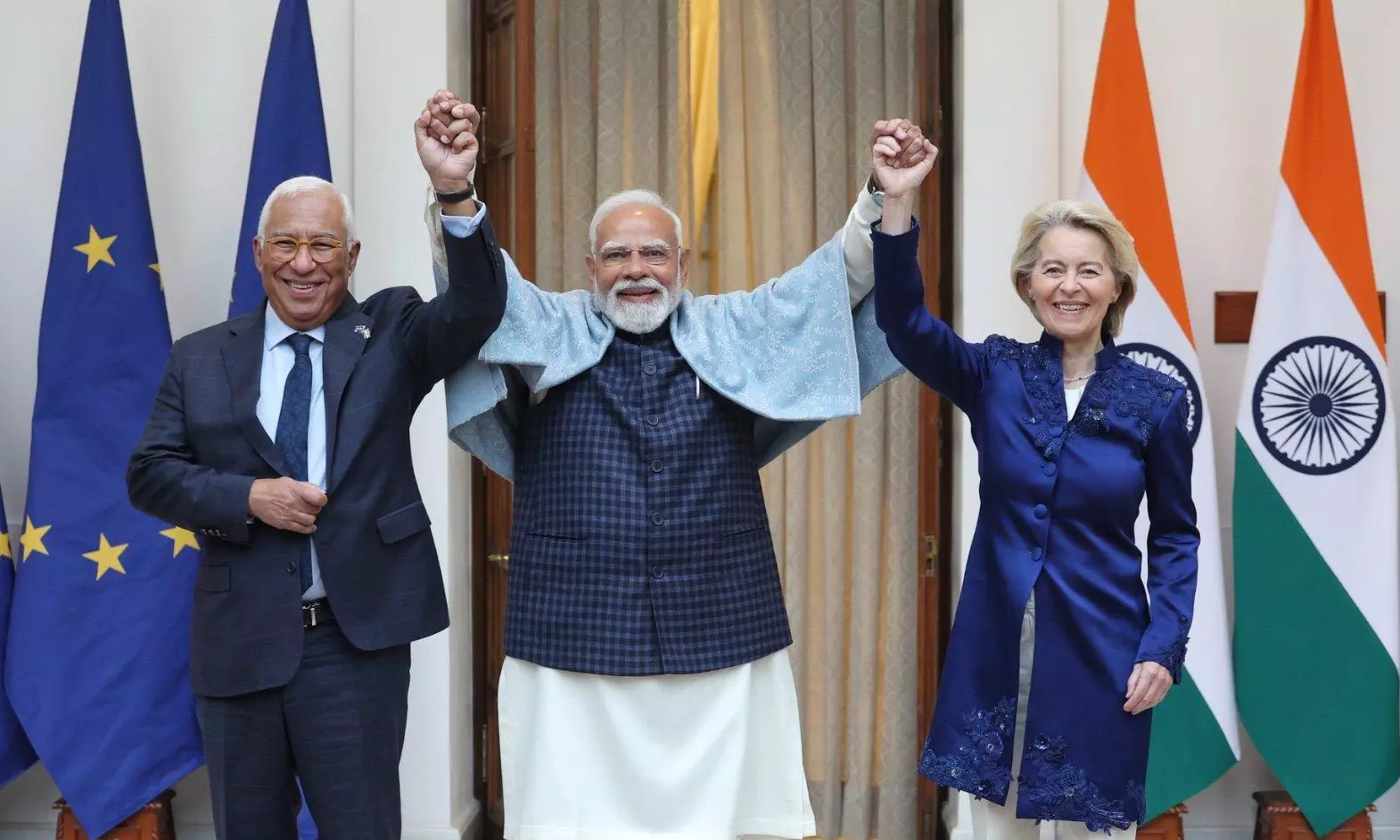
Amid choreographed fanfare and breathless superlatives, India and the European Union on Tuesday (January 27) selectively unveiled what they claim is a “historic” Free Trade Agreement (FTA). Prime Minister Narendra Modi declared that trade agreements “reinforce a rules-based economic order and promote shared prosperity,” insisting that this deal ranks among “the most ambitious ever concluded.”
European Commission President Ursula von der Leyen eagerly echoed the script. “We delivered the mother of all deals,” she proclaimed, even invoking Makar Sankranti—a curious cultural flourish aimed at flattering an increasingly religion-inflected Indian political order.
Yet once the applause fades, the substance of the agreement is conspicuously thin. Beyond glossy, PowerPoint-style outlines of tariff cuts, neither side has released a comprehensive, transparent account of what was actually conceded—and by whom.
Agriculture: A bonanza for Europe
According to the EU’s own factsheet, the FTA “removes often prohibitive Indian tariffs”, granting European agri-food exports “unmatched market access”, surpassing even what the EU secured from the UK and Australia.
Also read: India–EU FTA decoded: Trade expert Biswajit Dhar on winners, losers, and hidden risks
India has agreed to slash tariffs across a sweeping range of agricultural products. Wine tariffs will plunge from a peak of 150 per cent to 20 per cent for premium varieties and 30 per cent for mid-range products. Spirits—including whisky, rum, and gin—will face a 40 per cent tariff, down from 150 per cent. Beer will be taxed at 50 per cent. Tariffs will be eliminated entirely on fruit juices, non-alcoholic beer, breads, pastries, biscuits, pasta, vegetable oils, and sheep meat.
For Europe’s farmers and food conglomerates, this is a windfall. For Indian producers, it is an open gate.
Industry: Make in India unmade
The concessions on industrial goods are even more dramatic. A vast array of EU exports—machinery, electrical equipment, aircraft and spacecraft, optical and medical instruments, plastics, chemicals, iron and steel, precious metals, and pharmaceuticals—will enter India at zero tariff.
Even European automobiles will enjoy tariff reductions to a historic low of 10 per cent, under a quota of 250,000 vehicles.
Also read: India-EU FTA: Good beginning, but don’t count the chickens yet
At a moment when India’s manufacturing sector is shrinking, shedding jobs, and gasping for policy support, the Modi government has chosen to dismantle what little protection remains. The much-hyped Make in India programme now risks being submerged in the Indian Ocean—jettisoned in a rush to appease Brussels. Whatever safeguards were needed to revive manufacturing have been discarded, casually and irrevocably.
Services and IP: Binding India’s hands
On services, the EU boasts that India accepted “ambitious commitments”, binding current levels of liberalization beyond those offered to the UK or Australia. For the first time, India has locked itself into commitments on dredging and maritime cable-laying services, alongside new transparency rules affecting senior management and boards.
Even more striking is the surrender on intellectual property. While Modi proclaims India the “pharmacy of the world”, the FTA opens the floodgates to European pharmaceutical giants. India has agreed to a “high level of protection and enforcement” of IP rights, covering copyrights, trademarks, designs, trade secrets, undisclosed information, and even plant varieties.
For a country whose public health system relies on affordable generics, this is a perilous gamble.
A one-way street
What does India get in return? The EU factsheet is silent on the market access it will provide to Indian exports. India, tellingly, has released no factsheet of its own. Some reports hint at zero tariffs for Indian textiles and leather—but these gains are marginal, diluted within the EU’s already crowded web of FTAs.
Also read: India-EU FTA sends strong global cooperation message: European Commission chief
A former Indian trade negotiator sums it up bluntly: This looks like a one-way street. Much like India’s recent FTAs with Australia and New Zealand, the agreement throws open Indian markets in one sweeping move, with little reciprocity.
Behind the grand claims of a “mother of all deals” lurks an uncomfortable truth: India may be entering a new phase of economic colonization—arguably more insidious than Macaulay’s East India Company two centuries ago.
It’s the NTBs, stupid
In today’s trade regime, non-tariff barriers (NTBs) matter more than tariffs. And the EU is among the most aggressive users of such barriers, deploying unilateral instruments like the Carbon Border Adjustment Mechanism (CBAM) and the Deforestation-Free Products Regulation—measures that disproportionately target developing countries.
There is little evidence India secured relief. Stringent SPS standards continue to block Indian farm exports. For iron, steel, and cement, India’s own commerce secretary has acknowledged that CBAM will remain firmly in place. The EU’s promise of €100 million in technical assistance is a fig leaf, not a solution.
Also read: India-EU FTA: Tariffs on European cars to be gradually cut to 10 pc from 110 pc
Meanwhile, India appears to have granted European financial and other services near-free rein at home, without clarity on whether it secured meaningful Mode IV access for its own service providers. Longstanding EU barriers—such as economic needs tests—remain unresolved. India has even opened a slice of its vast government procurement market to European firms, again without visible reciprocity.
Against China—or against India?
The scale of concessions to the EU also raises questions about India’s China strategy. China can supply advanced industrial goods, including electric vehicles and renewable technologies. Granting sweeping access to European vehicles while restricting others appears economically incoherent.
Having dismissed ASEAN FTAs as “silly” for enabling China’s “B team”, India is now embracing an equally questionable arrangement with the EU—one that may prove just as damaging.
A reverse EU-US deal
Last year, the EU agreed to a framework deal with the United States, accepting a 15 per cent tariff on its exports while granting zero tariffs to many American products. That deal remains unimplemented.
Also read: US Commerce Secretary slams India-EU trade deal over Russian oil purchases
India has now been handed a reverse version: Zero tariffs for EU exports, while Indian goods face continued barriers in Europe. The Modi government can hardly claim ignorance of what it has conceded.
Concede bilaterally, resist multilaterally
Even as India surrenders trade sovereignty to the EU bilaterally, it may soon face Brussels as its fiercest adversary at the WTO. The EU is pushing to dilute consensus decision-making, erode special and differential treatment, and replace multilateralism with plurilateral deals—moves India has long opposed.
The new FTA is a litmus test. Will India hold the line at the WTO’s 14th ministerial conference, or quietly cave—helping to bury the very rules-based trade order it claims to defend?
Also read: India, EU complete FTA negotiations, summit announcement today
In sum, India appears to be trading Macaulay’s East India Company for a multi-member European colonization project—this time under the aegis of the Narendra Modi government. Behind the rhetoric of democracy and rule of law lies a deeper drift towards centralized power and economic submission.
On that score, India can indeed claim to be a Vishwa Guru—a global cautionary tale in how not to negotiate trade sovereignty.