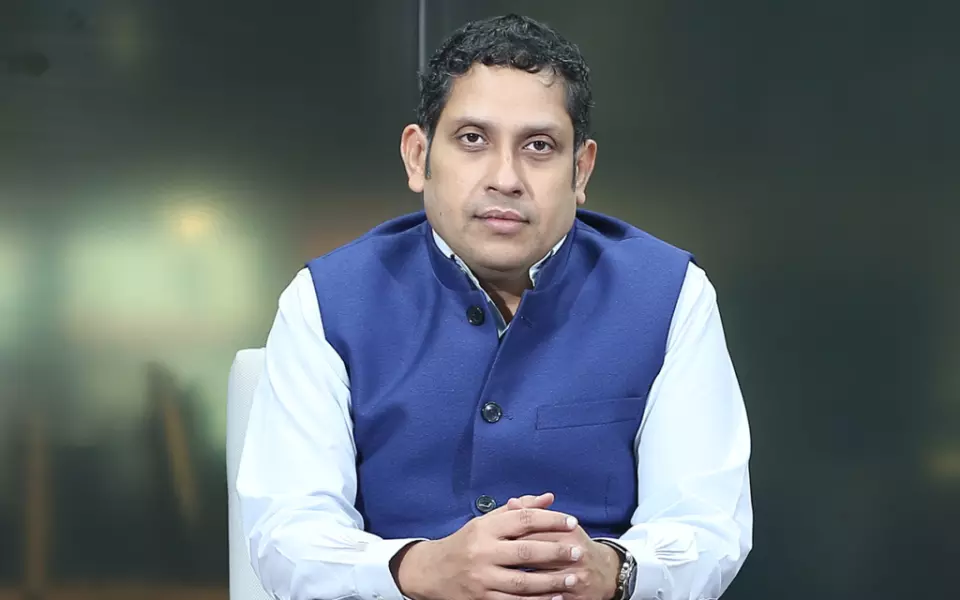
Praveen Chakravarty slams Budget 2026, says it ignores jobs, state debt
Congress leader and economist warns that headline GDP growth numbers mask a real-world crisis in household incomes

Praveen Chakravarty, political economist and chairperson of the All India Professionals' Congress, has questioned the substance of the Union Budget 2026, arguing that headline growth numbers and fresh announcements conceal deeper weaknesses in the economy, especially on jobs, household incomes and rising state-level debt.
Also read: Budget's STT hike on F&O delivers a double-engine blow to investors
Speaking to The Federal, he said Union Finance Minister Nirmala Sitharaman’s “boring” Budget speech on Sunday (February 1) marked a shift away from political theatrics, but warned that repeated announcements without implementation mean little for the real economy.
Here are some edited excerpts:
You described the Union finance minister’s Budget speech as “boring” in your Indian Express column. Why so?
First, the finance minister did not even have a Thirukkural quote, the customary Thirukkural quote in her speech. So, doesn’t that qualify it to be boring? Now jokes apart, I think it is very clear that there was a certain listlessness in her Budget speech. After all, this finance minister is not new to us because this is her ninth budget presentation.
Also read: Is India’s Goldilocks economy leaving states high and dry? | Talking Sense With Srini
We’ve seen how animated and excited and agitated the finance minister could get in previous Budget speeches, but all of that was lacking. Now, don’t get me wrong, I actually think boring is good. So in a sense, the finance minister has perhaps finally realised that the Budget is a serious, more technical exercise than political grandstanding.
Analysts and even the governor of the Reserve Bank of India have described India as a ‘Goldilocks Economy’. Growth is steady, and inflation is low. Isn’t India at a sweet spot?
As far as the headline GDP growth and even headline inflation numbers are concerned, I think now we have seen this enough to know that headline GDP growth really doesn’t resonate or even make sense any longer. There is a very clear divorce between headline GDP growth and the real state of the economy as experienced by the common people.
So, we can call it whatever — double-digit growth, fastest-growing economy in the world and all these other things. I’ll give you one simple clue. Did you hear the word jobs ever mentioned in the Budget speech yesterday? And what matters in an economy? The economy is the one thing that every Indian experiences. They may not understand it, but they experience it — through incomes, which come from jobs — and through expenditure, which comes from prices and inflation.
Also read: Budget 2026: Sitharaman's IT Safe Harbour gambit reflects long history of trial and failure
And on both these counts, the headline numbers do not matter as much. Yes, inflation is low, but that's largely because what’s happening to oil prices around the world and very little to do with the government’s own policy.
The government has announced a Rs 10,000-crore MSME growth fund and higher allocations for schemes such as outgoing MGNREGA. Isn’t this an attempt to address jobs indirectly?
We must be careful about a lot of these announcements that are made. And I’ll give you one simple clue. Along with the Budget documents, there was another document that was placed yesterday. It is called the implementation of the announcements made in last year’s budget. It’s a 76-page document — read the document, and you will understand why I said these announcements matter very little.
For example, last year, the finance minister announced a scheme for jobs in the manufacturing of toys. We were supposed to make India a global hub for toy manufacturing, which would create jobs. According to the government’s own report on implementation, you know what has happened in one year? The report says we have had an inter-ministerial consultation on this.
Also read: Budget 2026 puts Tamil Nadu in spotlight with rare earth and rail push
I mean, this is laughable. So do not pay any heed or attention to any of these announcements. These are just grandstanding, political grandstanding. Honestly, don’t get fooled.
India is offering a long tax holiday for foreign firms setting up data centres. Will this attract private investment?
See, I think data centres are an opportunity for India, that is for sure. As the world embarks on massive AI spending, data centres are important. But tax holidays mean jack for attracting foreign firms to set up data centres. What do they need? They need massive amounts of land. They need reliable, continuous and affordable power. And they need water. These are the three things they need. If we can provide these, of course, we can attract data centres. This foreign tax holiday is just a distraction.
The government is sticking to its fiscal glide path and shifting focus from fiscal deficit to debt-to-GDP. Isn’t that a positive signal?
The year 2026 will go down in the history of India’s budget as the year when we moved away from fiscal deficits to focusing on debt and the debt-to-GDP ratio. On that, the current Union government’s debt-to-GDP is 56 per cent for this year.
The finance minister has projected it to go down to 55.6 per cent next year and promised to achieve 50 per cent in five years’ time by 2031. I think that’s a good direction to take. There is a larger problem here. For India, it is not just the Union government’s debt-to-GDP. We have to look at the combined debt of the Union and the states. On that front, unfortunately, states as a whole are actually increasing their debt levels.
Shouldn’t states be held responsible for their rising debt levels?
The onus certainly rests with the states; there is no doubt about that. But where do states get most of their revenues from? They get it from GST. The GST is the single largest source of revenues for state governments. Who sets GST rates? Neither the Union government nor one state government — it is the GST Council. So, states have almost no control over their largest source of revenue.
Also read: Budget 2026: Fiscal consolidation and incremental changes; no big bang reforms
Can states control expenditure? Absolutely, yes. But we have a federal structure administratively and political diversity across states. Local politics drives expenditure, while the federal structure dictates revenues. These two keep clashing. That is why states’ debt — especially in states such as Tamil Nadu and Punjab — has gone completely out of control. And this is a real harm to the nation’s economy.
The Congress had criticised the government for opting out of multilateral trade forums, including the Regional Comprehensive Economic Partnership (RCEP). But the Narendra Modi government has managed quite well to sign a barrage of free-trade agreements, with the latest one with the European Union (EU) very recently. How do you see these trade-related developments?
The India-EU free trade agreement is a very welcome move, perhaps late by a decade or so. It also signals a reversal in direction, a U-turn by the Modi government. Ever since 2014, import tariffs and customs duties have largely gone up, signalling protectionism. For the first time, we have agreed to lower import duties and tariffs. That is a good thing.
Defence spending has increased, but you have described it as nothing out of the ordinary. Isn’t the government still signalling defence as a high-priority sector, particularly in the current geopolitical climate?
Yes, I think the increase in defence expenditure is welcome. The share of defence expenditure in total spending was actually going down under Prime Minister Modi all these years. Now, because of what has happened to the global order, every country is beefing up its defence and internal security. In that context, India is justified in raising defence expenditure. Is it enough? Is it all for new defence equipment, given how warfare has changed? Absolutely not. But is it at least a step in the right direction? Yes.