








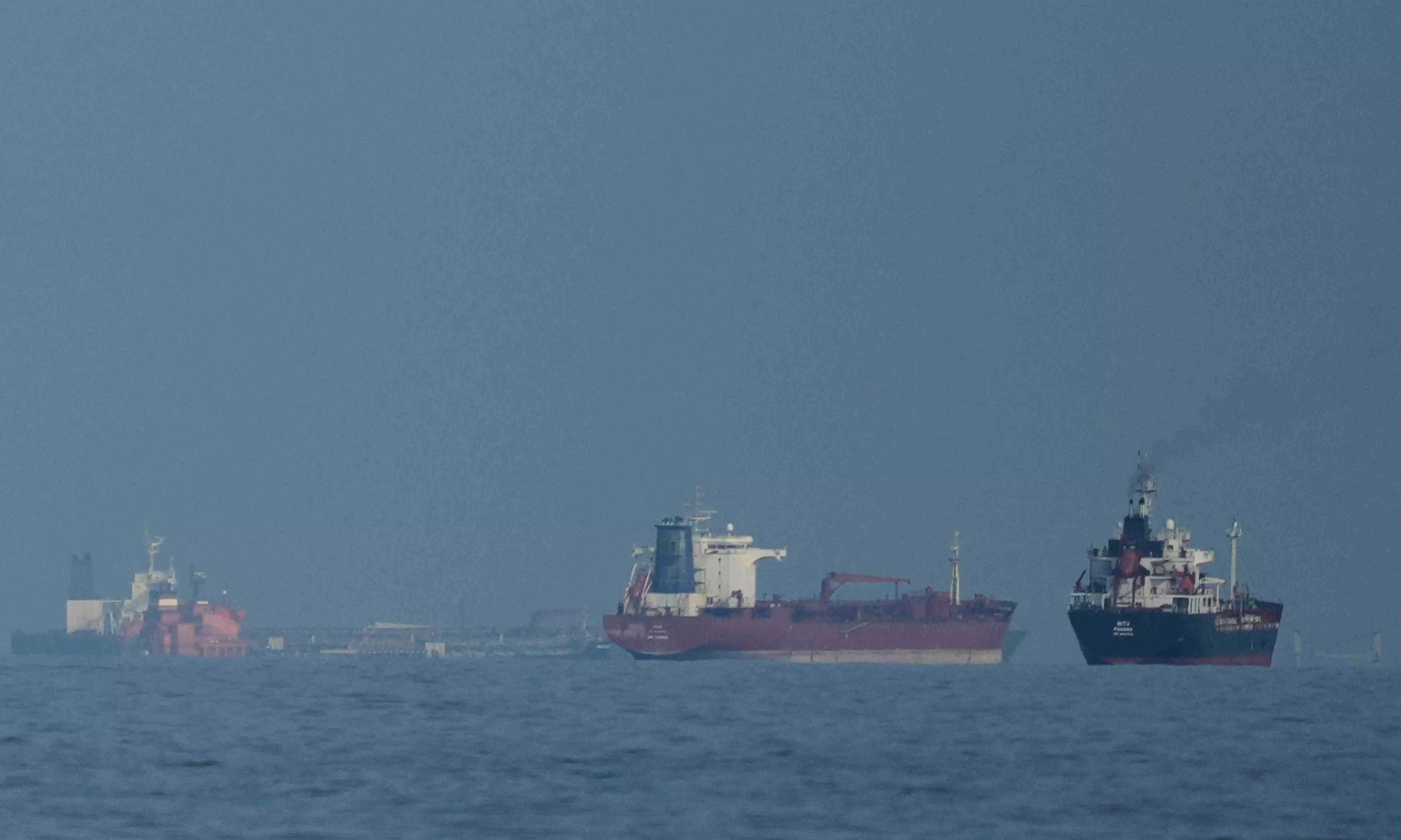
Oil tankers and cargo ships line up in the Strait of Hormuz as seen from Mina Al Fajer, United Arab Emirates. File photo: AP/PTI
Strait of Hormuz reopening to ease oil supply risks for India
The narrow waterway between Iran and Oman handles roughly a fifth of global oil consumption and serves as the primary export route for major Gulf producers

New Delhi, Jun 15 (PTI) A reopening or normalization of shipping through the Strait of Hormuz would provide significant relief for India, one of the world's largest crude importers, by easing concerns over oil supplies, lowering freight costs and reducing pressure on inflation.
The narrow waterway between Iran and Oman handles roughly a fifth of global oil consumption and serves as the primary export route for major Gulf producers, including Saudi Arabia, Iraq, Kuwait, the United Arab Emirates and Qatar - all key energy suppliers to India.
Supply of crude oil - the raw material for making fuels like petrol and diesel - and natural gas - the feedstock used to generate electricity, produce fertiliser, turned into CNG to run automobiles and piped to household kitchens for cooking - through the strait was disrupted since the start of Iran in the end of February. This triggered sharp increases in crude oil prices, shipping insurance premiums and freight rates.
Industry sources and analysts said the reopening and reduction in tensions would likely help stabilize global energy markets and improve the outlook for energy-importing nations such as India.
Oil prices fell on Sunday after US President Trump said the United States had reached a ceasefire agreement with Iran that would allow the "toll free" passage of ships through the Strait of Hormuz.
"I hereby fully authorize the toll free opening of the Strait of Hormuz, and, simultaneously herewith, authorize the immediate removal of the United States Naval blockade," US President Donald Trump posted online. "Ships of the World, start your engines. Let the oil flow!" Oil prices dropped on news of the ceasefire. Price of Brent crude, the global benchmark for oil, fell 4 per cent, to around USD 84 a barrel.
Global oil prices had risen to as high as USD 119 per barrel at the peak of war-related disruption, from USD 70-72 a barrel in February. This increased the cost of producing petrol and diesel, but the government held on to the retail rate revision till mid-May. The government on March 27 slashed excise duty on petrol and diesel by Rs 10 per litre each in a bid to avoid a retail price increase just when five critical states, including West Bengal, went to polls.
Post assembly elections, petrol and diesel prices were raised by about Rs 7.50 per litre each, while CNG rates were up Rs 6 per kg. LPG prices too were increased by Rs 89 per 14.2-kg cylinder in two instalments.
Notwithstanding the price increase, state-owned oil companies continue to lose about Rs 650 crore per day as retail rates lag cost.
With oil prices easing and the reopening of the Strait, these will gradually come down, industry sources and analysts said.
"State-owned fuel retailers booked losses in one quarter that were equal to the profit they earned in the entire year," an industry official said. "If the agreement holds, energy supplies will ease and so will the prices"
INDIA'S RESPONSE TO DISRUPTIONS
Pre-war, India imported more than 88 per cent of its crude oil requirements, with half of it being sourced from Gulf producers whose exports transit through Hormuz. It was 60 per cent import dependent to meet LPG needs, 90 per cent of which came through the strait. The country depended on imports to meet half of its natural gas needs, of which 65 per cent came from countries like Qatar and the UAE.
The war disrupted LPG supplies as well as natural gas flows from Qatar, India's largest liquefied natural gas (LNG) supplier.
Natural gas allocation was rationalised with cuts being imposed on certain users. LPG disruption led to initially stopping supplies to commercial users like hotels and restaurants, and gradually restoring up to 70 per cent of their needs. For household users, refill booking time was increased.
The government and refiners also stepped up efforts to diversify crude sourcing beyond traditional suppliers in the Gulf. Indian refiners increased engagement with suppliers across multiple geographies, including Russia, Africa, the United States and Latin America, to ensure alternative cargoes would be available if supplies from the Middle East were disrupted.
Natural gas buyers similarly explored additional procurement options and closely monitored spot LNG markets to secure supplies.
Authorities also reviewed inventory positions across the fuel supply chain and worked with oil marketing companies to ensure adequate stocks of petrol, diesel, LPG and aviation fuel were maintained at depots and retail outlets.
Last week, the government notified provisions allowing temporary restrictions on bulk purchases of petrol and diesel through retail fuel stations, citing risks of diversion and localised shortages.
Industry executives said oil companies also reviewed contingency plans covering shipping routes, vessel availability and cargo scheduling to ensure continuity of supplies under various disruption scenarios.
REOPENING OF STRAIT
Industry sources said an uninterrupted shipping route would reduce the risk of supply delays and help refiners maintain predictable procurement schedules.
Lower crude prices would be among the most immediate benefits. Every sustained decline in oil prices helps reduce India's import bill, supports the rupee, narrows the current account deficit and eases inflationary pressures. Indian refiners would also benefit from lower shipping and insurance costs.
Lower fuel costs can reduce transportation expenses, ease pressure on manufacturers and help moderate prices of goods ranging from food products to construction materials, they said.
A normalization of traffic through Hormuz would also provide relief to policymakers. Reduced geopolitical risk in the Gulf would give the government greater flexibility in managing energy and economic policy, containing inflation, and maintaining fiscal discipline.
The benefits could be particularly significant for sectors such as aviation, petrochemicals, fertilizers, shipping and logistics, all of which are highly sensitive to energy costs. PTI