








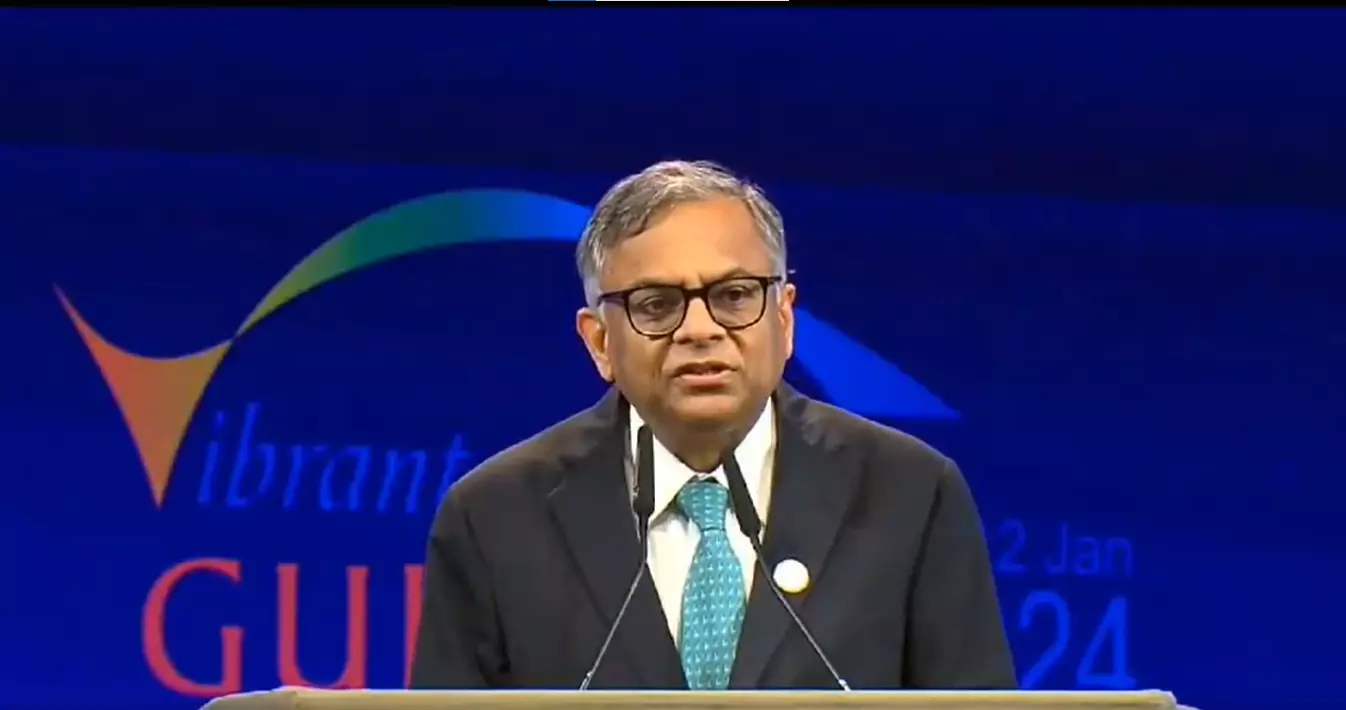
Speaking at the Vibrant Gujarat Global Summit in Gandhinagar, Tata Sons chairman Chandrasekaran said the group is also about to start a 20 GW gigafactory to manufacture lithium ion batteries in Sanand in two months. Photo: X screengrab | @InfoGujarat
Equal number of AI agents and employees in three years at TCS, predicts N Chandrasekaran
Tata Sons Chairman N Chandrasekaran says TCS could have as many AI agents as employees within three years as AI revenue reaches USD 2.5 billion

Indicating a major pivot towards the use of Artificial Intelligence (AI) by the company, Tata Sons Chairman N Chandrasekaran has said that the Tata Consultancy Services (TCS) will soon have as many AI agents and workers as human workers.
"I predict that over the next three years, TCS will have as many AI agents as human employees. The day is not very far when TCS will have an equal number of AI agents or AI workers as their physical workers,” said Chandrasekaran as quoted by ANI.
AI investment push
Elaborating further, Chandrasekaran said that TCS was heavily investing in AI agents in spheres such as internal operations, solution frameworks and external operations in a bid to capitalise on the rapid evolution of enterprise AI.
Also Read: AI may use more water than world's annual drinking water needs by 2030: UN Report
As for TCS’ AI revenue, Chandrasekaran said that it has witnessed consistent growth over the last four quarters and recorded a compound quarterly growth rate of more than 22 per cent, adding that TCS' annualised AI revenue reached USD 2.5 billion in the last quarter of fiscal 2026.
Describing AI as a major growth driver for the technology services industry, Chandrasekaran said concerns about AI disrupting the sector overlook the significant opportunities it is creating for enterprise IT.
"Far from being a mortal threat, AI is the most significant opportunity yet for enterprise IT," he told shareholders.
Five growth opportunities
Chandrasekaran outlined five areas expected to benefit from rising AI adoption. The first is the modernisation of legacy technology systems and fragmented data environments.
Also Read: Anthropic warns AI could one day build its own successors, challenging human control
The second involves redesigning business processes, including supply chains and customer interactions, using AI-driven solutions.
The third opportunity lies in managing and governing AI agents to ensure compliance, security and cost efficiency.
The fourth is the emergence of sovereign AI, as governments and regulated institutions seek greater control over AI infrastructure and data. Chandrasekaran said TCS has already launched sovereign AI initiatives in India and Europe.
Sovereign and physical AI
The fifth area is physical AI, which brings AI capabilities into factories, warehouses and vehicles. He cited an example of a global agribusiness client using a four-legged robot to monitor hazardous warehouse conditions.
Also Read: Apple unveils new AI features with privacy focus at annual developers conference
Despite concerns over AI-led disruption, Chandrasekaran said TCS continues to maintain strong business momentum. "Margins have held, revenues are up, and the deal pipeline is stronger than ever," he said.
"In enterprise AI, the scarcest resource will not be the model. It will be context and trust," Chandrasekaran said.
TCS reported FY26 revenue of Rs 2.67 lakh crore, up 4.6 per cent year-on-year, while net profit rose 8.8 per cent to Rs 52,820 crore. Total contract value exceeded USD 40.7 billion.