Budget 2026: Rail traffic stalls, congestion remains acute, debt burden mounts
Traffic data falls short and capital spending trails inflation, forcing modal shift to road transport as debt repayments to Railway Finance Corporation escalate

Finance Minister Nirmala Sitharaman’s latest Budget is like that of a petulant child who pretends that hiding its report card from its parents would somehow deflect attention away from its poor performance. Specifically, for all the bombast in the Budget about the “boost” to infrastructure, for the third successive year, Sitharaman has avoided mentioning the Indian Railways in her 90-minute Budget speech.
Crucially, by not mentioning the two most pressing problems of the railways – the poor performance on the rail traffic front and the continued under-funding for capacity expansion – she appears to think that the illusion of normality can be maintained.
More than the numbers in the budget, what characterises this Budget is the absence of any reference to the worrying performance of the Indian Railways in the current year. This, and not just the numbers in the Budget, is what would have provided the much-needed context for an evaluation of what is in store for the railways. Forget the next financial year, which is what this budget is about, in the current year, the Railways have missed targets she set last year for both passenger as well as freight traffic.
Railway traffic stagnant
First, let us examine the performance on the passenger traffic front. Last year, the Finance Minister set a target of 1,311 billion passenger km (PKM), 16 per cent higher than passenger traffic in 2024-25. The revised estimates for the current year reveal that passenger traffic in the current year will be 11 per cent below the target. In fact, the revised estimate shows that passenger traffic will be just 3.4 per cent higher than in the previous year. Undaunted by this – or perhaps aware that public attention next year will be drawn away from what she has promised now – she expects passenger traffic to grow by a little over 5 per cent in 2026-27.
Also Read: Budget 2026: Business as usual in a world that is not
Things are not much better in the movement of freight traffic, which is where the Indian Railways makes an operating profit. Last year, the Finance Minister hoped that the railways would move 967 billion net tonne km (NTK) in 2025-26. This target was itself marginally lower than what the railways carried in 2024-25. However, the revised estimate for the current year shows that freight traffic will be lower by 1.3 per cent when compared to the previous year. Undaunted yet again, the Finance Minister has projected an increase of about 4 per cent in 2026-27.
Freight traffic woefully short of 2030 target
Now, let us evaluate the performance on the freight traffic front by comparing with the targets set in the National Rail Plan formulated in 2021. As part of a plan to improve the modal share of the Railways in freight from the abysmal 25-26 per cent to about 40 per cent by 2047, it set a medium-term target of 3,000 million tonnes of originating traffic for the railways by 2030. The Railways currently carry about 1,700 million tonnes of originating traffic, which means that freight traffic has to increase by more than 75 per cent in the next four years to achieve the target set for 2030.
The compound annual growth rate of freight traffic carried by the railways since the Modi government assumed office has been just about 4 per cent. This means that traffic has to increase at a compound rate of 15.7 per cent per annum in order to reach the 2030 target. This indicates just how hopelessly off-target the government is, according to normative standards it set for itself five years ago.
Serious bottlenecks in passenger traffic
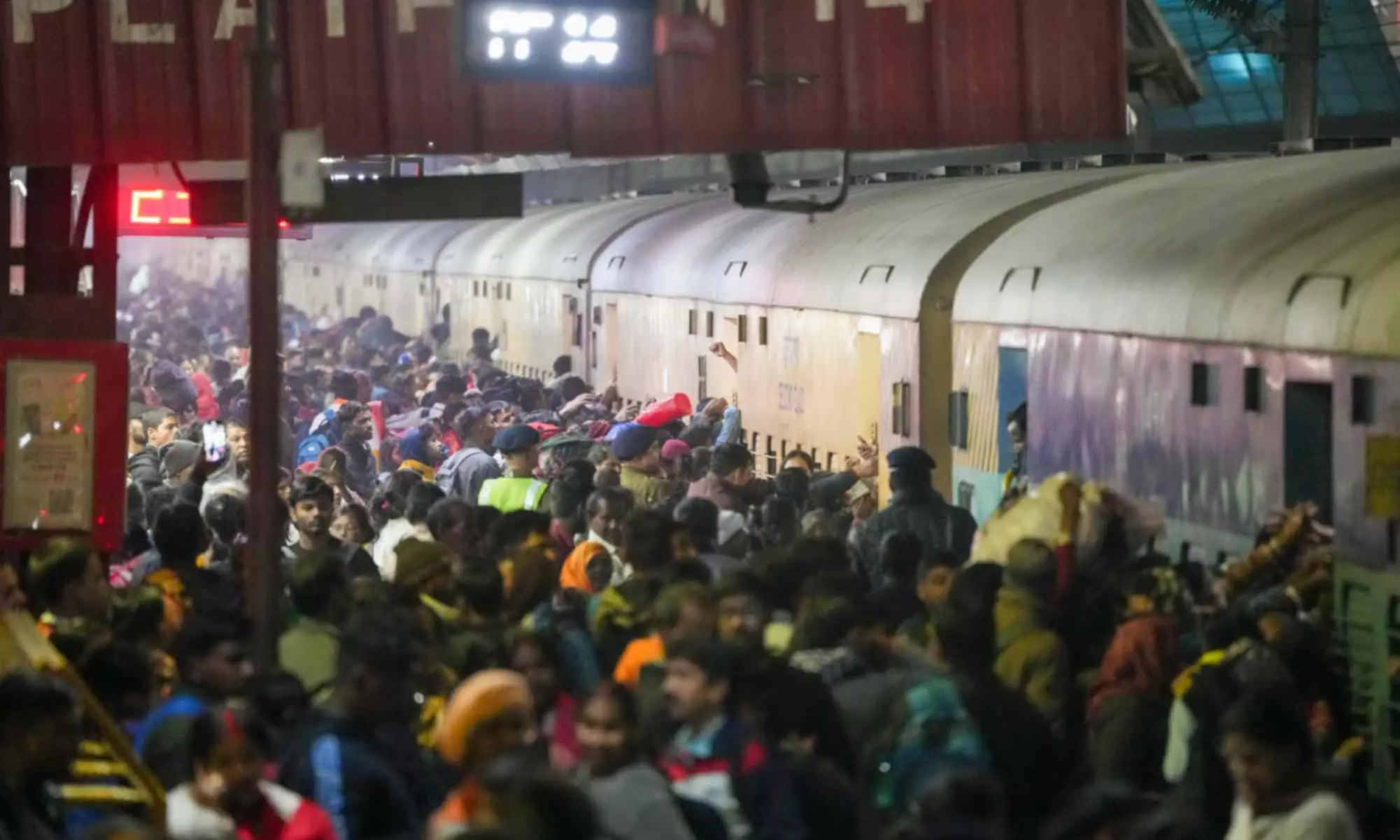
There is little doubt that despite the fanfare with which the Vande Bharat trains have been introduced, passenger traffic suffers from a serious capacity constraint. This was highlighted during the Indigo Airlines meltdown, which offered the railways a godsend opportunity to tap into the inter-city travel market that was vacated by the biggest Indian airline. The fact that the railways could not accommodate the demand for rail travel suggests a serious capacity constraint. The stark reality that passenger traffic increased at a compound annual rate of 1.22 per cent in the decade since the Narendra Modi Government assumed office demonstrates this very clearly.
Indeed, on the passenger traffic front, there are indications that the modal share of road travel has increased sharply in recent years because of the railways’ failure to cater to demand. A recent study by railway experts has suggested that inter-city bus travel has been growing at 25 per cent per annum in the last few years. It observed that inter-city bus travel by potential upper-class passengers is about 300 million passengers – about the same volume of railway passenger traffic in higher class services.
Anecdotal evidence suggests that at the other end of the social spectrum too – for instance, migrant workers – people travel long distance in crowded and unsafe buses packed far beyond their legally-set capacity. For example, busloads of Nepali workers travel all the way from the towns along the India-Nepali border or from Delhi to Bengaluru, simply because they cannot get aboard one of the jampacked trains.
Also Read: Budget 2026: Fiscal consolidation and incremental changes; no big bang reforms
The largely unregulated business of long-distance bus travel, indicated by the spate of fatal bus accidents in recent times, illustrates the failure of the railways to cater to this important sector. This is quite apart from the obvious benefits of rail travel as an environmentally-friendly mode of transport.
About two-thirds of the total non-suburban passenger traffic ferried by the railways in 2024-25 are of those travelling by Sleeper Class or Second Class. Of the total non-suburban traffic of 1,011 billion passenger km (PKM), these two classes of travellers accounted for 670 billion PKM. Another one-fifth of the total non-suburban traffic – about 218 billion PKM – is accounted for by AC-Three Tier and AC Chair car passengers.
These two categories of travellers can be said to typically belong to two different social categories. It is evident that the railways is failing these two segments of passengers, both of which are turning to the costlier and less-safe option of road travel. If anything, the neglect of the railways is pushing a modal shift away from the Railways, instead of augmenting its share of traffic – passenger or freight.
The mention of seven new high-speed corridors is not backed by any allocations, demonstrating yet again that a wish list does not make a Budget.
Stagnant capital expenditure
There is little doubt that track congestion is the single most important reason for the railways’ failure to acquire a higher share of traffic, in terms of passengers as well as freight. This is what brings us to the question of the capital expenditures in not just this budget but the previous ones.
Capital support to the budget in the current year (2025-26) was estimated at Rs 2.55 lakh crore; inclusive of extra-budgetary resources (mainly public private partnerships amounting to a mere Rs 10,000 crore), the total budgetary support was Rs 2.65 crore. Most crucially, this allocation was lower (albeit marginally) than resources mobilised in the previous year, indicating that in real terms the allocations were significantly lower. Now, in 2026-27, the total allocation is being increased by about 11 per cent, amounting to Rs 2.93 lakh crore. Most strikingly, the allocation for 2026-27 is just 8.5 per cent higher than the allocation made two years earlier – not even enough to account for inflation in this period.
Cost escalation eats into capex
But things are worse, much worse, for two sets of reasons. First, the railways is realising less and less bang for its buck in the investments made for strengthening its capacity to carry traffic on its network. While it is true that allocations for new lines, track renewal (a euphemism for replacing aged tracks), and line doubling – all of which go towards creating additional carrying capacity - have risen in the last few years, the costs have increased much higher than the allocations.
Also Read: Budget 2026 bets on long-term growth, but is it politically ambitious? | Capital Beat
For instance, the allocation for new lines in 2026-27 has been projected at Rs 36,772 crore, almost 20 per cent higher than that for the current year. However, the higher allocation is for building 500 km of new lines, compared to 700 km in 2025-26. Effectively, this means that the railways plans to spend Rs 73 crores per km of new lines, compared to Rs 44 crore per km, implying a cost escalation of 66 per cent within a year. Similarly, although allocations for track doubling have increased, the cost per km is set to increase by more than 40 per cent.
The growing burden of debt
A second major feature of the accounting in the Budget relating to capital expenditures is overhang of accumulated debt. What the budget for 2026-27 reveals is that an escalating fraction of the railway capex is going towards repayment of past borrowings. In 2024-25, the payment of capital costs of leased assets – effectively repayment of borrowings – accounted for 8.40 per cent of the total capex of the railways; this is projected to increase to 10.6 per cent in the current year; and, in 2026-27, repayments are set to account for 13.50 per cent. In 2026-27, repayments are set to amount to almost Rs 40,000 crore, an increase of 40 per cent over 2024-25 (revised estimate).
Also Read: Budget 2026 and the unanswered crisis facing India’s MSMEs
In fact, net repayments to the Indian Railway Finance Corporation in 2026-27 are projected to increase to Rs 22,389 crores, compared to Rs 5,203 crore in the current year. Overall, in the four years since 2023-24, the railways is projected to repay a total of more than Rs 50,000 crore to the IRFC. In fact, these repayments are projected to escalate sharply after 2028 when a large proportion of past borrowings of the railways move out of the moratorium phase. The outstanding liabilities to the IRFC amounted to more than Rs 4.50 lakh crore in 2025-26.
It is clear that the realities of perhaps India’s most valuable – yet neglected - national asset, potentially one that can generate a wider economic stimulus, will catch up with those in power, sooner rather than later. Not addressing the most profound problems of the Indian Railways is not going to make them go away.