








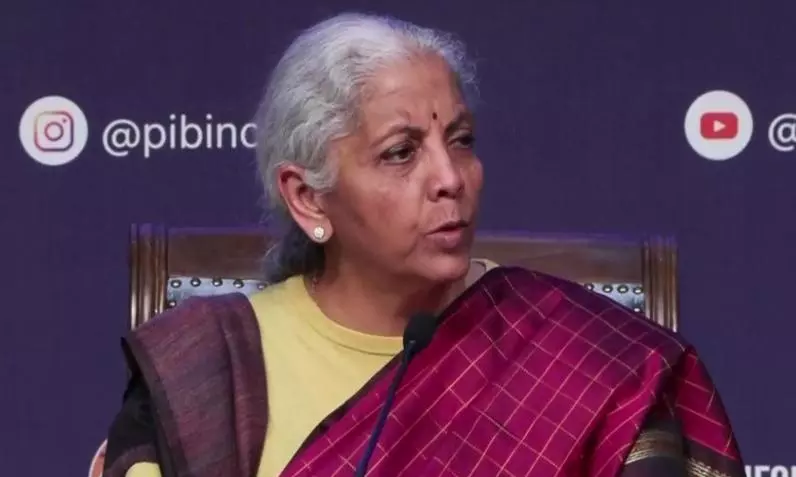
Sitharaman said the 21st century would be driven by technological adoption that benefits ordinary citizens. Screengrab: ANI
Budget 2026-27: Record Rs 12.22 lakh crore Capex, says Nirmala Sitharaman
Union Budget 2026-27 proposes record Rs 12.22 lakh crore capex, 4.4% of GDP, as Finance Minister Nirmala Sitharaman outlines growth push

Finance Minister Nirmala Sitharaman on Sunday (February 1) said that the Union Budget 2026-27 proposed the highest-ever capital expenditure of Rs 12.22 lakh crore, which is 4.4 per cent of the GDP.
FY27 Capex 10 per cent higher than FY26
The capital expenditure for FY27 is 10 per cent higher than the Rs 11.11 lakh crore budgeted capex announced in FY26.
"We have announced that Rs 12.22 lakh crore is coming through public expenditure. This time it is 4.4 per cent of GDP, which is the highest at least in the last 10 years, it could even be the highest if you were to take data of earlier period," Sitharaman told reporters at the post-budget conference.
Also Read: Repackaged Budget sops for Bengal irk state players: 'Humpty Dumpty Budget'
The capital expenditure was 2.5 per cent of GDP in 2021-22 and around 4 per cent of GDP in 2024-25. The government's capital expenditure was Rs 2.35 lakh crore in 2015-16.
The 4.3 per cent fiscal deficit target for FY27 is "realistic and responsible", Sitharaman said.
‘Focused on sustaining economic growth’
The Union Finance Minister further stated that the government is focused on sustaining economic growth by strengthening the underlying ecosystem through continued structural reforms.
Also Read: Budget 2026-27 gives big push to rare earths; these 4 states to get dedicated corridors
“We are laying the path and giving a push to the economy to maintain the growth momentum,” she said, adding that the emphasis remains on reforms aimed at improving productivity and generating employment, reported ANI.
On technological adoption
Stressing the role of technology in future growth, Sitharaman said the 21st century would be driven by technological adoption that benefits ordinary citizens. “We will ensure that technology is brought in to benefit the common man,” she said.
She further stated that funding of Rs 1,000 crore per city per year has been provided, with a major focus on tier-2 and tier-3 cities.
Also Read: Budget 2026 | The same old grouse: Kerala feels Left out
As for industrial initiatives, the Finance Minister said the semiconductor mission included two major announcements linked to strengthening India’s technology stack and intellectual property ecosystem.
She pointed to the Rs 40,000 crore electronic components manufacturing scheme as a significant boost toward self-sufficiency in electronics.
Rare earth corridors
“We have also announced establishing rare earth corridors,” she said, explaining that this would reduce India’s dependence on external sources for critical materials.
Also Read: Budget 2026-27: What gets cheaper and what gets costlier?
Sitharaman said the proposed rare earth corridors would be located in Odisha, Kerala, Andhra Pradesh and Tamil Nadu.
“Once we identify and explore these minerals and process them, our dependency on external sources will be lesser,” she said, adding that such measures would have a wide-ranging impact on the economy and reduce reliance on imports such as magnets and rare earths.
Additional tax-relief measures
On the taxation front, the finance minister said additional relief measures had been introduced. “Seven more rare diseases are added to the import exemption list,” she said, noting that baggage clearance and personal items brought in by travellers would also receive enhanced duty-free allowances.
She added that the budget includes several proposals relating to both direct and indirect taxes.
(With agency inputs)