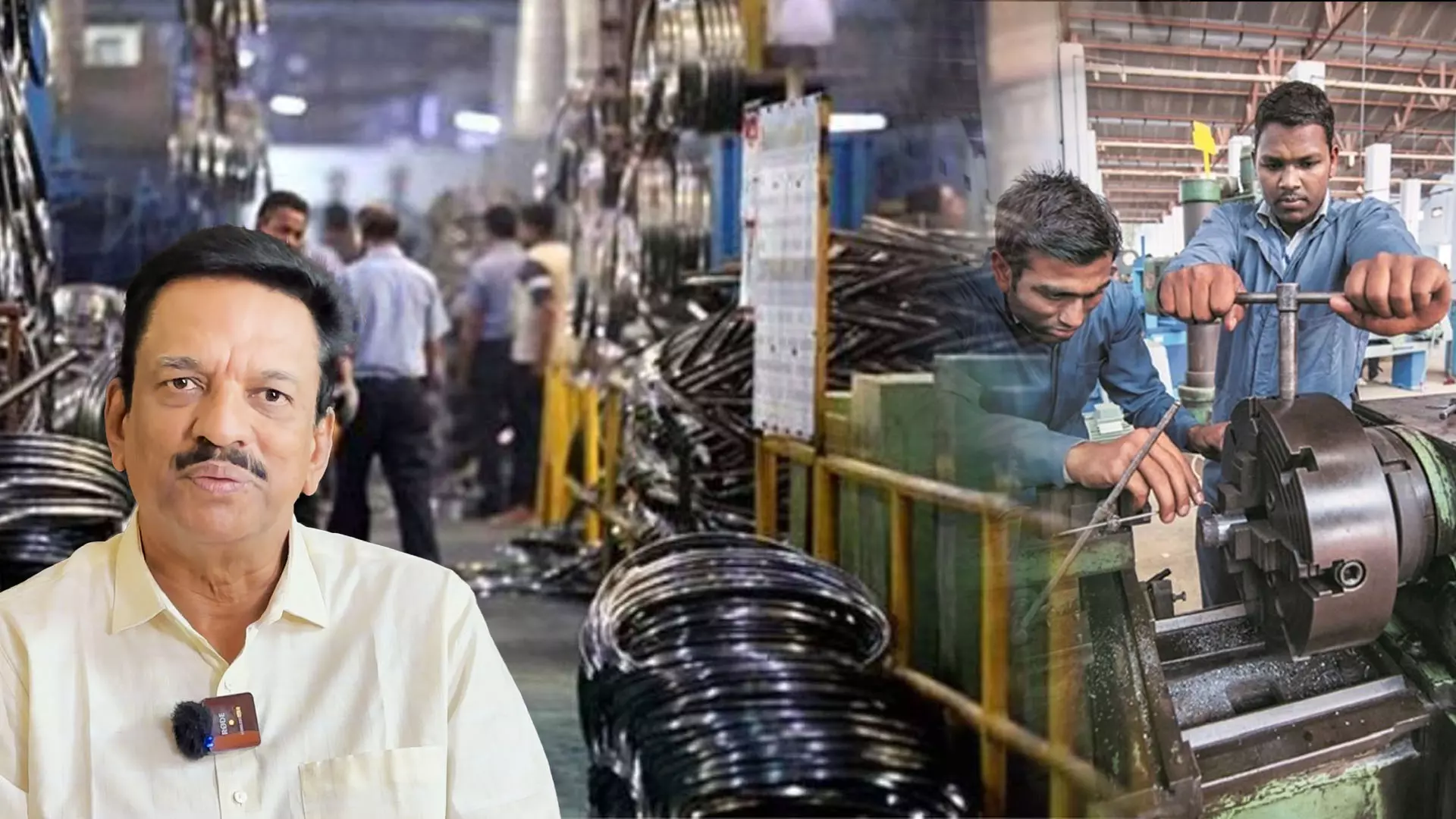
Union Budget 2026: MSME push faces ground-level scepticism
A Rs 10,000-cr growth fund promises future-ready MSMEs, but neglect, credit gaps, and market pressures remain unresolved. Is this real support?

The Union Budget 2026 has promised to make India’s micro, small and medium enterprises future-ready through a Rs 10,000-crore MSME growth fund. But questions remain on whether these announcements will translate into real relief on the ground for small entrepreneurs facing mounting economic pressures.
Chairperson of the Association of Indian Entrepreneurs, KE Ragunathan, examined the Budget through the lens of MSME industries, arguing that while big-ticket announcements sound promising, the sector’s core problems remain largely unaddressed.
According to Ragunathan, MSMEs continue to be misunderstood, with policy support skewed towards corporates rather than small and micro enterprises that form the backbone of employment and manufacturing.
Growth fund doubts
Finance Minister Nirmala Sitharaman spoke of creating “champion MSMEs” through the new growth fund. However, Ragunathan questioned whether such funds would genuinely reach small entrepreneurs.
“Most of the time the Budget gives relief to corporate sectors. The MSME sector seems to have been neglected or not properly understood in terms of its requirements,” he said.
Also read: Budget 2026 and the unanswered crisis facing India’s MSMEs
He pointed out that MSMEs are already struggling with external shocks such as recent US tariff actions, which hit exporters without warning. Despite months of consultations, he said, no concrete relief measures were announced.
Missing safety net
Ragunathan said MSMEs had expected the government to announce an emergency relief fund to protect small and micro enterprises from shocks like wars, tariffs, raw material shortages, container shortages, and currency fluctuations.
“If only this fund was created and an SOP was drawn, relief would have been immediate rather than being heard, considered, and then not announced,” he said.
He argued that the absence of such a mechanism reflects what he described as a shift from delayed response to outright neglect of MSMEs.
Credit bottlenecks
One of the biggest challenges highlighted was delayed payments and access to working capital. The government’s Trade Receivables Discounting System (TREDS), meant to ensure MSMEs receive payments within 45 days, was described as ineffective.
“All of us know it was a big failure. Not many people even adopted the process,” Ragunathan said.
Also read: Budget 2026: MSME sector gets Rs 10,000 cr boost
He also flagged raw material price volatility, suggesting the government could have supported MSMEs through the National Small Industries Corporation by supplying essential raw materials at stable prices for limited periods.
Market imbalance
Marketing and platform dependence emerged as another key concern. Ragunathan said many MSMEs now depend heavily on e-commerce platforms dominated by large players such as Amazon, Flipkart, and Jio.
“It is just a one-sided deal. MSMEs have no say when payments are delayed and no choice in deciding margins,” he said, arguing for a government-backed marketing platform for small and micro enterprises.
Reacting to incremental reforms around credit guarantees, he remarked that such assurances were “not acceptable, expected, or pleasing to the ears.”
Lending reality
Ragunathan questioned the gap between policy announcements and banking practices. Despite priority sector lending norms, he said micro enterprises still cannot access even Rs 5-lakh loans without collateral.
“There is a gap between the cup and the lip,” he said, noting that MSME lending accounts for barely 19–22 per cent of total bank outflows.
Also read: MSME export credit push: How govt plans to cut costs for small exporters
He suggested the creation of a dedicated micro and small enterprises lending bank. While the Small Industries Development Bank of India (SIDBI) was created for this purpose, he said it does not function as a direct, large-scale lending institution for MSMEs.
Unanswered questions
Ragunathan argued that this year should have been declared an MSME rehabilitation year, especially after pandemic-era shocks and ongoing global uncertainties.
“Why did you let the SME die? Why did you allow the SME to cry?” he asked, addressing the finance minister directly.
He also questioned the logic of skilling and middle-income empowerment when MSMEs themselves remain financially stressed, asking whether the budget truly views MSMEs as a growth engine or merely as a welfare segment.
Also read: Is India’s Goldilocks economy leaving states high and dry? | Talking Sense With Srini
As key issues like price competitiveness, faster refunds, collateral-free credit, and market access remain unresolved, Ragunathan concluded that without structural reforms, it is difficult to call Union Budget 2026 an MSME-friendly Budget.
(The content above has been transcribed from video using a fine-tuned AI model. To ensure accuracy, quality, and editorial integrity, we employ a Human-In-The-Loop (HITL) process. While AI assists in creating the initial draft, our experienced editorial team carefully reviews, edits, and refines the content before publication. At The Federal, we combine the efficiency of AI with the expertise of human editors to deliver reliable and insightful journalism.)