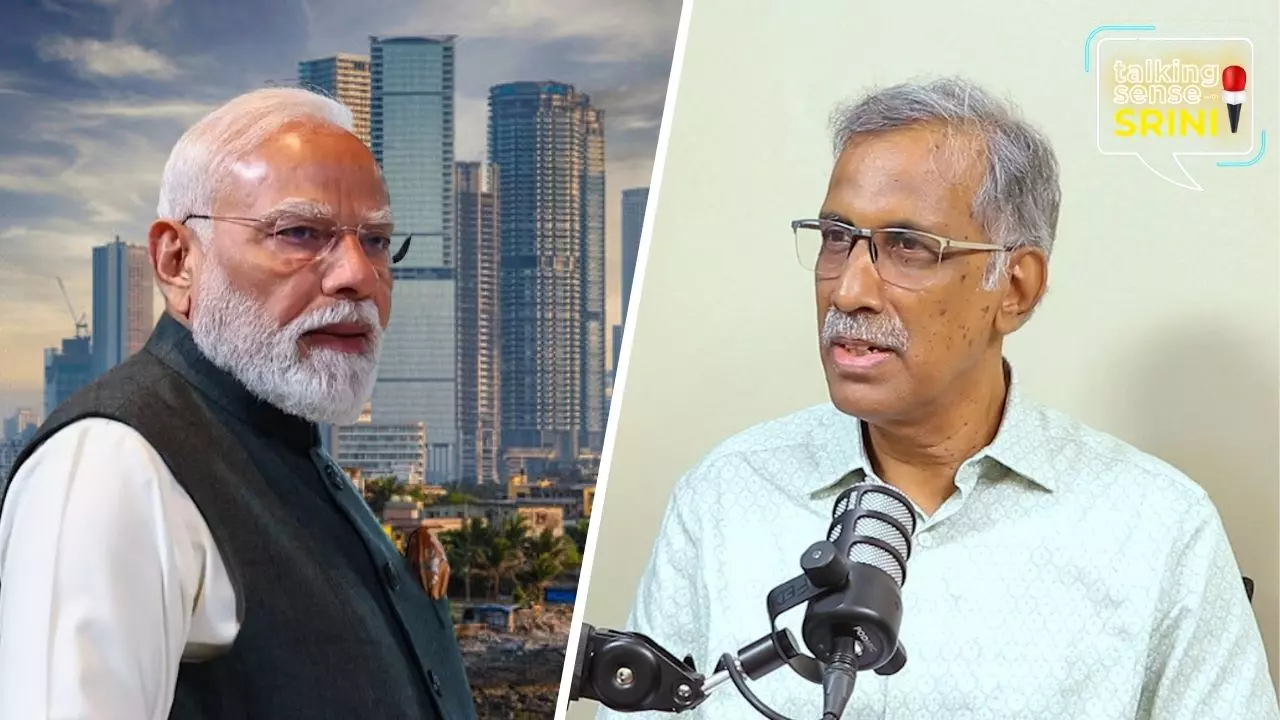
Why India's tough economic reality can't be ignored anymore | Talking Sense With Srini
The Federal's Editor-in-Chief S Srinivasan argued that India’s current economic stress predates the geopolitical crisis and stems from deeper structural weaknesses.

India’s macroeconomic indicators may still look stable on paper, but concerns are mounting over stagnant wages, weakening foreign direct investment (FDI), and the economic impact of rising crude oil prices amid the escalating US-Iran conflict.
In the latest episode of Talking Sense With Srini by The Federal, Editor-in-Chief S Srinivasan argued that India’s current economic stress predates the geopolitical crisis and stems from deeper structural weaknesses.
Modi's political messaging
Prime Minister Narendra Modi recently urged citizens to reduce spending on gold, fuel, and foreign travel, while emphasising “ease of living” and “ease of doing business” in a marathon Cabinet meeting.
Also read: PM Modi meets Marco Rubio, reviews India-US defence and trade ties
According to Srinivasan, these measures are more political messaging than economic solutions. “He’s trying to prepare people for a crisis, much like during COVID, by asking them to tighten their belts,” Srinivasan said, adding that the government may be “barking up the wrong tree” by focusing on austerity instead of structural reforms.
Srinivasan pointed out that India’s economic challenges have been building for years. Despite large public infrastructure spending and income tax cuts aimed at boosting demand, private investment has remained sluggish. “Companies are sitting on huge reserves but are unwilling to take risks,” he noted, explaining that many firms now prefer financial investments over expanding factories or hiring workers. Capacity utilisation, he said, remains stuck in the mid-70 per cent range, discouraging fresh capital expenditure.
FDI inflows decline
The US-Iran conflict has only worsened existing vulnerabilities. India imports nearly 85 per cent of its crude oil, making it highly exposed to disruptions in West Asian energy markets. Srinivasan warned that rising oil prices could spill over into LPG and fertiliser shortages, especially ahead of the agricultural season.
Also read: Sri Lanka’s ‘no’ to bridge with India fuels counter: 'Would raise mutual dependence'
Drawing comparisons with the 1991 balance-of-payments crisis, Srinivasan said today’s situation is less severe in terms of forex reserves and fiscal stability, but more troubling because economic momentum remains weak despite political stability and steady GDP growth. “Politically, this government has done very well. But from an economic point of view, it hasn’t,” he said, citing economist Surjit Bhalla’s criticism of India’s Bilateral Investment Treaty (BIT) regime as a deterrent to foreign investors.
He also stated that net FDI inflows have sharply declined, noting that nearly as much money is being repatriated as invested. Combined with high market valuations and limited innovation in sectors such as artificial intelligence, Srinivasan said India risks being viewed globally as “an old stock” rather than an emerging growth story.
The broader concern, he concluded, is that both domestic and foreign investors are losing confidence in India’s growth narrative, even as official macroeconomic indicators continue to appear stable.