CBSE OSM row sparks calls for grace marks, manual re-evaluation | AI With Sanket
Parents, students, and coaching experts urged CBSE to quickly resolve the Class 12 OSM controversy through manual re-evaluation, grace marks, and special relief measures

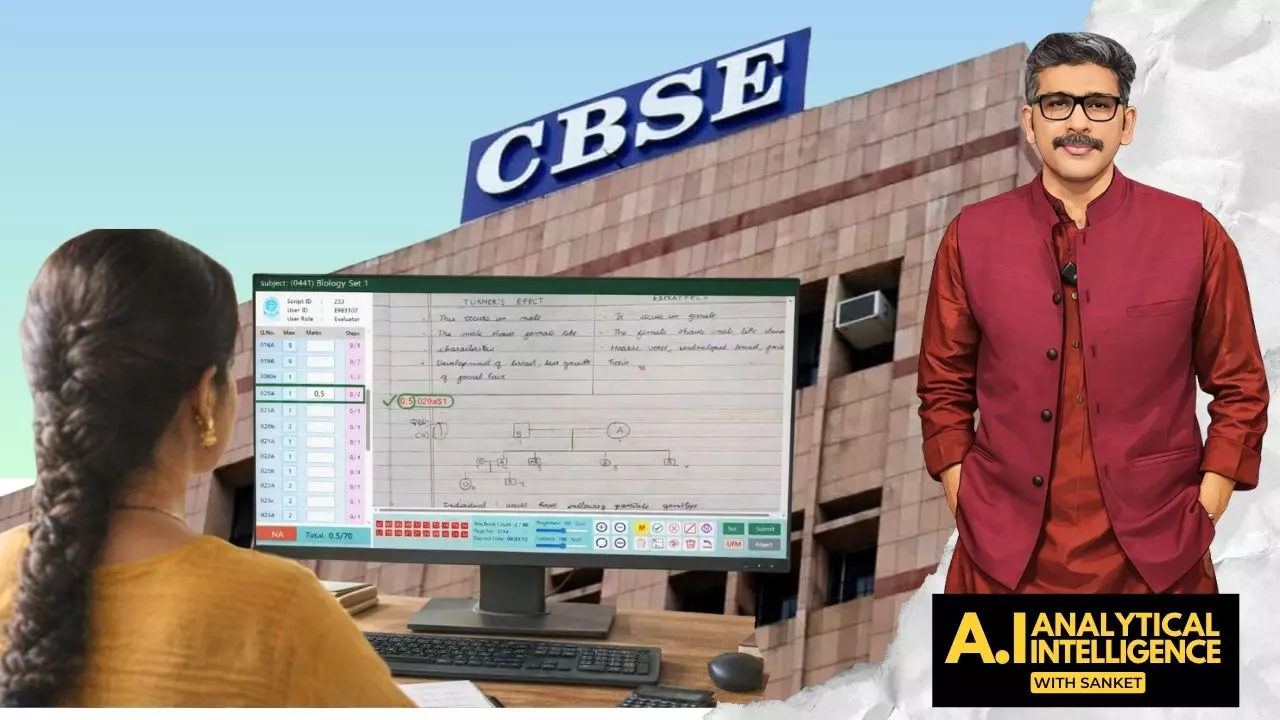
The CBSE Class 12 OSM evaluation that resulted in several discrepancies including systemic marking errors, misallocated grades, faulty checking, blurred scans, and technical glitches has generated a lot of anxiety among students and parents.
On AI With Sanket, The Federal spoke to IWPA president Anubha Srivastava Sahay, CBSE student Ibrahim Khan, and Coaching Federation of India vice-president Keshav Agarwal on possible solutions to the crisis surrounding CBSE’s Class 12 board examination results.
The discussion focused less on blame and more on urgent remedies that could provide immediate relief to students awaiting revaluation, admissions, counselling, and foreign university deadlines.
“CBSE should first accept its mistake and admit that multiple errors happened in the copy-checking system,” said Ibrahim Khan, a Class 12 student from Saharanpur, as anger mounted over the Central Board of Secondary Education’s controversial On-Screen Marking (OSM) system. Parents’ groups and education experts warned that lakhs of students were suffering because of what they described as a poorly-implemented evaluation process.
Immediate relief measures
Sahay said the first priority should be quick and time-bound re-evaluation of answer sheets. She pointed out that many students were still struggling to even access their answer copies despite repeated complaints.
She said CBSE had recently issued helpline numbers and email IDs, but questioned whether those systems were functioning effectively. According to her, several students had continued reporting delays in receiving answer sheets even days after the process began.
Also Read: CBSE OSM row takes new turn amid claims of students being pressured to defend it online
Sahay stressed that the government, CBSE, and the University Grants Commission should immediately coordinate with universities and examination authorities so that students do not lose admission opportunities because of delays in re-evaluation.
She also proposed grace marks for affected students, particularly those who had already applied for re-evaluation. According to her, such a measure could prevent large-scale academic losses while the review process continued.
Student anxiety
Khan said students and parents had undergone severe stress since the results were announced on May 13. He said many students who consistently scored well throughout the year had unexpectedly received low marks or compartment results.
“Students who were supposed to cross 85 to 90 are now stuck in 70,” Ibrahim said, adding that the issue was not a matter of bad luck but a result of “reported checking mistakes” under the OSM system.
He argued that the technology should have undergone proper testing before implementation, and said students had become victims of an “improper and unprepared system”.
Also Read: Centre accepts responsibility for CBSE revaluation issue, says Dharmendra Pradhan
Khan said grace marks were necessary, but also suggested that CBSE directly engage with affected students through surveys or consultations. According to him, every student’s experience differed and a one-size-fits-all solution might not satisfy everyone.
The student also advocated manual re-evaluation instead of relying again on OSM. He argued that teachers could apply judgement and logic while evaluating answers, unlike automated systems that may only follow rigid templates.
'Re-evaluation should be done manually'
Agarwal said the controversy had spiralled because CBSE attempted to manage the fallout through “knee-jerk reactions” rather than transparent communication.
Referring to an RTI he had filed, Agarwal claimed that the board underestimated the scale of dissatisfaction among students. He said the number of re-evaluation requests had risen dramatically, with more than 11 lakh answer sheets reportedly under review.
According to Agarwal, the biggest issue was not just OSM but the scanning process itself. He questioned how nearly 40 crore pages could have been scanned accurately in such a short period.
Also Read: How CBSE's OSM upgrade turned nightmarish for students | Blurred scans and mix-ups
He alleged that supplementary sheets may not have been scanned properly, resulting in incomplete evaluation. He also claimed that teachers had complained that some scanned copies were missing pages.
Agarwal strongly opposed using the OSM system again for re-evaluation and demanded complete manual checking instead.
“It’s a very good concept, but you have implemented it badly and made it a villain,” he said about the OSM system.
Foreign admissions, improvement exams
Agarwal warned that students applying to foreign universities were particularly vulnerable because delays could result in cancelled admissions and lost opportunities.
He proposed a special “tatkal window” for such students, where candidates could submit proof of foreign applications and receive expedited re-evaluation within four to five days.
He also demanded multiple improvement examinations instead of the current single-subject format. According to him, students affected by faulty evaluation should be allowed to improve marks in up to three subjects.
Also Read: CBSE Class 12 results: Centre defends on-screen marking, slashes revaluation fees
Agarwal said many students were simultaneously preparing for CUET, JEE, and other entrance examinations while struggling with the uncertainty around their board results.
He described the situation as “total chaos”, saying students were spending entire days trying to access portals or complete re-evaluation applications instead of focusing on competitive examinations.
Trust deficit
Sahay said CBSE risked losing public trust if it failed to resolve the crisis quickly. She noted that some families were already considering shifting students to other education boards.
She also suggested that CBSE could explore internal assessment models similar to those used during the COVID-19 pandemic, when boards relied partly on school-based evaluation systems.
Sahay maintained that immediate action was critical because counselling and admission processes had already started in India and abroad.
Also Read: CBSE OSM row debate | ‘Students are losing trust in the government’
The panel repeatedly emphasised that the issue had gone beyond technical glitches, and has become a matter of student welfare and institutional credibility.
Throughout the discussion, the panellists urged the authorities to prioritise relief measures over political blame games.
Agarwal said the focus should now remain on “instant solutions” rather than defending systems or denying failures. He argued that even a single student losing marks unfairly was unacceptable.
The discussion concluded with calls for transparency, faster grievance redressal, functioning helplines, manual rechecking, and flexible relief mechanisms to prevent long-term damage to students’ futures.
(The content above has been transcribed from video using a fine-tuned AI model. To ensure accuracy, quality, and editorial integrity, we employ a Human-In-The-Loop (HITL) process. While AI assists in creating the initial draft, our experienced editorial team carefully reviews, edits, and refines the content before publication. At The Federal, we combine the efficiency of AI with the expertise of human editors to deliver reliable and insightful journalism.)