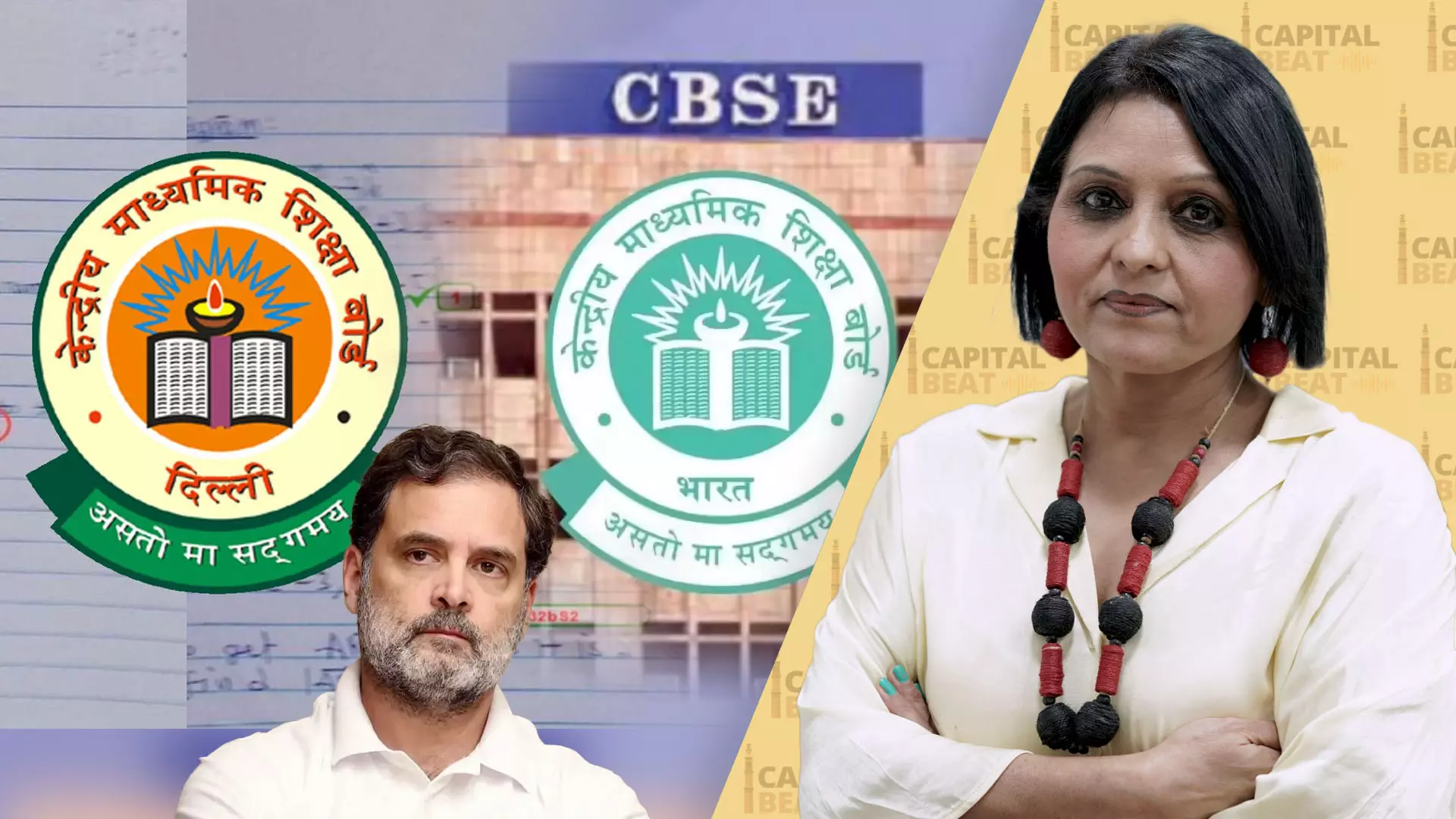
CBSE OSM row debate | ‘Students are losing trust in the government’
Capital Beat discussion looks at CBSE discrepancies, cyber vulnerabilities, outsourcing concerns and demands for a judicial probe into the board’s OSM system

Congress leader Rahul Gandhi’s allegations of irregularities in CBSE evaluation processes and demands for a judicial probe formed the focus of a recent episode of Capital Beat featuring Rajat Yadav, General Secretary of the Yuva Halla Bol movement, Prof Tanvir Aeijaz, and political activist Ayushman Pandey.
The discussion centred on the CBSE’s On Screen Marking (OSM) system, the role of private contractor Coempt, and concerns raised over evaluation errors, digital vulnerabilities, and accountability.The programme highlighted Rahul Gandhi’s public remarks alleging “massive tampering” in CBSE examination results and questioning why the OSM contract was awarded to Coempt, a company that he claimed had earlier operated under the name Globe Arena in Telangana in 2019. Rahul also demanded an independent judicial inquiry and the formation of a Special Investigation Team to probe the matter.
Also read: How CBSE's OSM upgrade turned nightmarish for students | Blurred scans and mix-ups
The panel discussion referred to concerns over the evaluation process under the OSM system, where answer sheets are uploaded digitally and evaluated online by teachers. The discussion cited reports of blurred answer sheets, incorrect uploads, and alleged discrepancies in marking during the re-evaluation process.
Questions over OSM rollout
The discussion referred to a post by a 19-year-old identified as Nisarg Adhikari, who claimed to have ethically hacked into the CBSE OSM portal and reported vulnerabilities to CERT-In. The programme discussed his claims that several vulnerabilities remained unpatched even after being reported.
The panel also referred to concerns raised by the Internet Freedom Foundation over cybersecurity and transparency in the OSM portal. The programme cited the organisation’s statement that vulnerabilities in a national examination system raised questions about fairness, trust, and the future of students.
The discussion also highlighted reports that governing body members had allegedly warned CBSE against rolling out the OSM system without adequate regional trials and additional technical safeguards. The panel referred to meeting minutes that reportedly documented these concerns before implementation.
Personal experiences shared on air
During the programme, concerns were also raised about discrepancies allegedly found during the re-evaluation of answer sheets. The discussion referred to instances where students claimed that answers had not been marked or that answer sheets had been uploaded incorrectly.
The programme highlighted one example involving a student named Vedant, whose answer sheet was allegedly uploaded incorrectly. The discussion also referred to cases where scanned answer sheets were reportedly blurred or difficult to read.
Also read: CBSE revaluation row: Rahul slams PM Modi, demands judicial inquiry
The programme discussed concerns about the impact of such issues on students applying for higher education and professional courses. Questions were raised over whether even minor discrepancies in marks could affect admissions and future academic opportunities.
Rajat Yadav calls for investigation
Rajat Yadav said the allegations surrounding the OSM system required a thorough investigation. “This is not just about the 18 lakh students. This is about 18 lakh families,” he said during the discussion.
Yadav stated that the evaluation process, standard operating procedures, and the awarding of contracts to private agencies required scrutiny. “A particular agency has to investigate what this company did, how they performed, who were the teachers, and how they evaluated exactly,” he said.
He also questioned the outsourcing of examinations and recruitment systems to private vendors. “The government doesn’t want accountability to come towards itself. That is exactly why they give every examination or recruitment process to private vendors,” he said.
Debate over privatisation of education systems
The programme also focused on concerns regarding the role of public-private partnerships in education and examinations. Prof. Tanvir Aeijaz argued that systems should not be implemented without being fully prepared and tested.
“If they are not ready to implement a programme in a foolproof method, they should not start it,” Aeijaz said during the discussion. He added that governments should identify and plug loopholes before introducing new systems affecting students.
Also read: CBSE admits answer sheet error after Class 12 student labelled ‘Pakistani’ online
Aeijaz also criticised the increasing contractualisation of educational functions. “You cannot simply contract out the examination system,” he said. He described the expansion of public-private partnerships in universities and educational institutions as a growing concern.
Concerns over trust and accountability
The discussion repeatedly returned to the issue of trust in public institutions. Aeijaz said students were increasingly losing confidence in government systems and educational institutions.
“Students are losing trust in the government. Students are losing trust in the public system. Students are losing trust in the education system,” he said.
The programme also discussed the mental stress allegedly faced by students and parents during re-evaluation processes. Aeijaz stated that governments should address student anxiety and ensure transparency in evaluation mechanisms.
Questions were also raised during the discussion about cybersecurity and digital preparedness. The programme highlighted concerns about whether adequate training had been conducted before the OSM rollout.
Ayushman Pandey alleges systemic failure
Political activist Ayushman Pandey described the controversy as a “huge scam” during the programme and argued that education should remain a public good rather than becoming profit-driven.
Also read: CBSE Class 12 results: Centre defends on-screen marking, slashes revaluation fees
“Education is a public good. They are bringing in a profit motive in this public good,” Pandey said during the discussion.
Pandey also criticised the use of private contractors in educational systems and questioned the decision to award contracts to companies already facing allegations or scrutiny. He referred to the OSM issue as part of broader concerns surrounding education policy and public institutions.
The programme also included criticism of the New Education Policy and concerns about declining trust in CBSE certification systems. Pandey said, “If you destroy CBSE and the world stops believing in it, what are we going to have?”
Student protests and future concerns
The panel also discussed student protests over examination issues, including paper leaks and evaluation concerns. Rajat Yadav said students across the country had been organising protests and demonstrations against alleged irregularities.
“Students have been fighting and struggling on the streets,” Yadav said during the discussion.
Also read: What if CBSE Board exams don't go as planned? Here's the way forward
The programme also discussed whether compensation for affected students was possible. Yadav argued that even minor discrepancies in marks could permanently affect admissions and opportunities, making compensation difficult.
Aeijaz suggested that students and civil society groups should demand accountability, fairness, and institutional reforms. “Education has never been on the political agenda. It is high time education must come on the political agenda,” he said.
The discussion concluded with renewed references to Rahul Gandhi’s demand for a judicial inquiry and an SIT probe into the OSM controversy and the functioning of the CBSE evaluation process.