



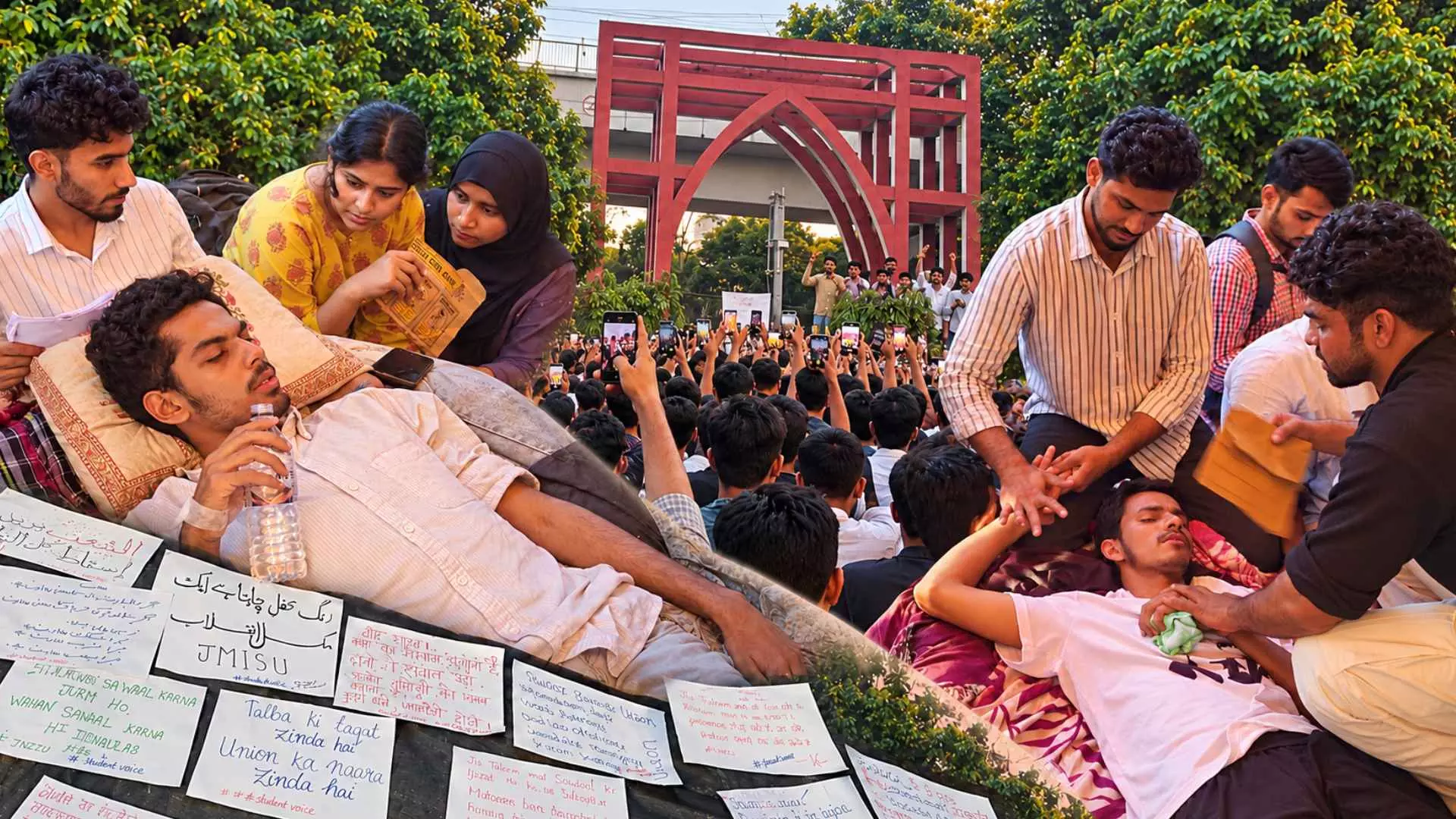
Students want the university’s elected union revived after 20 years, the chief proctor’s resignation and an end to action against protesters.
Why are Jamia Millia students on an indefinite hunger strike?
With no student union election since 2006, students say they have no elected platform to put their concerns before the administration

Students at Jamia Millia Islamia in New Delhi entered the 11th day of an indefinite hunger strike on Friday, demanding the revival of the university’s students’ union, the chief proctor's resignation and an end to disciplinary action against protesters. Some hunger strikers are facing health complications, and talks with the administration have not ended the standoff.
The students, who began the strike on October 12, have put forward three demands. They want the immediate restoration of the Jamia Millia Islamia Students’ Union (JMISU), the resignation of Chief Proctor Mohammad Asad Malik, and an assurance that no legal or administrative action will be taken against those taking part in the protest.
What do union leaders say?
The union has been inactive since 2006. “We’ve not had an election since 2006, which means it’s been 20 years,” a protesting student said. The student said the administration had cited the possibility of violence as the reason for not holding elections. Students argue the union is about more than polls: it gives them an elected platform to represent their concerns and take part in negotiations with the administration.
Students allege that on the sixth day of the strike, security guards entered the campus around 5.30 am, dismantled the protest site and forcibly removed them while they slept. One student claimed the chief proctor arrived with 50 to 60 guards, and that protesters were beaten and dragged outside the gates. Women protesters alleged that female guards beat them and dragged them towards a police vehicle.
Students also said police outside the gate detained those removed from campus. Protesters gathered outside Gate 7 were detained and released after about an hour, then returned and reclaimed the site amid police and paramilitary presence. The administration later took disciplinary action against some protesters.
Also Read: Jantar ka Mantar: The protest site that taught Delhi to listen
One student said low blood sugar and high uric acid levels led to a hospital visit, and that doctors warned of risks to his joints and kidneys. He refused to quit. Another reported low blood pressure and pulse, a loss of two kilograms and a mild fever. A third student was rushed to hospital after his condition worsened.
On the 10th day, the administration began negotiations through a high-level committee under the vice-chancellor. Students said it first seemed open to restoring the union, then proposed doing so after two months. They questioned the delay, noting that examinations would be underway by then, and alleged the aim was to disperse the protest. They say the strike will continue until all demands are met unconditionally.