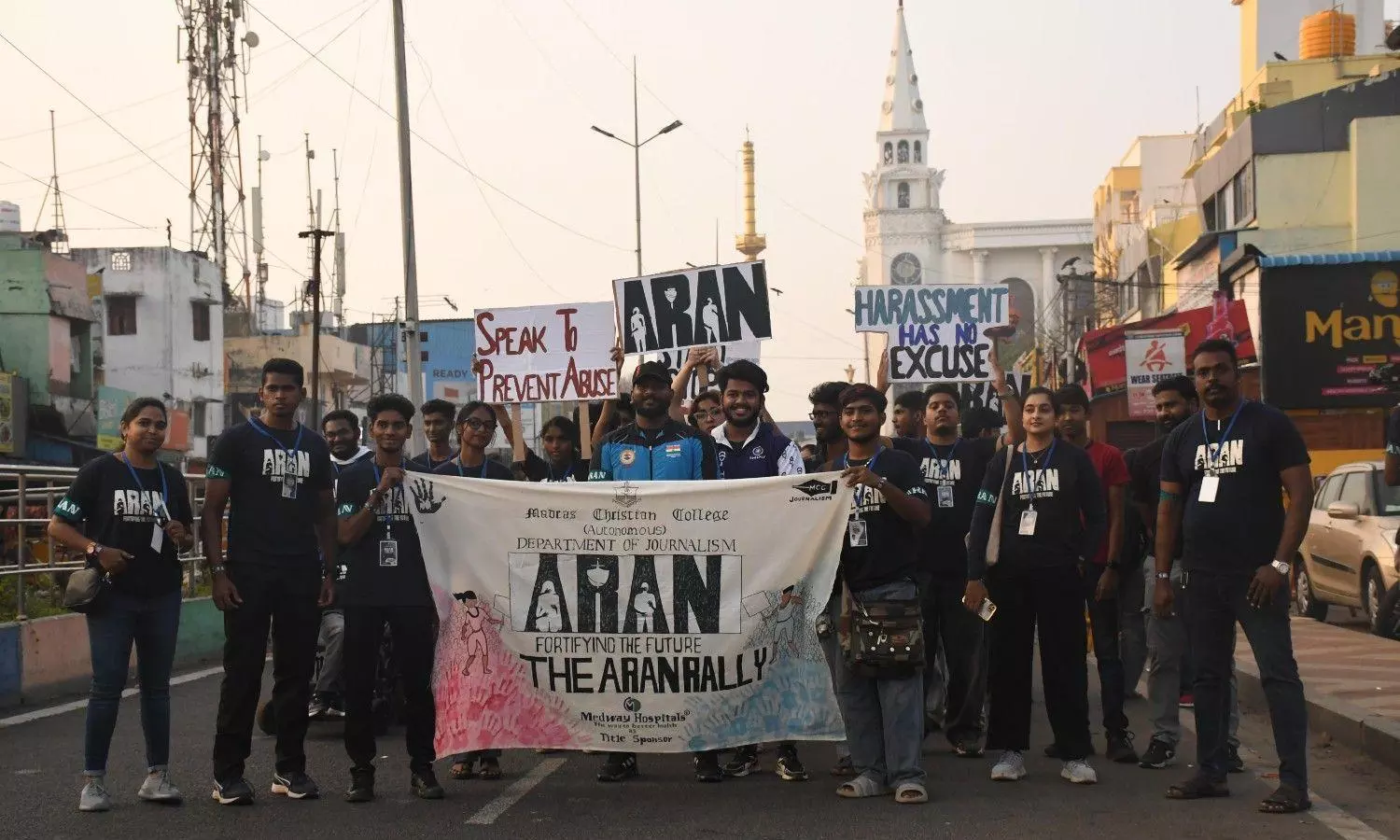
MCC's ARAN campaign stresses gender-neutral sexual harassment awareness
3-day initiative by Chennai college's journalism department focused on reporting mechanisms, role of internal complaints panel; The Federal was media partner

The Department of Journalism at Chennai's Madras Christian College (MCC) conducted a three-day awareness campaign on sexual harassment. The event concluded on February 11 with a call for a gender-neutral approach to prevention and reporting.
Titled “ARAN: Fortifying the Future”, the campaign featured awareness sessions, outreach programmes, competitions and discussions centred on prevention, accountability and institutional mechanisms. The Federal was the media partner for the initiative.
Rally at Elliot's Beach
The campaign opened with the ARAN Rally at Elliot’s Beach, at Chennai's Besant Nagar, on February 7. Around 70 students and faculty members marched along the promenade holding placards that read, “Respect has no gender,” “Safety starts with speaking up,” and “Laws exist — use them.”
Organisers said the choice of a public venue was intended to emphasise that sexual harassment extends beyond institutional spaces.
At the valedictory function, student organisers explained the decision to adopt a gender-neutral perspective.
Gender neutral approach
Gaurav from the Department of Journalism said the campaign sought to move beyond viewing harassment as an issue affecting only women.
“Whenever harassment is termed, it is often seen only from the women’s side. But no one looks at the other genders and the problems faced by them. Our whole motive when we chose the topic was for it to be gender neutral,” he said.
He added that harassment against men remains underreported. “People don’t even think harassment against men is a thing. It’s not just about men and women — it’s about anybody, including the third gender. Harassment against men is real, but it is not spoken about as prominently.”
He also cautioned against stereotypes, arguing that polarised narratives should not overshadow conversations about justice and accountability.
Keeping off sensationalism
CR Pranav Shankar, convener of the campaign, said the focus was on awareness rather than sensationalism. “Our motto was complete and clear. On the first day, speakers explained what the Internal Complaints Committee (ICC) is and how to report cases. Until then, even members of the ICC did not realise the full extent of their role,” he said, pointing to gaps in institutional awareness.
Over three days, the campaign included expert talks, legal awareness sessions, outreach to educational institutions and workplaces, and panel discussions on structural safeguards and cultural barriers to reporting.
A promotional video conceptualised around a time-loop narrative — where silence causes repetition and reporting breaks the cycle — was produced but not screened publicly due to concerns about triggering survivors. “It shows how deeply trauma affects people,” said V Sarvesh, fellow convener. “The topic is still considered taboo by much of society. The more people speak out, it will get better — but it differs from person to person,” he added.
Sustaining awareness
By foregrounding the role of the ICC and discussing legal remedies, the organisers said the campaign aimed to equip individuals with knowledge of procedures and protections, while encouraging reporting.
As the campaign concluded, organisers said the objective was to sustain awareness beyond the three-day event and continue conversations on sexual harassment across genders.