



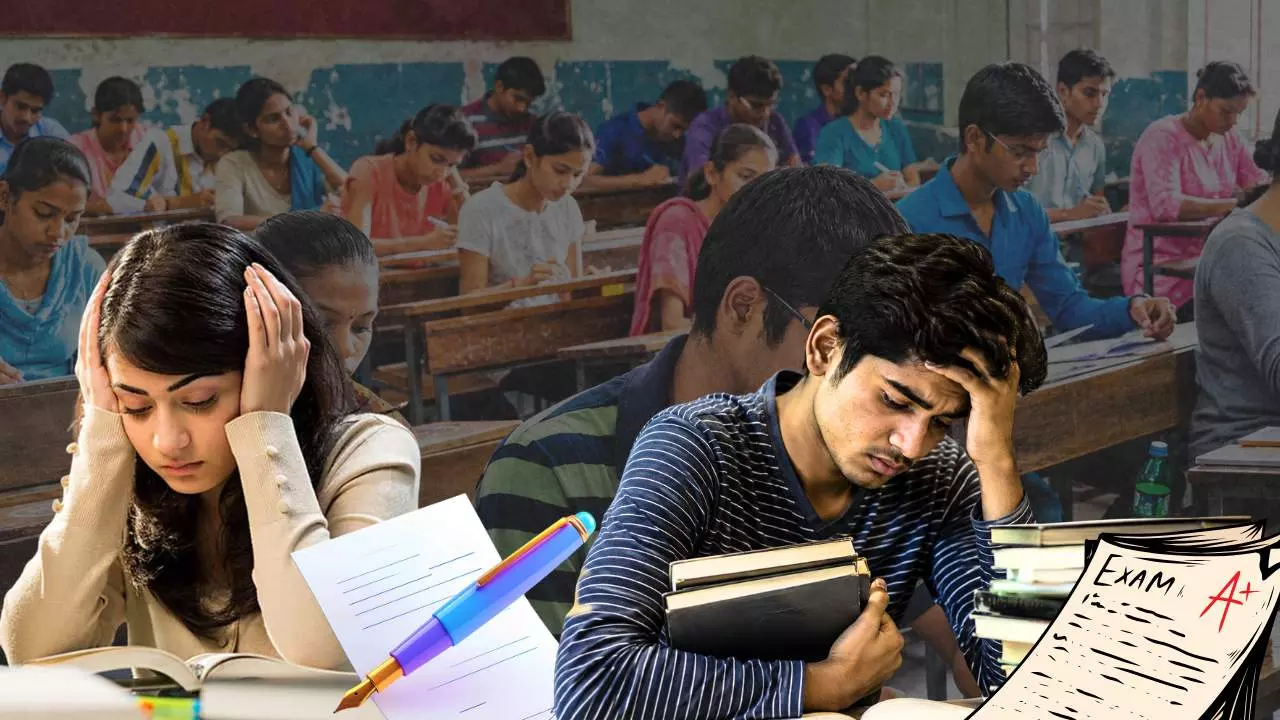
Are students paying the price of India's broken exam system?
From NEET to UPSC, paper leaks, glitches and cancelled exams have shaken the trust of crores of students and families who have everything riding on the results

India's examination system is facing intense scrutiny after a series of controversies involving major entrance, school and recruitment exams. From allegations of paper leaks and disputed results to technical glitches and administrative lapses, questions are being raised about the credibility of a system that shapes the futures of millions of students.
The latest concerns extend beyond any single examination. NEET, CBSE, CUET, SSC, JEE, CLAT and UPSC have all faced criticism over various issues in recent years. Together, these incidents have fuelled a broader debate about trust, transparency and accountability in India's examination ecosystem.
Massive scale
Every year, millions of students organise their lives around competitive examinations. For many families, an exam represents far more than an academic test. It can determine access to a government job, a medical college seat, an engineering degree or a pathway to financial stability.
Students across the country spend years preparing for examinations such as UPSC, IIT-JEE, NEET, SSC, banking, railway recruitment and state government jobs.
Also Read: CBSE files police complaint over cyber attacks on post-result services portal
The scale of the system is enormous. According to educationist Sriram Naganathan, Uttar Pradesh's Class 10 and 12 board examinations alone involve around 52 lakh students, while Bihar adds another 28 lakh. When school board exams, entrance tests and recruitment examinations are combined, between 15 crore and 20 crore candidates could be taking examinations every year.
Dreams and uncertainty
What begins as ambition often turns into a prolonged struggle. One attempt becomes two, two become five, and for some aspirants, preparation stretches across a decade.
Many spend their twenties in rented rooms surrounded by coaching notes, textbooks and exam schedules. While friends move into jobs and careers, they continue preparing for the next examination cycle.
The emotional burden becomes even heavier when examinations themselves become controversial.
NEET, which attracts around 24 lakh candidates annually, has faced allegations of paper leaks, evaluation controversies and questions over transparency in recent years.
Naganathan argued that these incidents reflected a deeper systemic problem rather than isolated failures.
"It represents a deep systemic failure. These are not isolated incidents," he said.
According to him, fragmented governance, weak oversight, inadequate technological infrastructure and insufficient accountability remain key fault lines in the system.
Financial burden
The stakes for students and families are often enormous.
A single NEET attempt can cost between ₹1.5 lakh and ₹4 lakh per year in coaching fees, excluding accommodation, books, test series and other expenses. Many students spend two to four years preparing.
When examinations are delayed, cancelled or challenged, those investments cannot be recovered.
The anxiety is not limited to entrance exams.
CBSE results can significantly affect admissions, scholarships and future opportunities. Parents frequently seek re-evaluation of answer sheets, spending thousands of rupees on verification and rechecking processes.
Students dissatisfied with multiple subjects can spend between ₹5,000 and ₹10,000 pursuing various review mechanisms.
Repeated issues
CUET, introduced in 2022 to simplify undergraduate admissions, faced cancellations and rescheduling affecting more than two lakh students in its first year. This year, some centres witnessed delays due to technical glitches.
JEE candidates have reported server issues, admit card problems and last-minute exam centre changes.
CLAT disputes have reached the Supreme Court, while UPSC has occasionally dropped questions due to ambiguity or errors.
Also Read: JEE-Advanced data breach claims misleading, factually incorrect: IIT-Roorkee
The Staff Selection Commission has also faced criticism over delays and administrative issues affecting recruitment examinations.
Naganathan said accountability remained a major concern.
"Exam agencies face no accountability. Convictions are very rare," he said.
He argued that investigations often remain internal, while officials responsible for failures frequently face transfers or suspensions rather than meaningful consequences.
Political flashpoint
The issue has also entered the political arena.
Congress leader Rahul Gandhi accused the government of failing to conduct major examinations smoothly and claimed that repeated disruptions had affected nearly one crore students, in his X post.
AAP chief Arvind Kejriwal also criticised the government's response, arguing that symbolic measures would not address deeper structural issues.
Meanwhile, activist Abhijeet Dipke and the organization Citizens for Justice and Peace have launched a campaign seeking the Education Minister's resignation.
Dipke argued that repeated exam controversies were damaging students' futures and eroding public trust in the system.
"No serious strict action is being taken," he said, questioning whether transfers alone were an adequate response to repeated failures.
He also claimed that students were being treated unfairly and argued that accountability should extend beyond lower-level officials.
While each controversy may appear separate, together they point to a larger challenge.
India's examination system expects near-perfect performance from students. Yet students often find themselves dealing with paper leaks, glitches, delays and disputed results beyond their control.
The content above has been transcribed from video using a fine-tuned AI model. To ensure accuracy, quality, and editorial integrity, we employ a Human-In-The-Loop (HITL) process. While AI assists in creating the initial draft, our experienced editorial team carefully reviews, edits, and refines the content before publication. At The Federal, we combine the efficiency of AI with the expertise of human editors to deliver reliable and insightful journalism.


