Why students and parents bear the brunt of govt schools' consolidation
School mergers are said to address low student enrolment, rationalise teacher deployment and manage infra costs better, but at what cost? Part 1 of a 3-part series

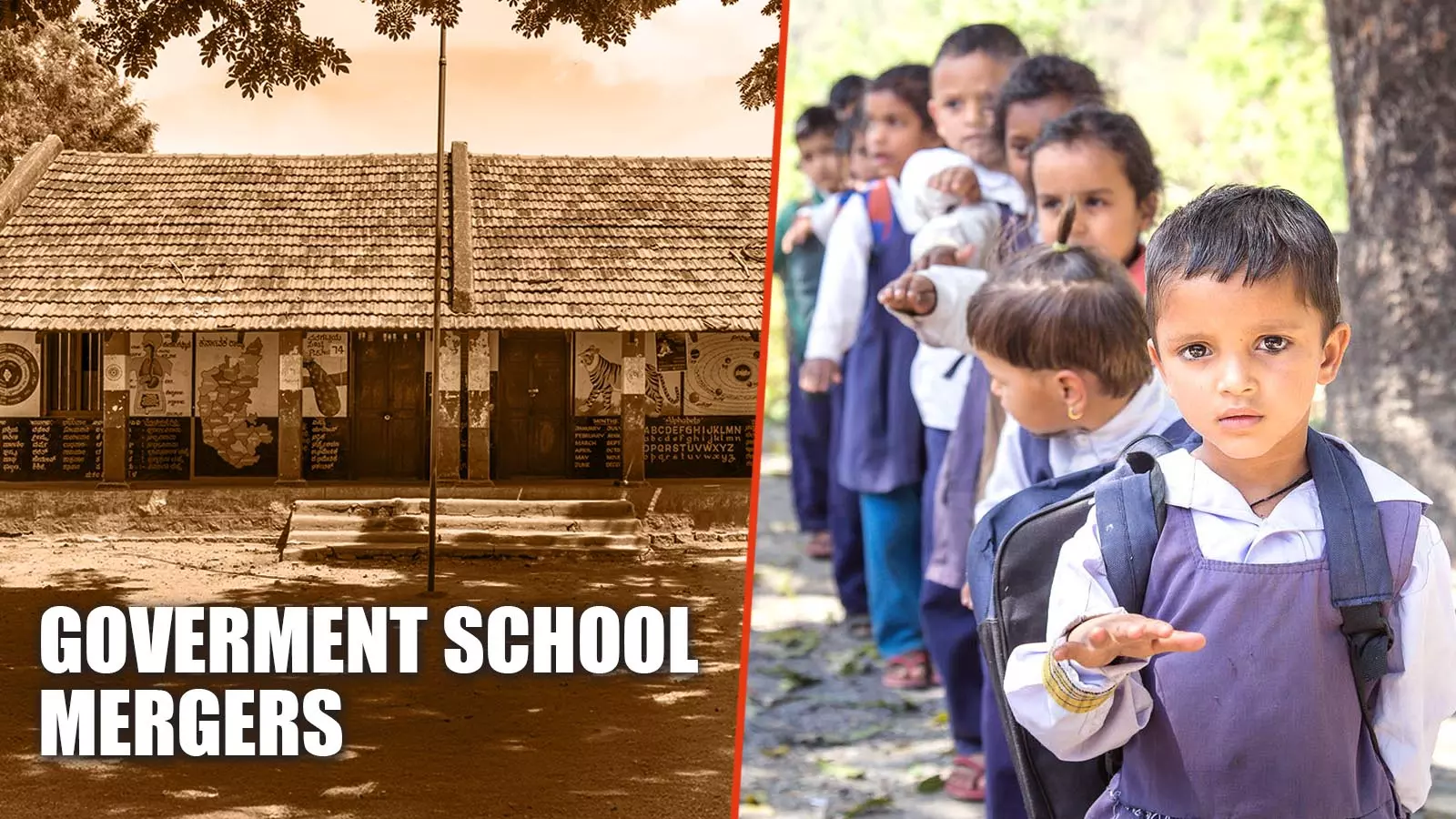
Karnataka has sparked a high-stakes conversation with its new "KPS Magnet Schools" initiative. By consolidating small, scattered government schools into robust, centralised hubs, the state has reignited a decade-long national debate: Is bigger truly better when it comes to school education?
The Karnataka plan envisions establishing one school in every gram panchayat by merging 8 to 10 nearby schools, within a radius of up to 10 km. It has faced resistance from teachers’ groups, activists and student organisations.
Read Part 2 | How government school mergers have triggered varied fallout across states
Read Part 3 | How government school mergers hit Dalit, Adivasi, girl students hardest
Even as the debate intensifies in Karnataka, the issue reflects a worrying broader national trend: the steady consolidation of government schools in response to falling enrollment and a growing number of under-utilised institutions.
Drop in enrolment
Data from the Unified District Information System for Education (UDISE+) shows that enrolment in government schools has been declining sharply in recent years. Total enrolment has fallen from around 13.62 crore in 2022-23 to about 12.15 crore in 2024-25, a drop of over 10 per cent in three years. This is part of a longer-term shift.
Even as India’s school-age population has not contracted at the same pace, a smaller proportion of children are attending government institutions. At the same time, private schools have expanded steadily, with enrolment rising from 7.92 crore in 2014-15 to 9.58 crore in 2024-25.
The decline in enrolment has not been matched by a proportional reduction in the number of schools. India had about 11.07 lakh functional government schools in 2014-15. Since then, nearly 93,779 schools have been merged or “rationalised”, but a large number of institutions continue to operate with very low student strength.
The number of low-enrollment schools has increased by over 24 per cent in recent years, indicating a widening gap between infrastructure and actual student demand.
In 2024-25, more than 65,000 government schools reported 10 or fewer students, and 5,149 had zero enrolment, despite collectively employing around 1.44 lakh teachers. The number of low-enrollment schools has increased by over 24 per cent in recent years, indicating a widening gap between infrastructure and actual student demand.
Call for consolidation
Unintended consequences and widening gaps
♦ Increased student dropouts after school closures
♦ Longer travel distances for rural children
♦ Disruption to teaching and learning continuity
♦ Greater burden placed on parents for enrolment
♦ Lack of community consultation in school closures
♦ Loss of access to welfare support systems
The guidelines stated, “The need for rationalisation of schools arises due to the fact that schools established more than a decade ago or even before may have undergone a change in terms of demand and supply. It is a process of working with Parents, Teachers, Children and Communities to improve functioning of schools and better use of the assets in the present context. It is a collective effort undertaken to promote access to schools, to expedite the resourcing of schools, to improve the quality of education, and to ensure the retention of children in schools."
Myriad problems
“The reasons the government states for merging schools are low enrolment, infrastructure utilisation, better quality of education. However, these are all for narrative building," Asha Mishra from the voluntary organisation Bharatiya Gyan Vigyan Samiti (BGVS) told The Federal. "We know that these claims are not supported by facts. Data from the states tells a different story." The BGVS works at the intersection of science and education.
Rise of dropouts
Disruptions, onus on parents
“There was also no effort on the part of the teacher/s or any other cluster/block/mandal level officials to guide the parents or facilitate the entire process of so-called mergers. In Odisha, parents shared that, when the schools were closed, the children were just given a “transfer certificate” and were expected to go and join a nearby school,” it added.
What needs to be done?