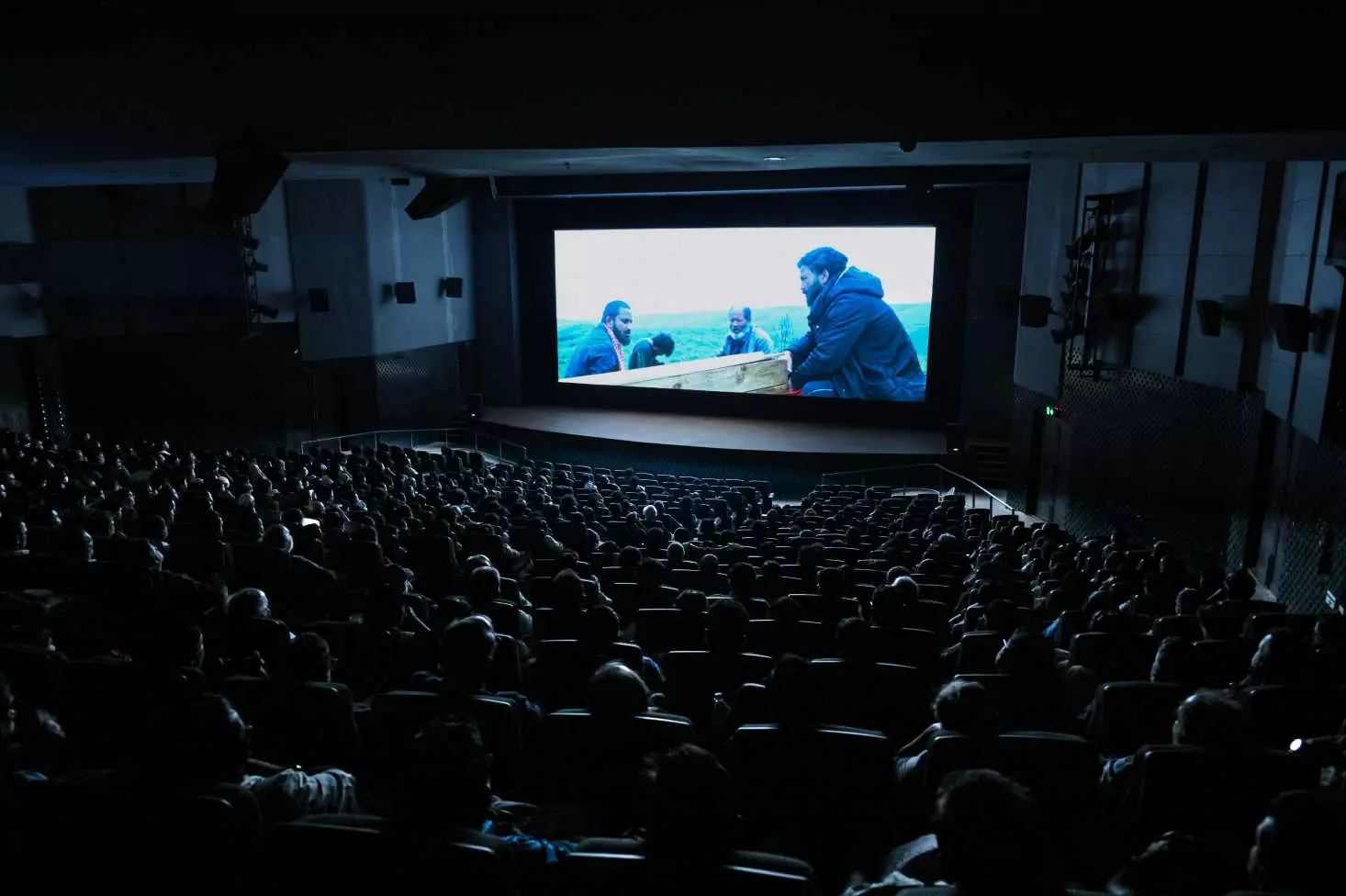
With the festival entering its second half, uncertainty remains over whether any of the cancelled films will be reinstated. Photo: X | @iffklive
IFFK: Kerala to screen films despite Centre's clearance denial
The cancellations mid-way through the 30th International Film Festival of Kerala due to the Union I&B Ministry denying censor exemptions sparks protests, reignites debates on artistic freedom and Centre–State cultural governance

The International Film Festival of Kerala (IFFK) has decided to screen all films as scheduled despite the Centre denying permission to screen over a dozen films at the festival, which is being held here from December 12 to 19, Kerala Chalachitra Academy chairman Resul Pookutty said on Tuesday. (December 16).
"I am happy to let you know, dousing all the fire on the controversies regarding film screening in the IFFK, we are going ahead with all the screenings of the film as scheduled as per the notification issued by the Kerala government and long live cinema," he said in a video message.
Earlier in the day, four of the 19 movies awaiting the Centre's approval for screening were granted official censor exemptions. They said discussions were held with the Union Ministry of Information and Broadcasting to obtain permission to screen these films at the 30th edition of the International Film Festival of Kerala (IFFK)
Sergei Eisenstein’s Battleship Potemkin, among the most-screened world cinema classics in Kerala, has travelled across the State for decades from 16 mm film societies of the 1960s to packed auditoriums at contemporary film festivals. The same is true of The Hour of the Furnaces by Argentine filmmaker Fernando Solanas, a seminal political documentary that has been screened hundreds of times in Kerala at film society events, campuses, and international festivals.
Yet, in an unprecedented move, both films were abruptly pulled from the schedule midway through the 30th International Film Festival of Kerala (IFFK), after festival delegates received official messages stating that their screenings had been cancelled due to the absence of censor exemption clearance from the Union Ministry of Information and Broadcasting.
The list of cancelled films also included Palestine 36, the festival’s opening film, which had already been screened on December 12, the inaugural day of the event. The sudden cancellations sent shockwaves through the festival circuit, triggering protests by delegates and reopening a long-standing debate on censorship, artistic freedom, and Centre–State relations in cultural governance.
Mid-Festival shock
The cancellations were communicated to delegates on the fifth day of the festival through official festival channels, stating that 19 films had not received censor exemption certificates from the I&B Ministry. Under Indian law, films without certification from the Central Board of Film Certification (CBFC) require special exemption from the ministry to be screened at international film festivals.
Also Read: Kerala film festival: Centre denies permission for Palestine films among others
Festival organisers confirmed that while exemptions for the majority of films had been cleared in batches, the remaining 19 were denied clearance, forcing the organisers to cancel scheduled screenings at short notice. The decision disrupted the tightly-packed festival schedule and left audiences disappointed, particularly as several of the films were among the most-anticipated titles of this edition.
“What else can one expect from the current dispensation in Delhi?” asked 60-year-old George Sebastian, a film enthusiast who has been attending IFFK for over three decades. “We have not come across such disruption in the history of the Kerala festival, barring stray incidents involving a couple of controversial films in the past,” he said.
Protests inside Festival venues
The cancellations sparked protests within the festival premises. On the eighth day, delegates staged demonstrations at Tagore Theatre, with the agitation led by the Democratic Youth Federation of India (DYFI). Protesters accused the Union government of curbing artistic freedom and undermining the autonomy of international film festivals.
Placards and slogans demanded immediate clearance for the cancelled films, while speakers at the protest pointed out that several of the affected titles were internationally-acclaimed works that had been screened widely in Kerala and across the world without incident.
However, some filmmakers have expressed reservations about the organisation of this year’s festival and say they are not prepared to view the situation as a politically-motivated intervention at this stage.
“The Film Academy must submit the list of films requiring permission to the Central government at least a month in advance. It needs to be examined whether the Centre delayed granting clearance despite timely submission, or whether the Academy submitted the applications too close to the festival, leaving insufficient time for processing” opined Dr Biju, internationally-acclaimed film maker from Kerala.
Also Read: 10 contemporary films to look out for at the International Film Festival of Kerala
“The reasons for the prolonged delay in granting or denying permission must be understood. While the Centre’s political interference in cinema is a separate issue, scheduling films at an international festival without obtaining the required clearance is not a correct practice and needs to be corrected,” added Dr Biju.
However, the Chalachitra Academy maintains that these are largely technical and bureaucratic arguments, and that film festivals generally function in this manner.
“We submitted the list in the same way we did in the previous editions as well. Timing issues are cited every year, and technical objections are often raised to delay clearances. But the list of films denied permission this time clearly indicates a pattern. We do not believe several of these films would have received clearance even if the applications had been submitted well before the deadline,” a senior Academy official said.
Cancelled films screened earlier in Kerala
Film society activists noted that Battleship Potemkin and The Hour of the Furnaces have a long screening history in Kerala, dating back to the heyday of the State’s film society movement. Both films have been part of academic curricula, retrospective programmes, and festival line-ups over the years.
Also Read: IFFK turns 30 with a politically charged opening, ‘Palestine 36’ to inaugurate festival
Their removal during an ongoing international festival was seen by many delegates as unprecedented, particularly given that no official explanation was provided by the I&B Ministry regarding the specific grounds for denial.
Festival overshadowed
The controversy has cast a shadow over the landmark 30th edition of IFFK, which was otherwise marked by a wide international selection and high delegate participation. For many attendees, discussions around cinema have been overtaken by concerns over censorship and administrative intervention.
Also Read: 30 years on, how IFFK remains centered on perspectives of the oppressed
With the festival entering its second half, uncertainty remains over whether any of the cancelled films will be reinstated. Regardless of the outcome, the episode marks one of the most significant disruptions in the history of the Kerala film festival, which has long been regarded as a space for engaged and politically-aware cinema audiences.