








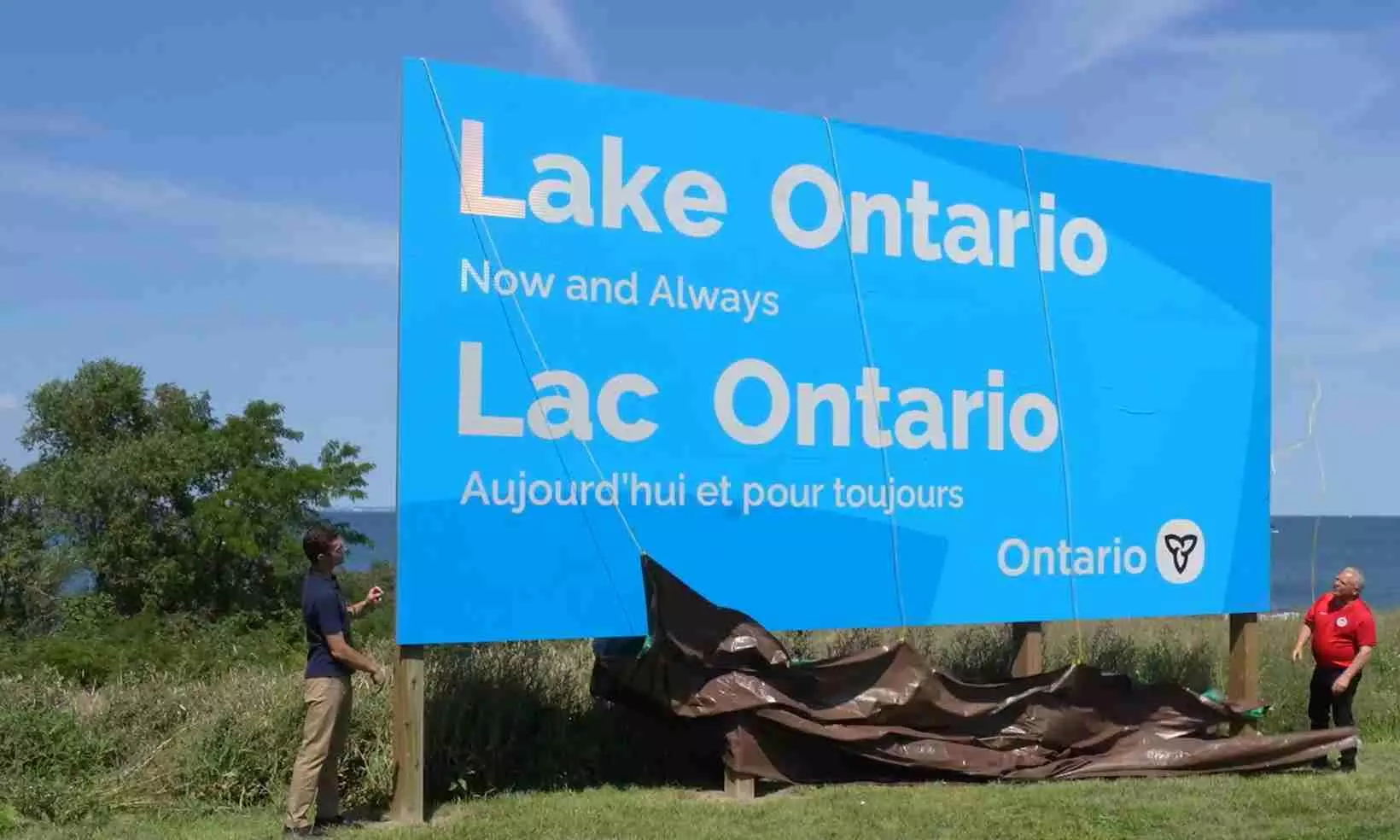
Following US President Donald Trump's order, Ontario Premier Doug Ford pushed back, with the province putting up a large “Lake Ontario. Now and Always” sign along the shoreline. Photo: X/@fordnation
Lake Ontario is now Lake America on Apple, Google maps; can Trump change names?
Per US law, the president can change the name used on its federal maps, but Canada has rejected this move, pointing out it's a water body shared by two nations

What began as a long-running dispute between the US and Canada over tariffs has now turned into something far more symbolic, with US President Donald Trump signing an executive order to rename Lake Ontario as “Lake America” for official US federal use.
The move has been rejected by Canada, with Prime Minister Mark Carney insisting that the water body will remain Lake Ontario. The name change has also exposed a peculiar reality of geography and diplomacy. While the US claims it can change what its federal maps call the lake, but Canada argues that it cannot decide what they calls a body of water shared by two countries.
So, why did Trump rename the lake, who actually has the power to make such a decision, and what does the change mean for Canada?
Why did Trump rename Lake Ontario?
The timing of the move is difficult to separate from the worsening US-Canada trade dispute.
Trade talks between Washington and Ottawa broke down in August, after which the US imposed 50 per cent tariffs on about $20 billion worth of Canadian goods, prompting Canada to announce retaliatory measures. Against this backdrop, Trump signed the executive order on August 27, describing the renaming as part of his administration’s approach to asserting American interests.
Also read: US, Canada fall deeper into trade war with new tariffs as talks collapse
Trump has also argued that the US is the major protector of the Great Lakes and has spent billions on their environmental upkeep. His administration has pointed to the lake’s geography and the amount of water within US territory as part of its justification.
But the renaming is largely symbolic. It does not change the international border, ownership of the water, fishing rights or shipping arrangements.
Where is Lake Ontario located?
Lake Ontario is one of North America’s five Great Lakes and sits directly on the US-Canada border. Around 52 per cent of the lake lies within Canadian territory, with the remainder belonging to New York state.
AI-generated map shows Lake Ontario flanked by the US and Canada.
The Canadian side includes major cities such as Toronto and Hamilton, while Rochester and other communities in New York lie along the US shoreline.
The lake receives water from Lake Erie through the Niagara River and ultimately drains into the St Lawrence River, which flows towards the Atlantic Ocean.
Who actually decides the name?
Trump can direct the US government to use “Lake America” in federal documents and maps. His executive order instructed the Interior Department to implement the change through the US Geographic Names Information System (GNIS), the federal database used for official geographic names.
Also read: US imposes 50 per cent tariffs on USD billion of Canadian goods; Ottawa vows retaliation
That does not give Washington the authority to impose the name on Canada or international organisations.
Interestingly, New York officials have also rejected the change. Governor Kathy Hochul has said the state will continue to call it Lake Ontario. The result is an unusual situation where the same lake can officially carry different names depending on where you are looking at it.
Internationally, naming shared resources is a tricky subject, so governments mostly let them be. Names like Indian Ocean, Arabian Sea, South China Sea and Sea of Japan have mostly been left alone, though the water bodies are shared by nations that barely see eye to eye.
What about Google and Apple Maps?
The name change now reflects on the everyday maps.
Google Maps began showing “Lake America” to users in the US after the federal database was updated. Google said users in Canada would continue to see “Lake Ontario”, while users outside the US and Canada could see both names.
Apple Maps followed on September 1, also displaying “Lake America” for US users.
The updates have added another layer to the dispute, as digital maps now reflect the different naming conventions on either side of the border.
How has Canada reacted?
Canada has been unequivocal: the lake remains Lake Ontario.
Canadian PM Carney rejected Trump's move, pointing to the name's long history and indigenous roots. The name “Ontario” dates back centuries and predates both modern Canada and the United States.
Ontario Premier Doug Ford has also pushed back, with the province putting up a large “Lake Ontario. Now and Always” sign along the shoreline.
Also read: Trump withdraws Canada’s invite to Board of Peace after Carney's rebuttal
Canadian officials have also stressed that the US cannot unilaterally rename the Canadian portion of a shared body of water.
The dispute has therefore become less about the actual name of the lake and more about sovereignty, identity and the increasingly confrontational nature of US-Canada relations.
Is this a first from Trump?
The Lake Ontario move follows Trump's 2025 executive order changing the US government's name for the Gulf of Mexico to the “Gulf of America”. That decision similarly applied to US federal usage and was not binding on Mexico or international bodies.
Trump has even suggested that further renaming could follow, joking that after having “a gulf and a lake”, the US might eventually rename the Atlantic or Pacific Ocean.