








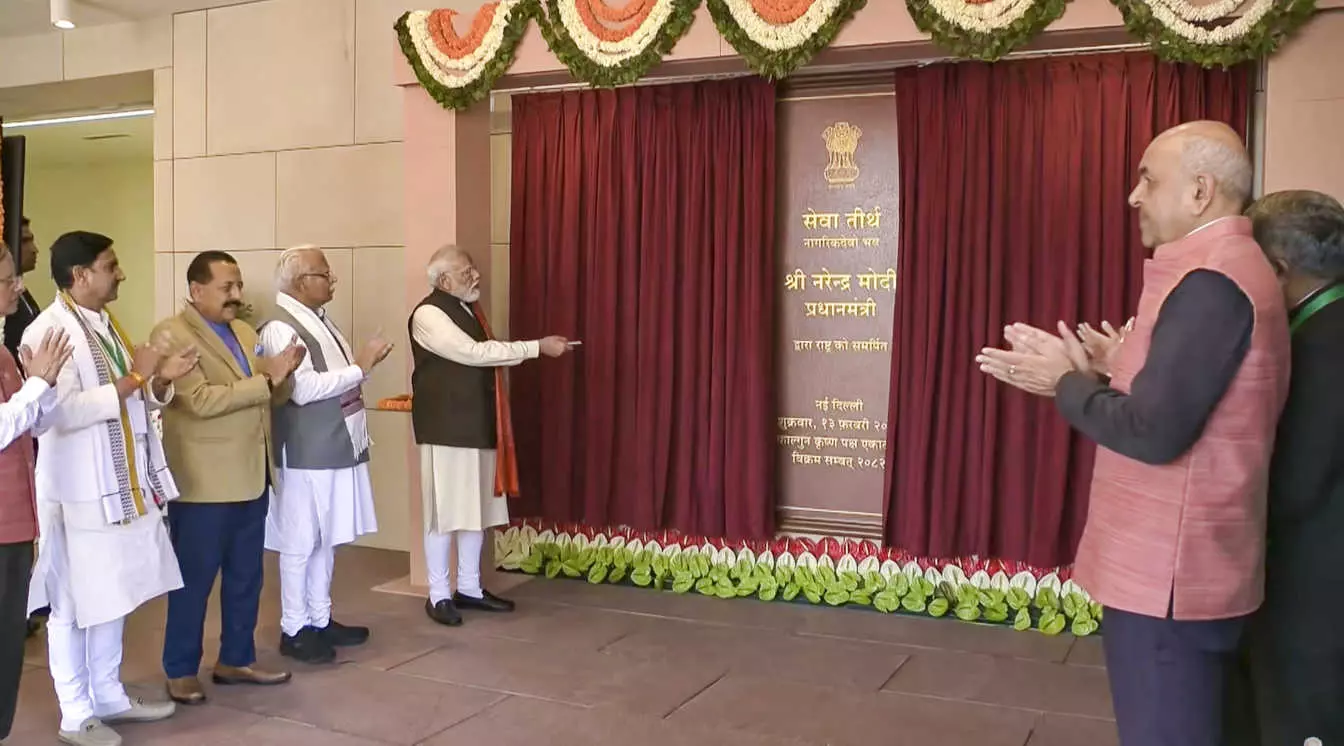
Prime Minister Narendra Modi and others during the inauguration of the 'Seva Teerth', the new PMO building, in New Delhi on Friday (Feb 13). Photo: PTI
Seva Teerth: Does India's new seat of power mark end of Colonial Era?
Modi inaugurates new PMO complex, ending 78 years of operations from British-era South Block as India seeks to transition to modern governance infra

Prime Minister Narendra Modi on Friday (February 13) inaugurated Seva Teerth, the new complex housing the Prime Minister's Office, bringing to a close nearly 78 years of operations from the British-era South Block. The relocation marks a symbolic departure from colonial administrative structures as India moves its power centre to purpose-built modern facilities.
The name "Seva Teerth”, meaning "place of pilgrimage for service”, reflects the government's vision of citizen-centric governance. The complex consolidates three critical institutions under one roof: the PMO, the National Security Council Secretariat, and the Cabinet Secretariat — all previously scattered across different locations in the Central Vista area.
Why was the move necessary?
For decades, India's administrative machinery functioned from fragmented, aging infrastructure spread across multiple colonial-era buildings. These structures, designed in the early 1900s by British architect Herbert Baker to serve the requirements of the British Raj, had become operationally inefficient with escalating maintenance costs and sub-optimal working environments.
Also Read: PM Modi to inaugurate Seva Teerth, Kartavya Bhawan 1, 2 on Feb 13
The dispersion of offices led to coordination challenges and hindered seamless governance. The PMO's last Cabinet meeting at South Block was held on Friday afternoon before ministers and officials relocated to the new complex, situated less than a kilometre away on Raisina Hill.
What facilities does Seva Teerth offer?
Built to 4-Star GRIHA green building standards, Seva Teerth incorporates renewable energy systems, water conservation measures, and advanced waste management solutions. The complex features digitally-integrated offices, structured public interface zones, and centralised reception facilities designed to foster collaboration and enhance citizen engagement.
Comprehensive security frameworks include smart access control systems, surveillance networks, and advanced emergency response infrastructure. These modern facilities address the technological and functional limitations that plagued the old buildings, creating an optimal working environment for officials and improving employee well-being.
Also Read: Modi to chair last Cabinet meeting in South Block before PMO shift
Alongside Seva Teerth, Modi also inaugurated Kartavya Bhavan-1 and 2, which will house several key ministries including Finance, Defence, Health, Education, Culture, Law, Agriculture, and Tribal Affairs. This consolidation of 51 central ministries under the Common Central Secretariat buildings aims to improve administrative efficiency through easier inter-departmental movement and collaboration.
What happens to South Block?
With the PMO's departure, both North and South Blocks — the iconic colonial structures that have served as India's central power hubs since 1921 — will be converted into the "Yuge Yugeen Bharat National Museum”. This museum will showcase India's civilisational history through retrofitted, state-of-the-art facilities with display space three times larger than the current National Museum.
Also Read: SC clears Central vista project, says Centre can go ahead
The conversion represents what Union Minister Jitendra Singh called "a symbolic step in moving away from colonial legacies”. In a social media post, he noted that the transition coincides poignantly with February 13 — the same date in 1931 when the British declared New Delhi the capital of colonial India.
How does this fit into the larger vision?
The inauguration represents a key milestone in the Rs 20,000-crore Central Vista redevelopment project, conceived in September 2019 and scheduled for completion by 2026. The project has already seen the completion of the new Parliament building, the Vice President's Enclave, and the revamped Kartavya Path (formerly Rajpath).
Also Read: Kartavya Bhavan: All you need to know and why officers are not happy
The relocation reflects the government's commitment to shedding colonial symbols while building infrastructure that serves contemporary governance needs, marking a decisive turn in independent India's administrative history.